General
Home / Examples / Fluid Analysis [Bernoulli] / Example 1: Laminar Flow between Parallel Plates
The fluid flowing at the constant velocity between the parallel plates is studied in the steady-state analysis.
The flow velocity distribution, the temperature distribution and the flow velocity vectors are solved.
Unless specified in the list below, the default conditions will be applied.
Results will vary depending on Femtet version and the PC environment.
Item |
Settings |
Analysis Space |
2D |
Model Unit |
mm |
Item |
Settings |
Solver |
Fluid Analysis [Bernoulli] |
Analysis Type |
Steady-state Analysis |
Laminar Flow/Turbulent Flow |
Select Laminar Flow |
Meshing Setup |
General Mesh Size: 1 [mm] |
The Air (000_Air) is set to a rectangular sheet body. The boundary conditions of inlet and outlet are set on the left edge and the right edge, respectively.
The solid wall is automatically applied to the top and bottom edges where the boundary condition is not set, as the outer boundary condition.

Body Number/Type |
Body Attribute Name |
Material Name |
0/Solid |
Flow_path |
000_Air(*) |
* Available from the material DB
Boundary Condition Name/Topology |
Tab |
Boundary Condition Type |
Settings |
Inlet/Edge |
Fluid |
Inlet |
Force Inflow |
Outlet/Face |
Fluid |
Outlet |
Natural Outflow |
The Reynolds number calculated from this model form, material property, and flow velocity is about 63. It is small enough to analyze the laminar flow.
Generally, the laminar flow transitions to turbulent flow at the Reynolds number in the order of 1000.
Viscosity: μ=1.816e-5 [Pa s]
Density: ρ=1.144 [kg/m3]
Kinematic Viscosity: v=μ/ρ=1.816e-5/1.144=1.587e-5 [m2/s]
Flow Velocity: V=0.1 [m/s]
Distance between Plates: L=0.01 [m]
Reynolds Number: Re = V*L/ν=0.1*0.01/1.587e-5 = 63
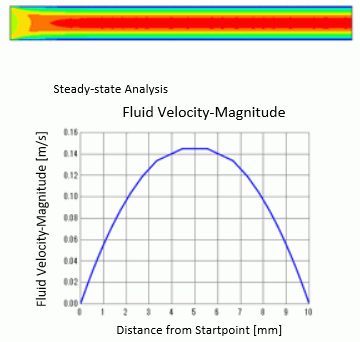
The distribution of the flow velocities is shown below.
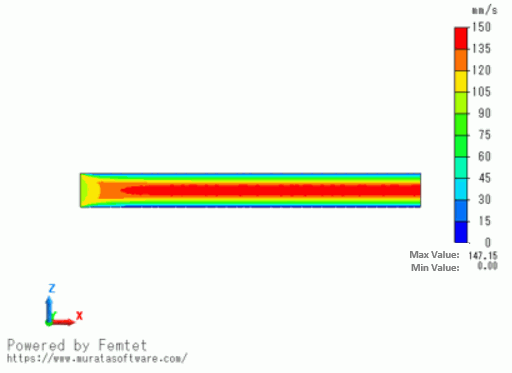
A graph below is given by selecting [Graph on edge] after right-clicking an edge near the outlet.
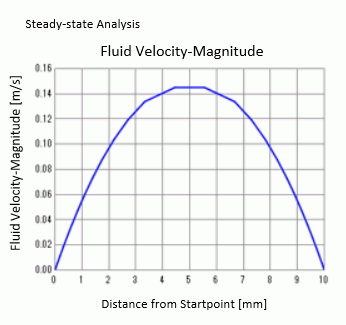
The laminar flow is known to show parabolic distribution of flow velocities. From the graph, it can be confirmed that the distribution is parabolic.
The maximum velocity in the center is said to be around 1.5 times the average flow velocity. It also can be confirmed from the graph that the maximum value is about 1.5 times the inflow velocity of 0.1 [m/s].