General
Home / Examples / Fluid Analysis [Bernoulli] / Example 4: Forced-outflow Fan
Fan boundary condition is applied to the model used in the tutorial.
See Boundary Condition of Fluid Analysis for the details of the fan boundary condition.
Unless specified in the list below, the default conditions will be applied.
Results will vary depending on Femtet version and the PC environment.
Item |
Settings |
Analysis Space |
3D |
Model Unit |
mm |
Item |
Tab |
Settings |
Solver |
Solver Selection |
Fluid Analysis [Bernoulli] |
Analysis Type |
Fluid Analysis |
Steady-state Analysis |
Meshing Setup |
Mesh |
General Mesh Size: 6 [mm] |

Body Number/Type |
Body Attribute Name |
Material Name |
3/Solid |
Flow_path |
000_Air(*) |
4/Solid |
007_Fe * |
* Available from the material DB
Boundary Condition Name/Topology |
Tab |
Boundary Condition Type |
Settings |
|||||||||
Inlet/Edge |
Fluid |
Inlet |
Natural Inflow |
|||||||||
Outlet/Face |
Fluid |
Outlet |
Forced Outflow PQ Characteristics
|
The figure below is the contour of [total pressure] field.
The integration results at the inlet and outlet boundary faces are shown as well. (Selected faces are integrated by the right-click menu)
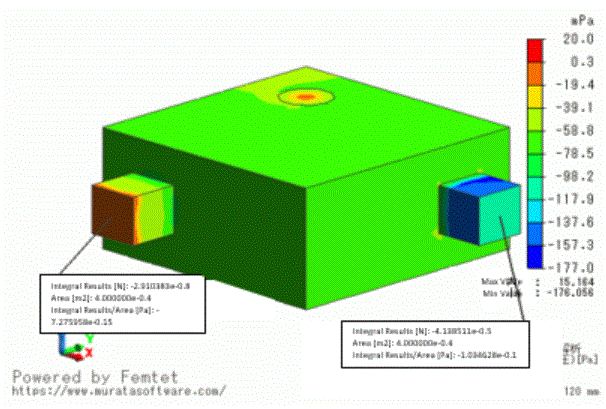
The total pressure is nearly zero under the natural inflow boundary. Under the forced-outflow fan boundary, it is -0.1034 [Pa] which is calculated from the PQ characteristics.
The tables of the volumetric flow rate and the pressure loss are as follows.
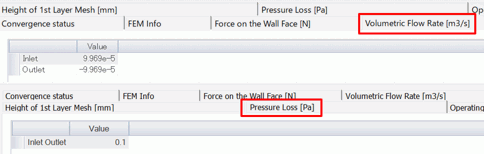
The differential pressure is calculated with PQ characteristics from the table of the volumetric flow rate of the outlet boundary as follows.
P = 0.2 - 0.2/2e-4 * 9.731e-5 = 0.1027
The calculation result matches with the values in the contour of the total pressure and in the table of the pressure loss.
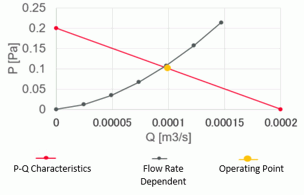
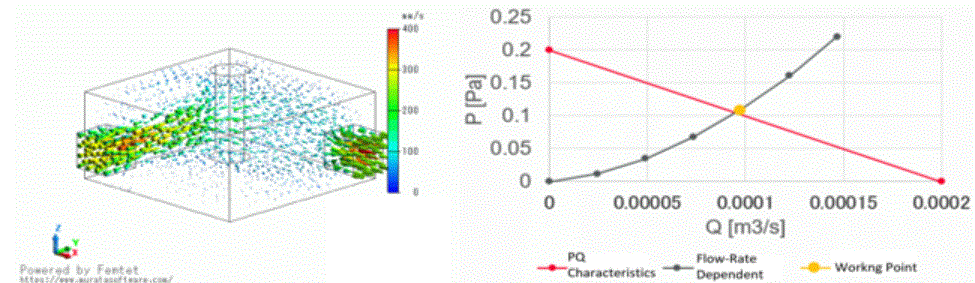
The PQ characteristics and the working point (volumetric flow rate:Q and pressure loss: P) are plotted as below.
It is confirmed that the working point is on the PQ characteristics curve.
For reference, the flow-rate dependent curve of the pressure loss is also shown below.
The curve is calculated for the volumetric flow rate between 2.5e-5 and 1.5e-4 using the velocity fixed boundary. The two curves are crossing at the operating point.
The flow-rate dependent curve of the pressure loss is obtained in the attached project [analysis model_reference].
・Open the project file.
・Change to the analysis model of [analysis model_reference].
・Perform the parametric analysis.
・The results of the flow rate and the pressure loss are saved in a csv file.