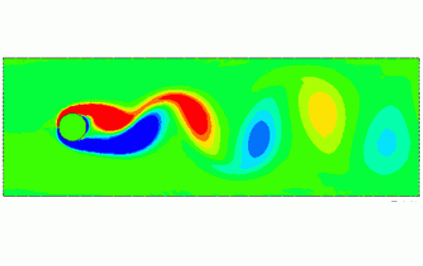
General
Home / Examples / Fluid Analysis [Bernoulli] / Example 5: Transient Analysis of Flow around Cylinder
The flow around the cylinder is analyzed.
The flow velocity distribution, the fluid velocity vectors, the streamlines, the vorticity, and the force on the wall face are solved.
Unless specified in the list below, the default conditions are applied.
Results will vary depending on Femtet version and the PC environment.
Item |
Settings |
Analysis Space |
2D |
Model Unit |
mm |
Item |
Tab |
Settings |
||||||||
Solver |
Solver Selection |
Fluid Analysis [Bernoulli] |
||||||||
Analysis Type |
Fluid Analysis |
Transient Analysis |
||||||||
Laminar Flow/Turbulent Flow |
Fluid Analysis |
Select Laminar flow |
||||||||
Layer Mesh Setting for Wall Surface (General Settings) |
Fluid Analysis |
Specify mesh height of 1st layer Height of 1st Layer Mesh: 0.5 [mm] |
||||||||
Timestep |
Transient Analysis |
Timestep: Specify
|
||||||||
Meshing Setup |
Mesh |
General Mesh Size: 3 [mm] |
The model is a rectangular sheet body and the material is Air (000_Air). The boundary conditions of inlet and outlet are set on the left edge and the right edge, respectively.
The slip wall outer boundary condition is applied to the top and bottom edges where the boundary condition is not set.
The model is a circle sheet body and the material is iron (007_Fe).
The edges surrounding a circle is a boundary of solid and fluid. Solid wall is automatically set to them.

Body Number/Type |
Body Attribute Name |
Material Name |
0/Solid |
Air |
000_Air(*) |
1/Solid |
Column |
007_Fe * |
* Available from the material DB
Boundary Condition Name/Topology |
Tab |
Boundary Condition Type |
Settings |
Inlet/Edge |
Fluid |
Inlet |
Forced Inflow |
Outlet/Face |
Fluid |
Outlet |
Natural Outflow |
Outer Boundary Condition |
Fluid |
Slip Wall |
- |
If Reynolds number exceeds 100, the time dependency of the turbulence occurs. It makes calculation difficult in the steady-state analysis.
The Reynolds number calculated with this model form, material property, and flow velocity is about 126.0. Use transient analysis instead.
Viscosity: μ=1.816e-5 [Pa s]
Density: ρ=1.144 [kg/m3]
Kinematic Viscosity: v=μ/ρ=1.816e-5/1.144=1.587e-5 [m2/s]
Flow Velocity: V=0.05 [m/s]
Diameter of Cylinder: D=0.04 [m]
Reynolds Number: Re = V*L/ν=0.05*0.04/1.587e-5 = 126.0
The vectors of the flow velocity distribution around the cylinder at time 48 [s] and 50 [s] are shown below.
The vectors are adjusted to the same length in the graphics setup.
It is known that at a Reynolds number of 126, Karman vortices are shed from the alternating upper and lower sides at the back of the cylinder.
In the diagram below, a vortex appears on the upper side of the cylinder at 48 [s] and the lower side at 50 [s].
| 48 [s] | 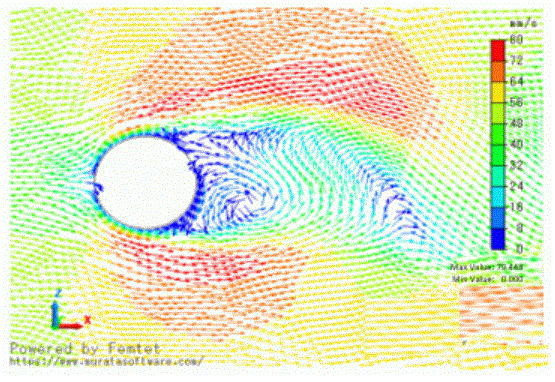 |
| 50 [s] | 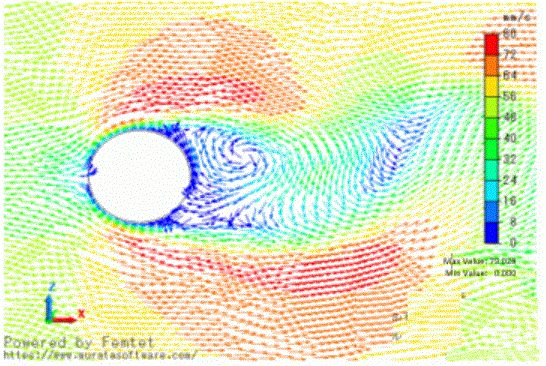 |
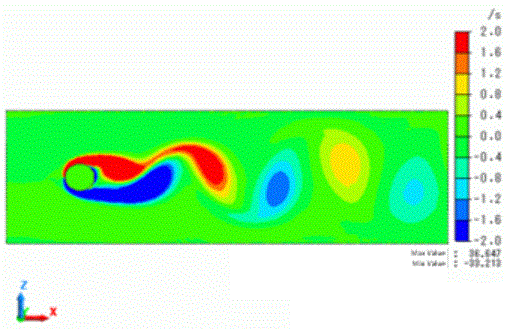
The figure below is the contour of Y component of the vorticity at 50 [s]. The color scale is minimum: -2 [/s] and maximum: 2 [/s].
The vortex strength in the Y direction is shown. The clockwise vortices are shown in the positive value, and the counter-clockwise vortices in the negative value.
You can observe the vortices are shed downstream from the cylinder.
The force on the wall face is shown by the table.
[Column] shows the force which the cylinder receives from the fluid.
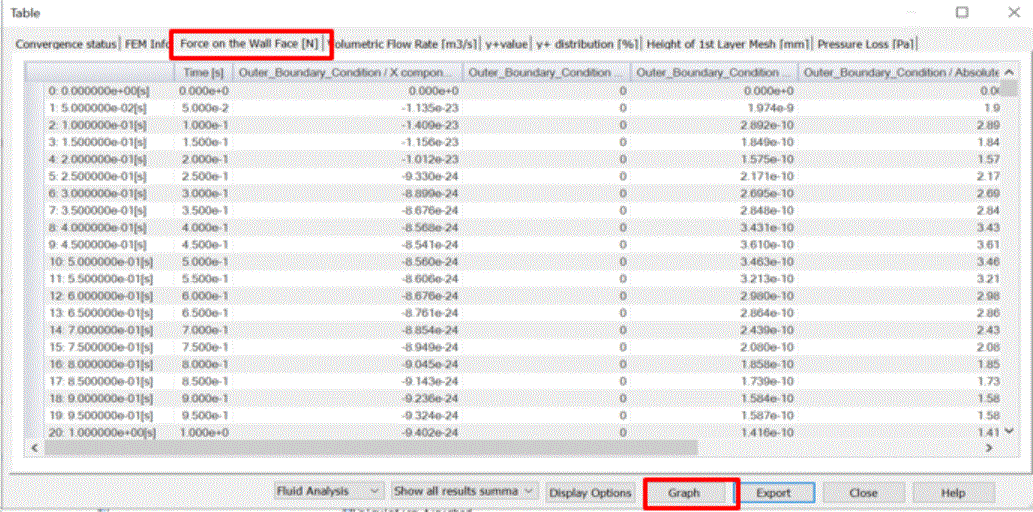
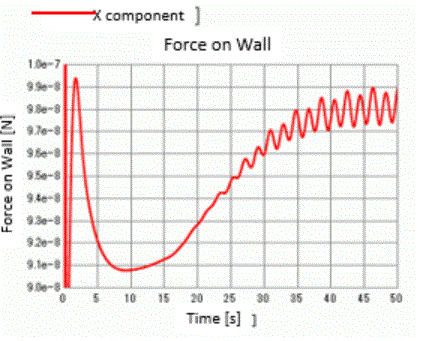
The result below shows only Column/X component (drag F: force in the flowing direction).
(Double click the graph to show the plot option. Deselect [Display Y-axis (primary axis)] except Column/X component. Change the color of column/X component to red.)
The range of the scale for the vertical axis is changed to 0.9 x 10^-7 ~1.0 x 10^-7.
The drag force near time 50[s] fluctuates, centering around a central value of 9.8 x 10^-8 [N] , with a cycle of about 2 [s].
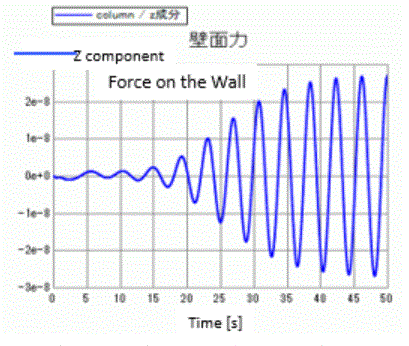
The result below shows only Column/Z component (lift: force in the direction perpendicular to the flow).
(Double click the graph to show the plot option. Deselect [Display Y-axis (primary axis)] except Column/X component. Change the color of column/X component to blue.)
You can see that the lift is fluctuating at a constant cycle of about 4 [s].
The drag coefficient CD can be calculated from the drag F.
Thickness in Depth Direction: t = 1 [mm]
Cross Sectional Area: S = D * t = 0.04 * 0.001 = 4e-5 [m2]
Dynamic Pressure: Pk = 0.5 * ρ*V^2 = 0.5 * 1.144 * 0.05 * 0.05 = 1.430e-3 [Pa]
Drag Coefficient: CD = F / Pk / S = 9.8e-8 / 1.430e-5 /4e-5 = 1.71