Home / Examples / Fluid Analysis [Bernoulli] / Example 16: Capillary Action Analysis

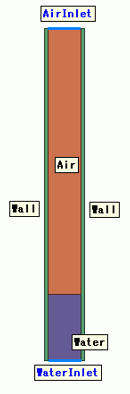
The model is two parallel plates and water sandwiched between them. Water rising by surface tension is solved with the VOF method.
The volume fractions of air and water are solved.
Unless specified in the list below, the default conditions are applied.
Results will vary depending on Femtet version and the PC environment.
Item |
Settings |
Analysis Space |
2D |
Model Unit |
mm |
Item |
Tab |
Settings |
||||||||
Solver |
Solver |
Fluid Analysis [Bernoulli] |
||||||||
Analysis Type |
Fluid Analysis |
Transient Analysis |
||||||||
Multiphase Flow Setting |
Fluid Analysis |
Execute free surface analysis (VOF method): Select Phase Setting: Register [000_Air] and [100_Water].
Take into account weight: Select Take into account surface tension: Select Phase Pair Setting:
|
||||||||
Detailed Settings |
Fluid Analysis Setup Details |
Volume Control Type: Cell-centered Base |
||||||||
Timestep |
Transient Analysis |
|
||||||||
Meshing Setup |
Mesh |
|
Body Number/Type |
Body Attribute Name |
Material Name |
0/Face |
Wall |
Wall |
1/Face |
Wall |
Wall |
2/Face |
Water |
100_Water * |
3/Face |
Air |
000_Air * |
* Available from the material DB
The material property of “Wall” is set as follows.
Material Name |
Tab |
Settings |
Wall |
Solid/Fluid |
Solid |
Contact Angle is set in the body attributes of “Wall”.
Body Attribute Name |
Tab |
Settings |
||||||
Wall |
Solid |
Multiphase Flow Setting (Contact Angle Setting): Specify for each body attribute: Select Phase Pair Setting:
|
Boundary Condition Name/Topology |
Tab |
Boundary Condition Type |
Settings |
WaterInlet/Edge |
Fluid |
Inlet/Outlet |
Natural Inflow/ Natural Outflow Multiphase Flow Setting: Inflow Phase [100_Water] |
AirInlet/Edge |
Fluid |
Inlet/Outlet |
Natural Inflow/ Natural Outflow Multiphase Flow Setting: Inflow Phase [000_Air] |
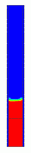
The volume fraction contours of phase 2 at 0, 0.1 [s], 0.2 [s], 0.3 [s], 0.4 [s], and 0.5 [s] are shown below.
Phase 2 (Water) is indicated in red.
Water level rises until 0.4 [s] and then decreases at 0.5 [s].
The water level does not converge to a certain value.
Time: 0 [s] |
Time: 0.1 [s] |
Time: 0.2 [s] |
Time: 0.3 [s] |
Time: 0.4 [s] |
Time: 0.5 [s] |
|---|---|---|---|---|---|
 |
 |
 |
 |
 |
 |
With contact angles taken into account, the calculation may not converge due to boundary oscillations.
About 10 times larger viscosity can suppress the undesired oscillations.
The steady-state is calculated where the surface tension and the weight are balanced.
Then, the change in viscosity does not affect the calculation of the steady-state.
Water level can be obtained from the equations below, which indicates water level does not depend on viscosity.
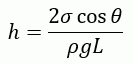
H [m]: Water Level, σ [N/m]: Surface Tension Coefficient, θ: Contact Angle, ρ [kg/m3]: Water Density, g [m/s2]: Gravitational Acceleration, L [m]: Distance between the parallel plates
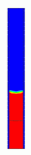
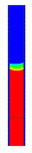
The calculation results with 10 times higher viscosity are shown below.
Water level converges to a certain value.
Time: 0 [s] |
Time: 0.1 [s] |
Time: 0.2 [s] |
Time: 0.3 [s] |
Time: 0.4 [s] |
Time: 0.5 [s] |
|---|---|---|---|---|---|
|
 |
 |
 |
 |
 |
The water levels of the two models are acquired by [VOF CaptureBoundary Macro.xlsm] and shown in the graph below.
The water level converges to about 5.8 [mm].
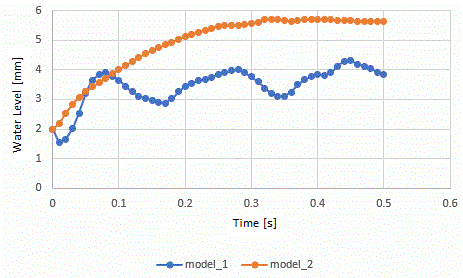
The theoretical value of water level is,
h = 2 * 0.07 * 0.5 / (997 * 9.8 * 0.1e-3 ) = 7.16 [mm].
The theoretical water level is slightly higher than the calculated level.