General
Home / Examples / Coupled Analysis / Electric-Stress Analysis [Coulomb/Galileo] / Example 1: Displacement Caused by Electrostatic Force
The model is a parallel-plate capacitor. Applied electric potential generates
electrostatic force between the electrodes, resulting in displacement.
The deformation, the displacement distribution, and the stress distribution are solved.
Unless specified in the list below, the default conditions will be applied.
Results will vary depending on Femtet version and the PC environment.
Item |
Settings |
Analysis Space |
3D |
Model Unit |
mm |
On the multiphysics setup, select "Electrostatic force to be taken into account".
Item |
Settings |
Solver |
Electric Analysis [Coulomb] |
Analysis Type |
Static Analysis |
Multiphysics Setup |
Electrostatic force to be taken into account |
Options |
N/A |
Ambient air is not required. Deselect the automatic creation.
Tab |
Setting Item |
Settings |
Mesh Tab |
Ambient Air Creation |
Create ambient air automatically: Deselect |
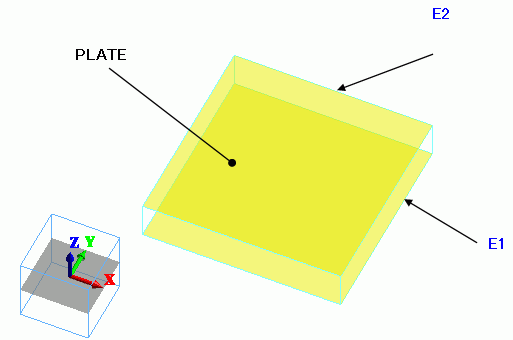
Body Number/Type |
Body Attribute Name |
Material Name |
0/Solid |
PLATE |
001_Alumina * |
* Available from the material DB
Boundary Condition Name/Topology |
Tab |
Boundary Condition Type |
Settings |
E2/Face |
Electric |
Electric Wall |
Electric Potential Specified 1000 [V] |
E1/Face |
Electric |
Electric Wall |
Electric Potential Specified 0 [V] |
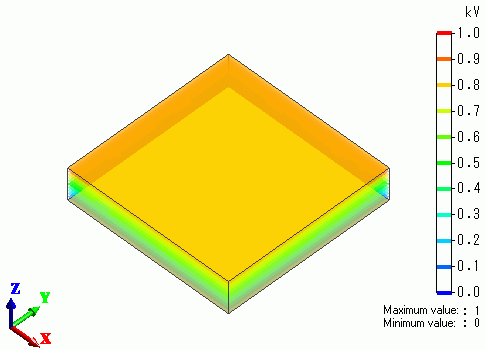
The electric potential distribution solved by Coulomb is shown below in the isosurface contour diagram.
The vectors of displacement caused by the electrostatic force are shown below.
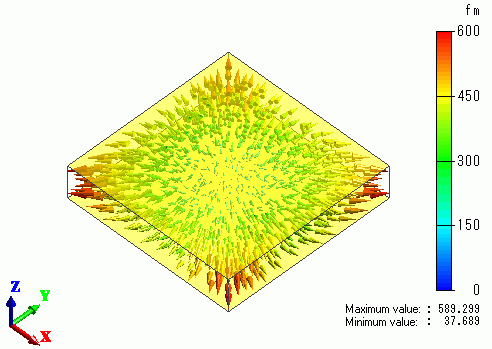
The electrodes are attracted to each other due to the electrostatic force, generating a tensile force. The tensile force will generate the displacement in the spreading direction.
The magnitude is quite small.