General
Home / Examples / Coupled Analysis / Electric-Thermal Analysis [Coulomb/Watt] / Example 5: Heating of Conductive Strip (Current Input)
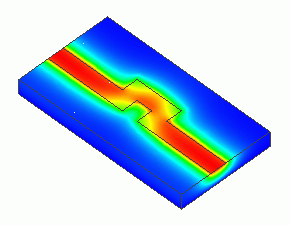
The model is a strip line having bend shapes. An electric potential is given across the strip line and the electric current is solved in the electric analysis.
Then the eventual joule loss and temperature rise are solved in the thermal analysis.
Current is specified in the boundary condition setting.
The current distribution and the temperature distribution can be viewed.
Unless specified in the list below, the default conditions will be applied.
Results will vary depending on Femtet version and the PC environment.
Item |
Settings |
Analysis Space |
3D |
Model Unit |
mm |
Select an electric solver [Coulomb] and a thermal solver [Watt] to execute coupled analysis.
For analysis type, select steady-state analysis to obtain the results only in the steady state.
Item |
Settings |
Solver |
Electric Analysis [Coulomb] Thermal Analysis [Watt] |
Analysis Type |
Steady-state Analysis |
The substrate is a box solid body.
The strip line is a sheet body on the substrate.

Body Number/Type |
Body Attribute Name |
Material Name |
0/Solid |
Board |
001_Alumina * |
6/Sheet |
StripLine |
008_Cu * |
* Available from the material DB
It is assumed that there is no current flow in the alumina substrate.
The conductive strip is a sheet body. The thickness must be defined in the body attribute, where the resistance can be entered too.
Current and heat source will vary depending on the thickness.
Body Attribute Name |
Thickness/Width |
Analysis Domain |
Board |
|
Solver: Deselect Electric Analysis (Coulomb) |
StripLine |
Thickness of Sheet Body : 0.1mm |
|
Resistivity/conductivity is required to be set to “Board” to run the Coulomb/Watt solver
even though it is not used in the electric analysis. As the resistivity in the database of the 001_Alumina is not defined by default,
the value is temporarily set to 1.0. (The result will not be affected)
Material Name |
Resistivity |
001_Alumina |
1.0 [Ωm] |
The temperature of the bottom face of the substrate is set to 25 [deg] using the boundary condition of T0.
The [Adiabatic] boundary condition is set to the faces that the strip line ends using the boundary condition of T_Wall.
This keeps the outer boundary condition from being applied on the faces.
Boundary condition V1 defines the current at the ends of the strip line.
Boundary condition V0 represents the outflow face of current.
The heat transfer to the ambient, air at 25℃, is defined by the outer boundary condition.
Boundary Condition Name/Topology |
Tab |
Boundary Condition Type |
Settings |
T_Wall/Face |
Thermal |
Adiabatic |
|
T0/Face |
Thermal |
Temperature |
25 [deg] |
V0/Edge |
Electric |
Electric Wall |
Current Specified, Outflow Face |
V1/Edge |
Electric |
Electric Wall |
Current Specified, Waveform: Constant, Inflow face, Current: 100 A |
Outer Boundary Condition * |
Heat |
Heat Transfer: Convection |
Heat Transfer Coefficient: 10 [W/m2/deg] Ambient Temperature: 25 [deg] |
To set Outer Boundary Condition, go to the [Model] tab
and click [Outer Boundary Condition]  .
.
The vectors of the current density are shown below.
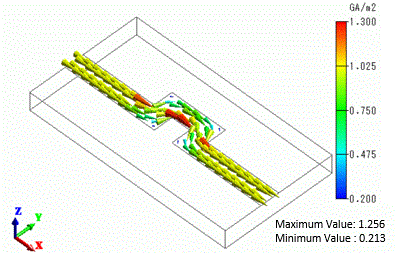
The current density is not even at around the bending area of the strip line.
The temperature contour as a result of the thermal analysis (Watt) is shown below.
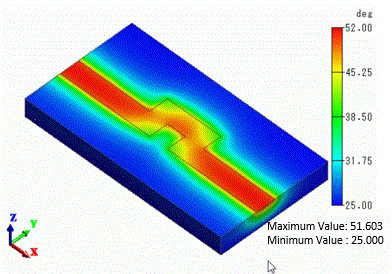
It is observed that heat raises the temperature of the strip line and transfers towards the substrate.