Home / Examples / Electric Analysis [Coulomb] / Example 1: Parallel-Plate Air-Gap Capacitor
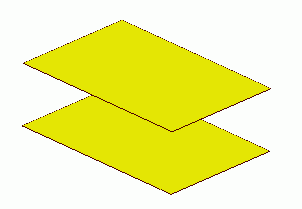
The capacitor analyzed in this example consists of two parallel conductive plates which have the electric potential difference.
The capacitance, the electric field, and the equipotential map are solved.
Unless specified in the list below, the default conditions will be applied.
Results will vary depending on Femtet version and the PC environment.
Item |
Settings |
Analysis Space |
3D |
Model Unit |
mm |
Select "Static analysis" as the electric potential is static.
Item |
Settings |
Solver |
Electric Analysis [Coulomb] |
Analysis Type |
Static Analysis (Capacitance) |
Options |
N/A |
In actuality, the electric field exists outside the analysis domain. Therefore the open boundary condition below is applied initially.
Tab |
Setting Item |
Settings |
Open Boundary Tab |
Type |
Absorbing Boundary |
Order of Absorbing Boundary |
1st-order |
Create 2 sheet bodies for electrodes. Then, specify the electric potential on each as boundary condition.
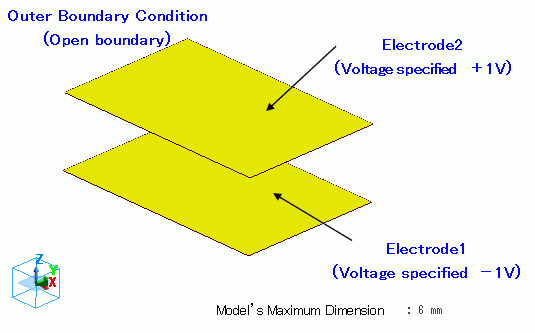
Two sheet bodies are used to imprint the electric potential-specified boundary condition.
They are called "imprinting body".
You don't need to set the body attribute or the material property on them.
Body Number/Type |
Body Attribute Name |
Material Name |
1/Sheet |
Imprinting body |
|
2/Sheet |
Imprinting body |
|
* Available from the material DB
Boundary Condition Name/Topology |
Tab |
Boundary Condition Type |
Settings |
Electrode1/Face |
Electric |
Electric Wall |
Electric Potential Specified -1 [V] |
Electrode2/Face |
Electric |
Electric Wall |
Electric Potential Specified +1 [V] |
Outer Boundary Condition * |
Electric |
Open Boundary |
To set Outer Boundary Condition, go to the [Model] tab
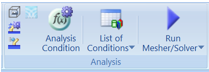
and click [Outer Boundary Condition]  .
.
To see the calculation results, go to the [Results] tab

and click [Table]  .
.
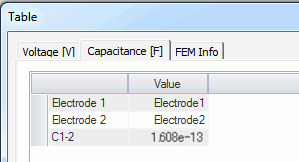
The vectors of the electric field are shown below.
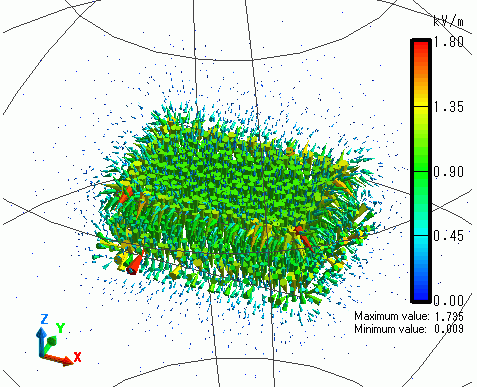
The electric field is generated between two plates.
The gradation contour of the electric potential on the XZ cross section is shown below.
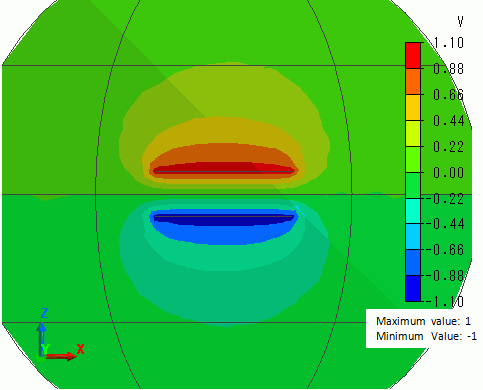
You can visually grasp the distributed electric potential in the space around the electrodes.