Home / Examples / Electric Analysis [Coulomb] / Example 13: Anisotropic Dielectric Material
An anisotropic dielectric material is placed in an isotropic dielectric material.
By applying an electric potential difference, the electric field is generated.
The distributions of the electric field and the current density are solved.
Unless specified in the list below, the default conditions will be applied.
Results will vary depending on Femtet version and the PC environment.
Item |
Settings |
Analysis Space |
3D |
Model Unit |
mm |
Select [Static Analysis] as the electric potential is static.
Select a dielectric material for analysis.
Item |
Settings |
Solver |
Electric Analysis [Coulomb] |
Analysis Type |
Static Analysis (Capacitance) |
Options |
N/A |
To create the ambient air manually, deselect the automatic creation.
Tab |
Setting Item |
Settings |
Mesh Tab |
Ambient Air Creation |
Create ambient air automatically: Deselect |
The anisotropic dielectric material, Block, is oriented in the X direction.
Air is angled 45 deg with referenced to Block.
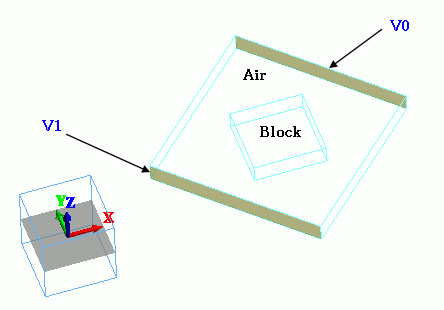
Body Number/Type |
Body Attribute Name |
Material Name |
0/Solid |
Air |
000_Air(*) |
1/Solid |
Block |
Anisotropic_Eps |
* Available from the material DB
The conductivity of the anisotropic conductor is set as follows.
Material Name |
Permittivity |
|||||||||
Anisotropic_Eps |
Anisotropy: Select [Anisotropic]. The [Relative Permittivity Matrix] is set as follows. *
* This is not the actual material's property. |
Boundary Condition Name/Topology |
Tab |
Boundary Condition Type |
Settings |
V0/Face |
Electric |
Electric Wall |
Electric Potential Specified 0 [V] |
V1/Face |
Electric |
Electric Wall |
Electric Potential Specified 1 [V] |
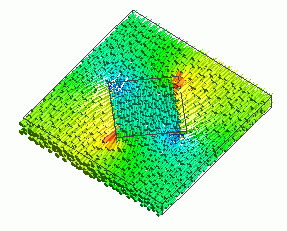
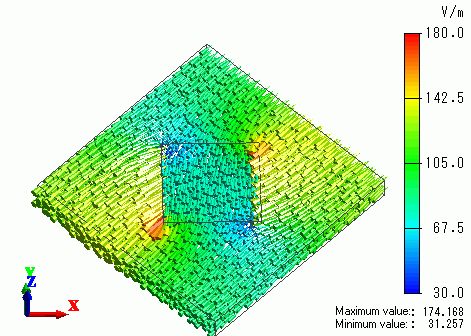
The vectors of the electric field are shown below.
Also shown are the vectors of the electric flux density.
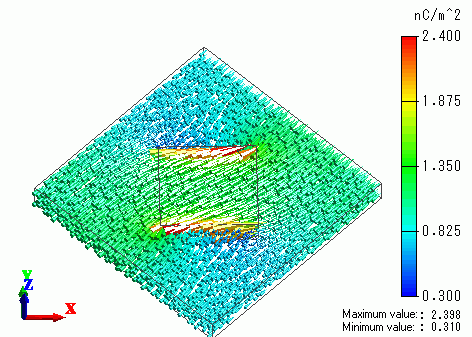
These two types of vectors are not parallel due to the anisotropy.
This example shows by applying the electric field in the direction of (1,1,0), the effect of the anisotropic relative permittivity can be calculated.
Alternatively, by creating a body (Air) with edges in parallel with the coordinate axis, and setting the Euler angle of (0, 0, 45) to the body of anisotropic material
, the same results can be obtained.