General
Home / Examples / Electric Analysis [Coulomb] / Example 17: Inductor's Floating Capacitance
The floating capacitance, or line-to-line capacitance, of a helical coil is solved.
Unless specified in the list below, the default conditions will be applied.
Results will vary depending on Femtet version and the PC environment.
Item |
Settings |
Analysis Space |
3D |
Model Unit |
mm |
Item |
Settings |
Solver |
Electric Analysis [Coulomb] |
Analysis Type |
Static Analysis (Capacitance) |
Options |
None |
Set the Mesh Tab as follows.
Tab |
Setting Item |
Settings |
Mesh |
Meshing Setup |
Automatically set the general mesh size: Deselect General Mesh Size: 2 [mm] |
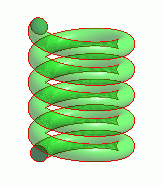
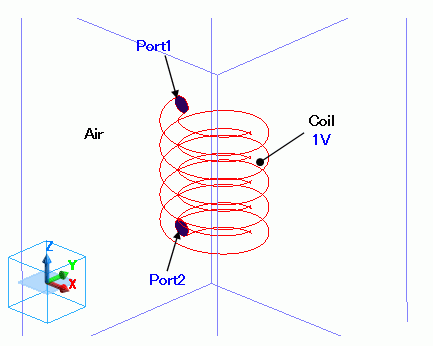
A helical solid body coil is defined.
Electric wall of 1 V is set on the whole of the coil body.
The ports are set on the edges of the coil where the floating capacitance is obtained.
Body Number/Type |
Body Attribute Name |
Material Name |
0/Solid |
Coil |
Coil |
1/Solid |
Air |
* 000_Air |
* Available from the material DB
Perfect conductor is set to the coil.
Material Name |
Tab |
Settings |
Coil |
Conductivity |
Conductivity Type: Perfect Conductor |
Set the electric wall of 1 V on the whole of the coil body.
The ports are set on the nodes where the floating capacitance is obtained.
Boundary Condition Name/Topology |
Tab |
Boundary Condition Type |
Settings |
1V/Face |
Electric |
Electric Wall |
Electric Potential Specified 1 [V] |
Port1/Face |
Electric |
Port |
|
Port2/Face |
Electric |
Port |
|
Outer Boundary Condition |
Electric |
Magnetic Wall |
|
To see the calculation results, go to the [Results] tab

and click [Table]  .
.
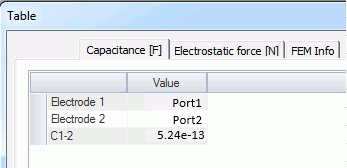
C1-2 is the floating capacitance. It is about 0.5 [pF].