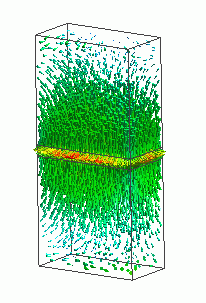
General
Home / Examples / Coupled Analysis / Magnetic-Stress Analysis [Gauss, Luvens/Galileo] / Example 1: Displacement Caused by the Forces between Magnets
A polyethylene plate is inserted in the magnets' gap of Example 5 of the magnetic analysis.
The plate is deformed due to the magnetic force between the magnets.
Unless specified in the list below, the default conditions will be applied.
Results will vary depending on Femtet version and the PC environment.
Item |
Settings |
Analysis Space |
3D |
Model Unit |
mm |
Item |
Settings |
Solver |
Magnetic Analysis [Gauss] |
Analysis Type |
Static Analysis |
Options |
N/A |
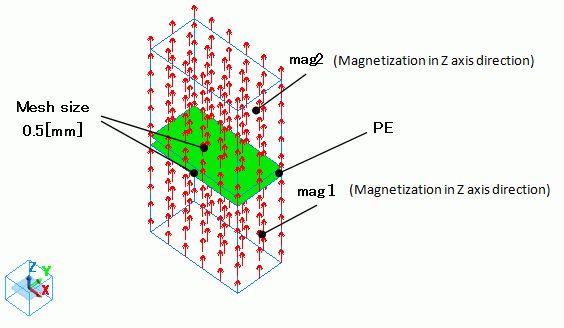
Two solid bodies of magnets (mag1, mag2) are defined.
A polyethylene plate, is inserted in the magnets' gap.
The magnetizing direction of the magnet is +Z by default.
That means the top of the magnet is the north magnet pole and the bottom is the south magnet pole.
The automatically created ambient air is analyzed only in the magnetic analysis, not in the thermal analysis.
Mesh size is set at 0.5 [mm] as the magnetic field changes drastically between the magnets.
Set the gap between the bodies and mesh size properly to obtain valid calculation results.
See [Calculation of the Electromagnetic Force] for more details.
Body Number/Type |
Body Attribute Name |
Material Name |
Mesh Size |
0/Solid |
mag1 |
mag |
2.5 |
2/Solid |
mag2 |
mag |
2.5 |
3/Solid |
PE |
000_Polyethylene(PE) |
2.5 |
* Available from the material DB
The material properties are set up as follows:
Material Name |
Tab |
Properties |
mag |
Permeability |
Select [Permanet Magnet] |
Magnet |
Magnetization Strength: 0.5 |
|
Elasticity |
Young's Modulus: 10 [GPa] |
To stabilize the stress analysis, XY plane displacements on the lower face of mag1 and upper face of mag2 are fixed.
Boundary Condition Name/Topology |
Tab |
Boundary Condition Type |
Setting |
Fix/Face |
Mechanical |
Displacement |
Select X and Y components. UX=0, UY=0 |
To see the electromagnetic force, go to the [Results] tab,

and click [Table]  .
.
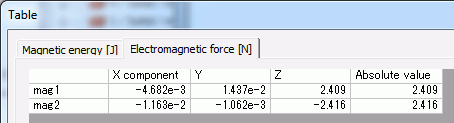
Two magnets are pulling each other with the force of 2.4 [N] in the Z direction.
The vectors of the displacement are shown for the XZ section.
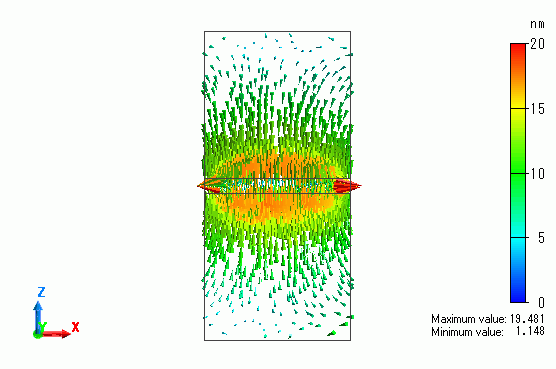
The displacement is generated by the magnets' pulling forces. The displacement is in the opposite direction at the other end of each magnet.
The vectors of the stress are shown below.
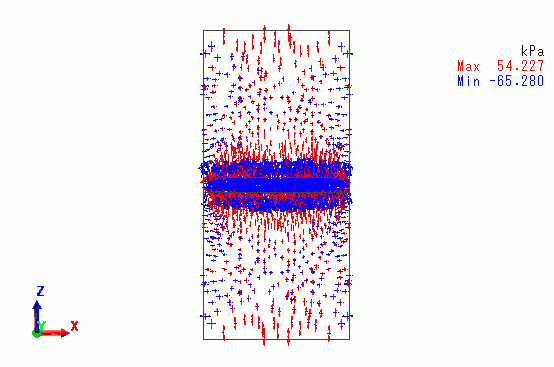
The compression forces are concentrated in the gap between the magnets.