General
Home / Examples / Magnetic Analysis (Gauss, Static Analysis/Harmonic analysis) / Example 13: Inductance of Two Parallel-Plate Electrodes
Inductance of the two parallel-plate electrodes is solved.
The inductance, the vectors of the magnetic field and the magnetic flux density are solved.
Unless specified in the list below, the default conditions will be applied.
Results will vary depending on Femtet version and the PC environment.
Item |
Settings |
Analysis Space |
3D |
Model Unit |
mm |
Item |
Settings |
Solver |
Magnetic Analysis [Gauss] |
Analysis Type |
Static Analysis |
Options |
N/A |
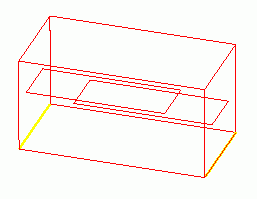
A ceramic cuboid is created and parallel plate electrodes are defined on the surface and inside of the cuboid.

Body Number/Type |
Body Attribute Name |
Material Name |
3/Sheet |
Coil |
008_Cu * |
4/Sheet |
Coil |
008_Cu * |
5/Sheet |
Coil |
008_Cu * |
6/Sheet |
Coil |
008_Cu * |
10/Solid |
Coil |
Ceramics |
* Available from the material DB
The body attribute is set as follows to apply the current to the electrodes and ceramic body.
Body Attribute Name |
Tab |
Settings |
Coil |
Current |
Waveform: Constant Current: 1 [A] Turns: 1 [Turns] Direction: Specify Inflow/Outflow faces (In the Air Box): Select Inflow Face and Outflow Face. |
Define Ceramics as a conductor of very low conductivity as follows.
Material Name |
Tab |
Settings |
Ceramics |
Conductivity |
Conductivity Type: Conductor |
No setting.
To see the results of inductance calculation, go to the [Results] tab

and click [Table]  .
.
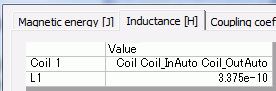
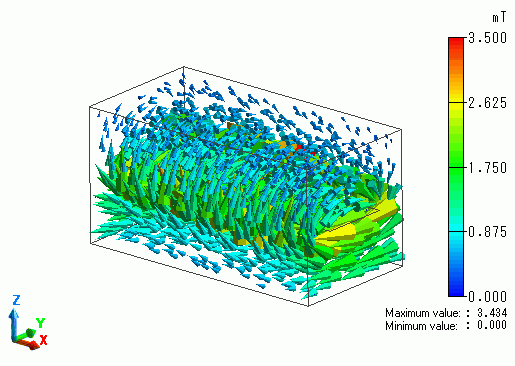
The vectors of the magnetic field are shown below.
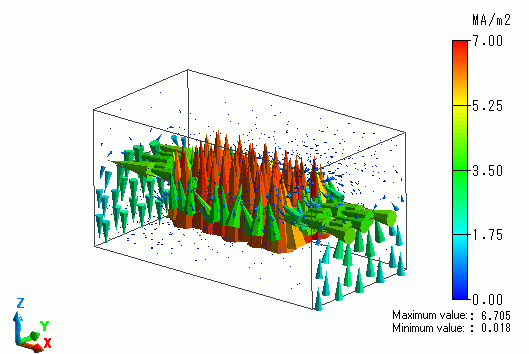
The vectors of the current density are shown below.