Home / Examples / Magnetic Analysis (Gauss, Static Analysis/Harmonic analysis) / Example 34: Electromotive Force of NFC Coil
External AC magnetic field is applied to a NFC coil (13.56 MHz) to induce current.
Electromotive force is generated by the induced current flowing through the coil.
Integral path is required to be set in the electric circuit.
The electromotive force, the magnetic field vectors and the magnetic flux density are solved.
Unless specified in the list below, the default conditions will be applied.
Results will vary depending on Femtet version and the PC environment.
Item |
Settings |
Analysis Space |
3D |
Model Unit |
mm |
Item |
Settings |
Solver |
Magnetic Analysis [Gauss] |
Analysis Type |
Harmonic Analysis |
Options |
N/A |
The frequency is set to 13.56 [Hz] on the harmonic analysis tab.
The external magnetic field is directing the positive Z direction.
Thus, the external magnetic field is set to be AC with the frequency of 13.56 [Hz].
Tab |
Setting Item |
Settings |
Mesh Tab |
Frequency-Dependent Meshing |
Reference Frequency: 13.56x10⁶ [Hz] |
Harmonic Analysis |
Sweep Type |
Single Frequency |
Frequency |
13.56×10⁶ [Hz] |
|
External Magnetic Field |
External Magnetic Field |
Input type: Magnetic Field X=0, Y=0, Z=1 [A/m] |
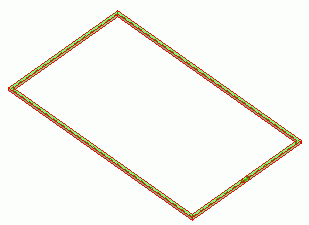
An NFC coil (Coil) is defined.
The coil size is 72 [mm] x 42 [mm].

Coil is terminated with a body R having sufficient resistance to measure the electromotive force.
If the boundary condition of integral path is set along the current path, the electromotive force can be calculated by integrating the electric field (current density*resistance) on the integral path.
Basically, the body R is not needed when setting the integral path along the current path of the loop coil. However, the current density is not constant at the cross section of the coil and calculation cannot be done accurately.
By adding the body R having resistance high enough,
the electric potential difference is generated mostly at the body R, and the current density at the cross section of the body R is almost constant. So the calculation will be accurate.
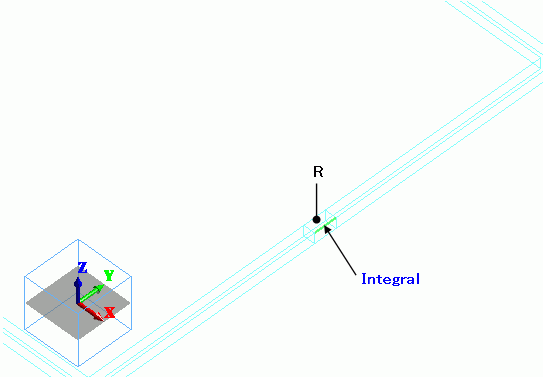
Body Number/Type |
Body Attribute Name |
Material Name |
6/Solid |
Coil |
008_Cu * |
5/Solid |
R |
R |
* Available from the material DB.
It is assumed that the induced current flows through the coil (Coil).
Therefore no settings to flow are required on the Current tab of the body attribute and with the port boundary condition.
The electric conductivity of the body R is set low enough compared to the coil as follows.
Material Name |
Tab |
Settings |
R |
Conductor Wall |
Conductivity Type: Conductor |
Conductivity: 1 [S/m] |
Integral path is set in the current path of the body R in order to calculate the electromotive force.
The outer boundary condition is magnetic wall in this example.
Boundary Condition Name/Topology |
Tab |
Boundary Condition Type |
Settings |
Integral/Face |
Electric |
Integral Path |
|
Outer Boundary Condition |
Electric |
Magnetic Wall |
|
To see the electromotive force, go to the [Results] tab

and click [Table]  .
.
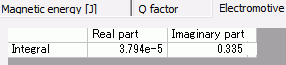
The absolute value is the amplitude of the electromotive force.
About 0.335 [V] is generated.
It is pretty close to the theoretical value: V=jωSB=j*2*π*13.56*10^6*0.072*0.042*1*μ0=j0.324 [V].
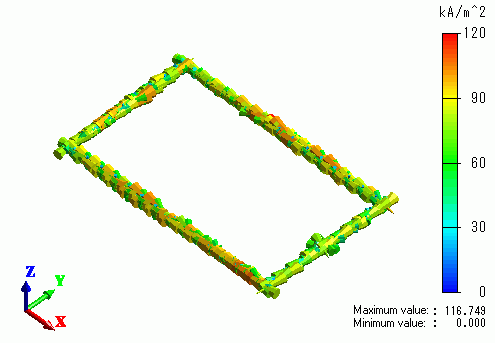
The vectors of current density are shown below.
The magnetic field sectioned at YZ plane is shown below.
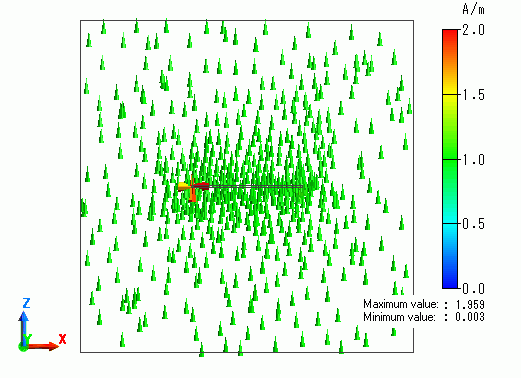
The magnetic field is created as set on [External Magnetic Field] tab.