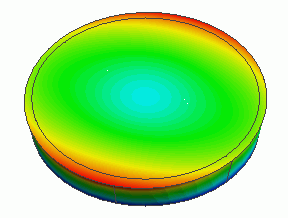
Home / Examples / Coupled Analysis / Electromagnetic-Thermal-Stress Analysis [Hertz/Watt/Galileo] / Example 1: TM-Mode Dielectric Resonator
The model is a TM-mode dielectric resonator.
It is analyzed by the electromagnetic-thermal-stress analysis.
Unless specified in the list below, the default conditions will be applied.
Results will vary depending on Femtet version and the PC environment.
Item |
Settings |
Analysis Space |
3D |
Model Unit |
mm |
Item |
Settings |
Solver |
Electromagnetic Analysis [Hertz] Thermal Analysis [Watt] Stress Analysis [Galileo] |
Analysis Type |
Electromagnetic Analysis: Resonant Analysis Thermal Analysis: Steady-state Analysis Stress Analysis: Static Analysis |
* [Thermal Load] is selected by default for the thermal-stress coupled analysis.
The resonant analysis is set up as follows.
Tabs |
Setting Item |
Settings |
Mesh Tab |
Mesh Size |
2.0 |
Element Type |
2nd-order Element |
|
Adaptive Meshing |
Off (to shorten the calculation time) |
|
Frequency-Dependent Meshing |
Reference Frequency: 1.0x10⁹ [Hz] |
|
Resonant Analysis |
Number of Modes |
3 |
Input Power |
10 [W] * |
|
Calculate the Q factor with high accuracy |
Select |
* The losses in electrodes and dielectric material are taken into account.
Therefore, all the input power is to be consumed in the resonator.
Electrodes are set on the top and bottom faces of the dielectric disc.
The temperature and the displacement are fixed at the bottom electrode.
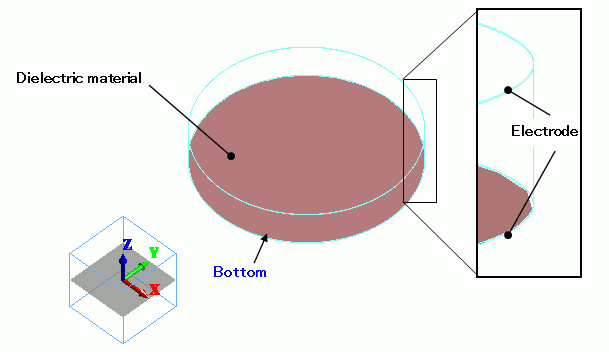
Body Number/Type |
Body Attribute Name |
Material Name |
0/Solid |
Dielectric material |
Dielectric material |
1/Solid |
Electrode |
008_Cu * |
2/Solid |
Electrode |
008_Cu * |
* Available from the material DB
Material Name |
Tab |
Properties |
Dielectric Material |
Permittivity |
Relative Permittivity: 40 tanD: 0.001 |
Thermal Conductivity |
10 [W/m/deg] |
|
Coefficient of Linear Thermal Expansion |
10X10-6 [1/deg] |
|
Elasticity |
Young's Modulus: 1x10⁹ [Pa] |
Boundary Condition Name/Topology |
Tab |
Boundary Condition Type |
Settings |
Bottom/Face |
Thermal |
Temperature |
25 [deg] |
Mechanical |
Displacement |
Select UX, UY, and UZ all. The displacement is 0 [m] for all. |
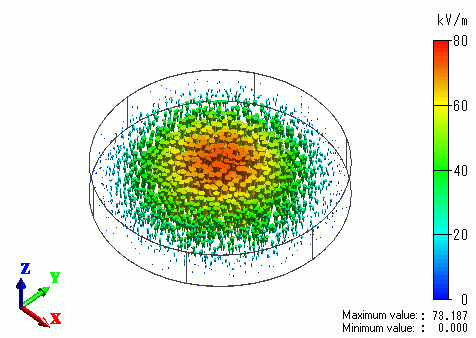
The vectors of the electric fields resulting from the electromagnetic analysis [Hertz] are shown below.
Mode 0:
Mode 1:

The electric field in the center is peaked and bottomed in Modes 0 and 1 respectively.
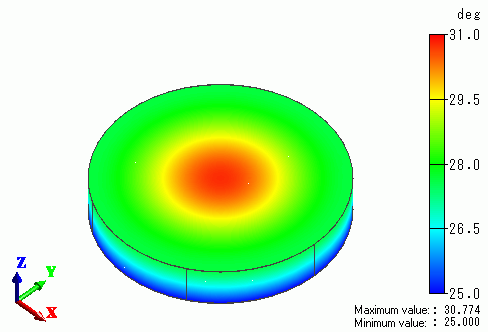
The next figures show the results of thermal analysis [Watt].
Mode 0:
Mode 1:
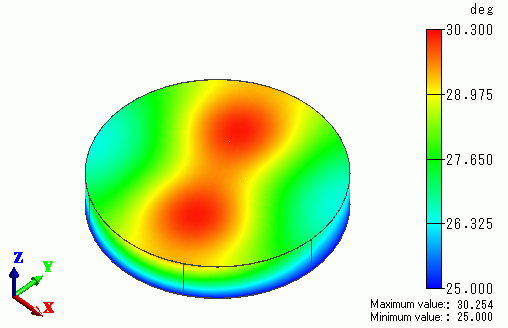
The temperature rise is high at the area where the electric field is concentrating.
It is dependent on the distribution of the electromagnetic field.
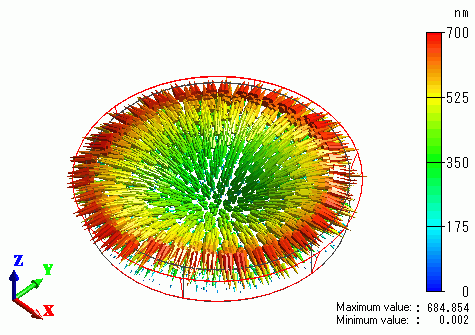
The next figure shows the vectors of displacement as a result of Galileo following Watt.
Mode 0:
Mode 1:
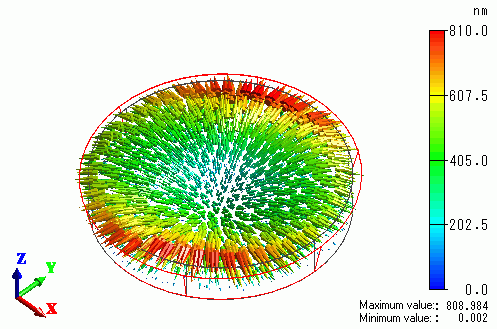
The deformation is dependent on the distribution of the electromagnetic field.