Home / Examples / Electromagnetic Analysis [Hertz] / Example 9: Coplanar Waveguide with Bend
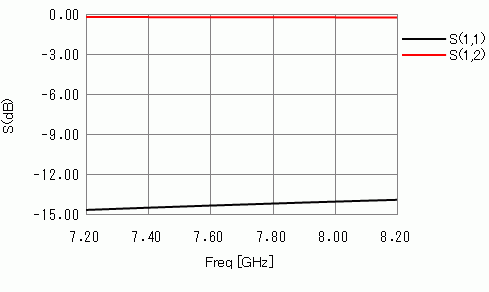
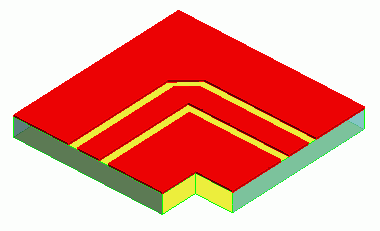
A coplanar waveguide with a bend is analyzed.
Unless specified in the list below, the default conditions will be applied.
[How to Reduce the Calculation Time]
Item |
Settings |
Analysis Space |
3D |
Model Unit |
mm |
Item |
Settings |
Solver |
Electromagnetic Analysis [Hertz] |
Analysis Type |
Harmonic Analysis |
The harmonic analysis is set as follows.
Tab |
Setting Item |
Settings |
Mesh Tab |
Element type |
2nd-order element |
Multigrid/Adaptive Mesh Method |
Select "Use the adaptive mesh method". |
|
Frequency-Dependent Meshing |
Reference frequency: 8x10⁹[Hz] Select "The conductor bodies thicker than the skin depth constitute the boundary condition."
As Hot and GROUND are thicker than the skin depth, the surfaces are applied with the boundary condition having some loss. |
|
Harmonic analysis |
Sweep Type |
Select [Linear Step by Division Number] |
Sweep Setting |
Minimum: 7.2×10⁹[Hz] Maximum: 8.2x10⁹[Hz] Division: 10 |
|
Sweep Setting |
Select Discrete sweep |
|
Input |
1.0[W] |
* Fast sweep is avoided for higher accuracy. The number of frequencies is relatively low, so the calculation will not take long.
Coplanar waveguide is formed on a alumina substrate. Electrodes of waveguide are solid bodies.
The outer boundary condition is set to the electric wall.

Body Number/Type |
Body Attribute Name |
Material Name |
4/Solid |
AIR |
000_Air(*) |
5/Solid |
SUB |
001_Alumina |
13/Solid |
HOT |
003_Ag * |
24/Solid |
GROUND |
003_Ag * |
26/Solid |
GROUND |
003_Ag * |
* Available from the material DB
Boundary Condition Name/Topology |
Tab |
Boundary Condition Type |
Settings |
PORT1/Face |
Electric |
Port |
Reference Impedance: Select [Specify] Enter 50[Ω] Number of Precalculated Modes: 5 Number of Modes Used in the Actual 3D Analysis: 1 Select Modes: None |
PORT2/Face |
Electric |
Port |
Same as Above. |
Outer Boundary Condition |
Electric |
Electric Wall |
|