General
Home / Examples / Electromagnetic Analysis [Hertz] / Example 10: Coil Formed in a Substrate
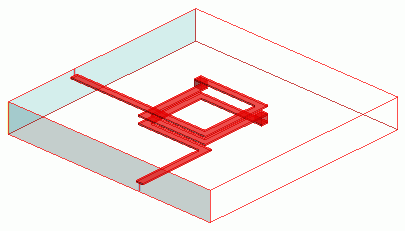
The frequency response of a coil formed in a substrate is solved.
Unless specified in the list below, the default conditions will be applied.
[How to Reduce the Calculation Time]
Item |
Settings |
Analysis Space |
3D |
Model Unit |
mm |
Item |
Settings |
Solver |
Electromagnetic Analysis [Hertz] |
Analysis Type |
Harmonic Analysis |
Harmonic Analysis tab and Open Boundary tab are set as follows.
Tab |
Setting Item |
Settings |
Mesh Tab |
Element Type |
2nd-order Element |
Multigrid/Adaptive Mesh Method |
Select [Apply the adaptive meshing]. |
|
Frequency-Dependent Meshing |
Reference frequency: 5x10⁹ [Hz] Select [The conductor bodies thicker than the skin depth constitute the boundary condition].
The surface of Metal is treated as the boundary condition having some loss, as Metal is thicker than the skin depth. |
|
Harmonic analysis |
Sweep Type |
Select [Linear Step by Division Number] |
Sweep Setting |
Minimum: 1×10⁹ [Hz] Maximum: 10x109 [Hz] Division Number: 10 |
|
Sweep Setting |
Select Fast Sweep S-Parameter Tolerance: 1x10⁻³ |
|
Input |
1.0 [W] |
|
Open Boundary |
Type |
Absorbing Boundary |
Order of Absorbing Boundary |
1st-order |
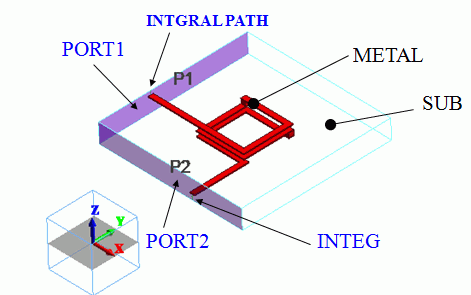
A coil (METAL) of a solid body is created inside a substrate (SUB). The ports (PORT1,PORT2) are set on the substrate faces where coil leads come out. Other substrate faces are set with the outer boundary condition to [Electric Wall].
Body Number/Type |
Body Attribute Name |
Material Name |
0/Solid |
SUB |
006_Glass_epoxy * |
4/Solid |
METAL |
003_Ag * |
8/Solid |
METAL |
003_Ag * |
14/Solid |
METAL |
003_Ag * |
15/Solid |
METAL |
003_Ag * |
16/Solid |
METAL |
003_Ag * |
* Available from the material DB
Boundary Condition Name/Topology |
Tab |
Boundary Condition Type |
Settings |
PORT1/Face |
Electric |
Port |
Reference Impedance: Select [Specify] and enter 50 ohms. Number of Modes Number of Precalculated Modes: 5 Number of Modes Used in the Actual 3D Analysis: 1 Select Modes: None |
PORT2/Face |
Electric |
Port |
Same as Above. |
Outer Boundary Condition |
Electric |
Electric Wall |
N/A |
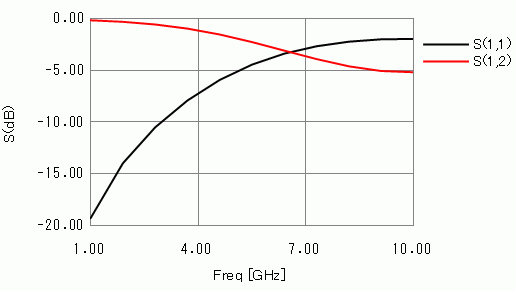
The frequency response of S11 and S22 is shown below.