
Home / Examples / Electromagnetic Analysis [Hertz] / Example 13: Corrugated Waveguide
The dispersion curve of a corrugated waveguide are solved. The model has uniform structure in the depth direction.
The periodic boundary condition is applied in the 3D resonant analysis.
Unless specified in the list below, the default conditions will be applied.
Results will vary depending on Femtet version and the PC environment.
Item |
Settings |
Analysis Space |
3D |
Model Unit |
mm |
Item |
Settings |
Solver |
Electromagnetic Analysis [Hertz] |
Analysis Type |
Resonant Analysis |
Mesh tab, Harmonic analysis tab and Open boundary tab are set as follows.
Tab |
Setting Item |
Settings |
Mesh Tab |
Element Type |
2nd-order Element |
Resonant Analysis |
Number of Modes |
5 |
Approximated Frequency |
0 [Hz] |
|
Input Power |
1.0 [W] |
The ambient air is defined with a solid body. No boundary condition is set on the faces normal to Z axis.
The waveguide has a periodic structure. Cut out one unit to set the periodic boundary condition [PERIOD1] and [PERIOD2] to its cross sections.
The other faces are set with Electric wall PEC.

Body Number/Type |
Body Attribute Name |
Material Name |
4/Solid |
AIR |
000_Air(*) |
* Available from the material DB
Boundary Condition Name/Topology |
Tab |
Boundary Condition Type |
Settings |
MW/Face |
Electric |
Magnetic Wall |
N/A |
PERIOD1/Face |
Symmetry/Continuity |
Periodic |
N/A |
PERIOD2/Face |
Symmetry/Continuity |
Periodic |
N/A |
Outer Boundary Condition |
Electric |
Electric Wall |
N/A |
Boundary Condition Name/Topology |
Boundary Condition Name/Topology |
Boundary Condition Type |
Settings |
PERIOD1/Face |
PERIOD2/Face |
Translational |
1 ≤ θ ≤ 359 |
The phase difference of periodic boundary is varied in the range of 1 ≤ θ ≤ 359. The resonant frequencies are plotted for each angle.

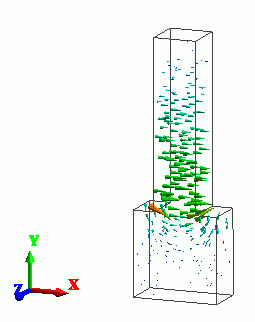
The electric field at θ=180.
This is the lowest - frequency resonant mode.
[Reference]
[1] Yu Zbu and Andreas Cangellaris, "Multigrid Finite Element Methods for Electromagnetic Field Modeling", The IEEE Press Series on Electromagnetic Wave Theory, pp. 396-397.