General
Home / Examples / Electromagnetic Analysis [Hertz] / Example 41: Frequency-Selective Reflector
Analyzed is a frequency-selective reflector that allows specific electromagnetic waves pass through.
Unless specified in the list below, the default conditions will be applied.
Results will vary depending on Femtet version and the PC environment.
Item |
Settings |
Analysis Space |
3D |
Model Unit |
mm |
Item |
Settings |
Solver |
Electromagnetic Analysis [Hertz] |
Analysis Type |
Harmonic Analysis |
Tab |
Setting Item |
Setting |
Mesh |
Frequency-Dependent Meshing |
Reference Frequency: 77 [GHz] Select The conductor bodies thicker than the skin depth constitute the boundary condition |
Harmonic Analysis |
Sweep Type |
Select [Linear Step by Division Number]. |
Sweep Setting |
Minimum Frequency: 40 [GHz] Maximum Frequency: 90 [GHz] Division: 200 |
|
Frequency Sweep |
Select Fast Sweep S-parameter Tolerance: 1x10⁻³ |
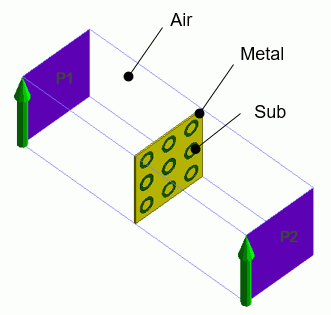
The model consists of a frequency-selective reflector and the air.
The dielectrics (Sub) are placed on the conductive plate (Metal) and encircled by curved slits.
Body Number/Type |
Body Attribute Name |
Material Name |
5, 30, 31, 32, 33, 34, 35, 36, 37/Solid |
Sub |
006_Glass_epoxy * |
38/Solid |
Air |
000_Air * |
39, 40, 41, 42, 43, 44, 45, 46, 47, 48/Solid |
Metal |
008_Cu (*) |
* Available from the material DB
Boundary Condition Name/Topology |
Tab |
Boundary Condition Type |
Settings |
Port_001/Face |
Electric |
Port |
Select Reference Impedance:
Integral Path Set Path1 |
Port_002/Face |
Electric |
Port |
Reference Impedance:
Integral Path Set Path1 |
EW/Face |
Electric |
Electric Wall |
|
Outer Boundary Condition |
Electric |
Magnetic Wall |
|
Setting Item |
Settings |
Frequency-Dependent Meshing |
Reference Frequency: 77 [GHz] Select The conductor bodies thicker than the skin depth constitute the boundary condition |
S-parameters are shown below. The transmission characteristic is observed at around 77 GHz.

Shown below are the current densities at 40 GHz (transmission characteristic does not appear) and at 77 GHz (transmission characteristic appears) on the frequency-selective reflector.

At 40 GHz, the current is flowing throughout the entire area of the conductor whereas the current is concentrated near the slit at 77 GHz.
Its value is large.
The electromagnetic field that causes the concentrated current near the slit is the resonant mode of the frequency-selective reflector. The resonant mode generates the transmission characteristic at a specific frequency.
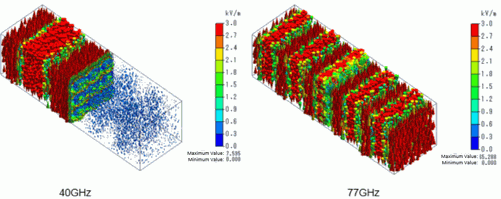
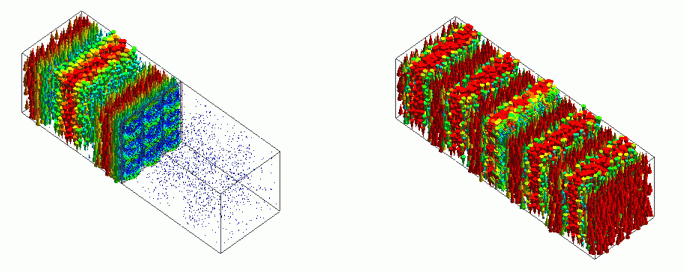
The figures below show the electric fields at 40 GHz and 77 GHz. At 40 GHz, the incident electromagnetic wave is blocked by the frequency-selective reflector and not transmitted.
At 77 GHz, the electromagnetic wave is transmitted through the frequency-selective reflector.
For a clear comparison, the scale factor for drawing vectors is set at 10 times, and the maximum value is set at 3k [V/m].