Home / Examples / Electromagnetic Analysis [Hertz] / Example 45: Radar Cross Section (RCS) of Conductive Sphere
Femtet can not calculate Radar Cross Section (RCS) directly. However, with additional calculations, RCS can be easily solved.
The example is a canonical problem provided by the Electronics Society of IEICE in Japan.
Unless specified in the list below, the default conditions are applied.
Results will vary depending on Femtet version and the PC environment.
Item |
Settings |
Solver |
Electromagnetic Analysis [Hertz] |
Analysis Space |
3D |
Analysis Type |
Harmonic Analysis |
Unit |
mm |
Analysis Options |
Select [Ignore the influence of face/edge electrode thickness] * |
* This option is selected be by default. In this example, the results will not be affected if it is deselected because there is no face electrode.
The Harmonic Analysis tab and Open Boundary tab are set as follows.
Tab |
Setting Item |
Settings |
Harmonic Analysis |
Frequency |
Single Frequency 2.998 [GHz] |
Sweep Setting |
Discrete Sweep |
|
Input |
1.0 [W] |
|
Incident Wave (plane wave) |
Propagation Direction |
( 0, 0, 1) |
Electric Field Vector |
( 1, 0, 0) [V/m] |
|
Open Boundary |
Type |
Absorbing Boundary |
Order of Absorbing Boundary |
1st-order |
The model inludes a body of air and a body of a conductive sphere. The Open Boundary condition is set using the Outer Boundary condition.

Body Number/Type |
Body Attribute Name |
Material Name |
0/Solid |
Conductive Sphere |
008_Cu * |
1/Sheet |
AIR Sphere |
000_Air * |
* Available from the material DB
Boundary Condition Name/Topology |
Tab |
Boundary Condition Type |
Settings |
Outer Boundary Condition |
Electric |
Open Boundary |
Setting Item |
Settings |
Frequency-Dependent Meshing |
Reference frequency: 2.998 [GHz] Select The conductor bodies thicker than the skin depth constitute the boundary condition |
Since Metal is thicker than the skin depth in the setting, the surface of Metal is set with the boundary condition of copper material loss.
Femtet can not calculate Radar Cross Section (RCS) directly. However, with additional calculations, RCS can be easily solved.
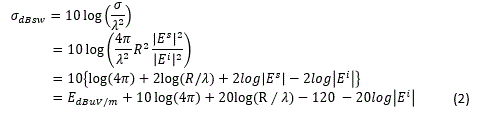
The equation of RCS(σ) is as follows.
R: Observation Point (Distance from Origin)
ES: Electric Field of Scattered Wave (Effective Values)
Ei: Electric Field of Incident Wave (Effective Values)

RCS[dBsw](=σdBsw), which is normalized by the wavelength (λ) in vacuum, can be obtained from the equation below. For R approaching infinity, perform the calculation by replacing R with a sufficiently far observation point.
“Log” is the common logarithm.
On the right side of Equation (2), the first term is solved with the surrounding electromagnetic field calculation in Femtet.
As each term from the second term on the right side of Equation (2) is easily calculated, adding them can result in RCS [dBsw]. In Femtet, direct calculation is not possible; instead, Excel is used.
Amplitude is entered on the Incident Wave (Plane Wave) tab in the Analysis Condition Setting dialog box. Be aware that the fifth term, Ei, on the right side of Equation (2) is the effective values.
Substituting the values below for Equation (2) will give Equation (3).
Ei = 1/1.414 [V/m]: Effective value of the electric field of the incident wave.
λ=0.1 [m]: Wavelength at 2.998 [GHz] in vacuum.
R=3.0 [m]: Observation point. This corresponds to the observation point, r, in the surrounding electromagnetic field dialog box. The value of 3.0 [m] is 30 times as long as the wavelength. It is a sufficiently far distance.

The electromagnetic field distribution obtained in the electromagnetic analysis is shown below.

Fig.1 Electromagnetic Field Distribution
Firstly, E [dBuV/m] is solved using the surrounding electromagnetic field calculation
The component of Eθ is calculated here.

Fig. 2 Directivity Calculation dialog, Surrounding Electromagnetic Field tab Fig. 3 Eθ [dBμV/m] from the surrounding electromagnetic field calculation
The graph below shows the result obtained by saving the surrounding electromagnetic field into a csv file and then performing the calculation of Equation (3) with Excel. The results of the numerical analysis and theoretical calculation match well.

Fig. 4 RCS [dBsw] of Conductive Sphere ,created with Excel.
[Appendix]
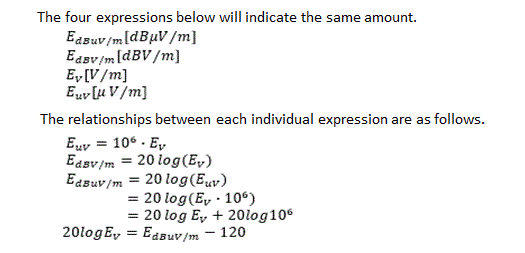
Refer below for unit conversion.