General
Home / Examples / Coupled Analysis / Transient Magnetic-Thermal Analysis [Luvens/Watt] / Example 1: Thermal Analysis of IPM Motor
Temperature and torque characteristics of IPM motor (Interior Permanent Magnet Motor) are analyzed when the electricity is applied.
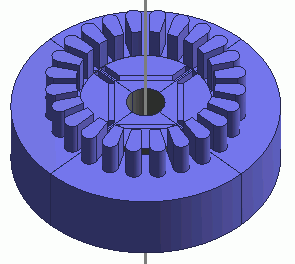
The model is a permanent magnet synchronous motor with magnets built in a rotor.
The analysis is coupled with the external circuit.
The homogenizing method is applied to simulate the layer structure of the electromagnetic plates of steel for the core.
Fast stabilizer is used to make the magnetic field reach the steady state in short calculation time.
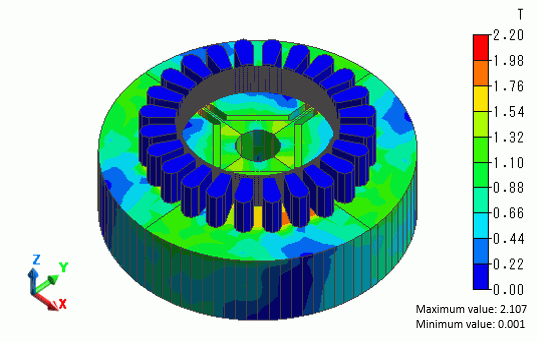
Temperature, torque and magnetic flux density are solved.
Unless specified in the list below, the default conditions will be applied.
Results will vary depending on Femtet version and the PC environment.
Item |
Settings |
Solver |
Magnetic Analysis [Luvens] Thermal Analysis [Watt] |
Analysis Type |
Magnetic Analysis: Transient Analysis Thermal Analysis: Steady-state Analysis |
Unit |
mm |
Options |
Select External Circuit Coupling. Select Rotating Machinery.
[Conversion] Model Thickness: 30×10-3 [m] Select Partial Model. Division Number: 4 [Conversion of external circuit I/O values] Select Convert Number of Series: 2 Number of Parallels: 2 Select Convert results to full model for output |
The Rotating Machinery tab is set as follows.
Tab |
Setting Item |
Settings |
Rotating Machinery |
Rotational Move |
Select Constant Velocity. Number of Rotations: 1800 [r/min] Rotor’s Initial Rotation Position: 0 [deg] |
Number of Sliding Mesh Divisions |
Circumferential Division Angle: 1.0 [deg] Rotational Quantity per Step: 1 [mesh] Number of Sliding Mesh Layers: 3 |
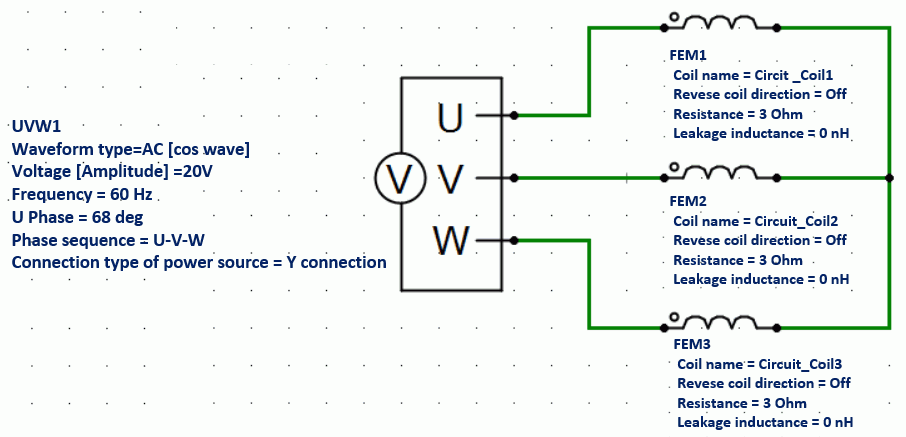
External circuit is as follows.
3-phase AC voltage of 60 [Hz] is applied.
Set the Mesh Tab as follows.
Tab |
Setting Item |
Settings |
Mesh |
Meshing Setup |
Set the general mesh size automatically : Deselect General Mesh Size: 4 [mm] |
Ambient Air Creation |
Select Create ambient air automatically. Ambient Air Scale: 1.2 |
The Transient Analysis tab is set up as follows.
With the settings as below, number of calculation steps is 450, circumferential division angle is 1.0[deg], and rotational quantity per step is 1 [mesh], the rotation up to 450 degrees (=450*1.0*1) is analyzed.
The steps are set until the magnetic field reaches the steady state.
Tab |
Setting Item |
Settings |
|||||
Transient Analysis |
Timestep |
Automatic |
|||||
Table |
|
Fast stabilizer is set up as follows to make the magnetic field reach the steady state in short calculation time.
Tab |
Setting Item |
Settings |
Fast Stabilizer |
Correction Method |
Simplified 3-Phase AC TP-EEC Method |
Coil Name on the External Circuit |
U Coil: Circuit_Coil1 V Coil: Circuit_Coil2 W Coil: Circuit_Coil3 |
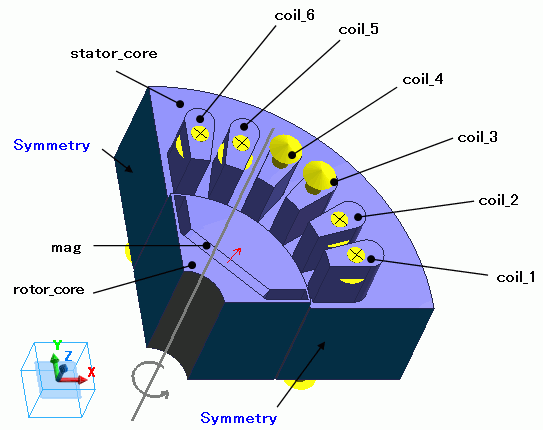
A rotor core and magnet are placed in the center. A stator and coils are placed around them.
This is a 3D analysis of a symmetric quarter model.
Half period rotation boundary (symmetry) is set.
[Create ambient air automatically] is selected.
Adiabatic boundary condition is set on the shaft and the gap between stator and rotor.
Body Number/Type |
Body Attribute Name |
Material Name |
28/Solid |
coil_1 |
Cu |
34/Solid |
coil_2 |
Cu |
35/Solid |
coil_3 |
Cu |
36/Solid |
coil_4 |
Cu |
37/Solid |
coil_5 |
Cu |
38/Solid |
coil_6 |
Cu |
55/Solid |
mag |
mag |
45/Solid |
stator_core |
core |
47/Solid |
rotor_core |
core |
The body attribute is set up as follows.
For the core, the homogenizing method is selected to simulate the layered steel plates.
Body Attribute Name |
Tab |
Settings |
coil_1 |
Current |
Waveform: External Circuit Coupling Coil Name on the Circuit: Circuit_Coil1 Turns: 35 [Turns] Direction: Specify Inflow/Outflow Faces |
Stator/Rotor/Air |
Stator |
|
coil_2 |
Current |
Waveform: External Circuit Coupling Coil Name on the Circuit: Circuit_Coil1 Turns: 35 [Turns] Direction: Specify Inflow/Outflow faces |
Stator/Rotor/Air |
Stator |
|
coil_3 |
Current |
Waveform: External Circuit Coupling Coil Name on the Circuit: Circuit_Coil2 Turns: 35 [Turns] Direction: Specify Inflow/Outflow faces |
Stator/Rotor/Air |
Stator |
|
coil_4 |
Current |
Waveform: External Circuit Coupling Coil Name on the Circuit: Circuit_Coil2 Turns: 35 [Turns] Direction: Specify Inflow/Outflow faces |
Stator/Rotor/Air |
Stator |
|
coil_l5 |
Current |
Waveform: External Circuit Coupling Coil Name on the Circuit: Circuit_Coil3 Turns: 35 [Turns] Direction: Specify Inflow/Outflow faces |
Stator/Rotor/Air |
Stator |
|
coil_6 |
Current |
Waveform: External Circuit Coupling Coil Name on the Circuit: Circuit_Coil3 Turns: 35 [Turns] Direction: Specify Inflow/Outflow faces |
Stator/Rotor/Air |
Stator |
|
mag |
Direction |
Vector: X=1, Y=1, Z=0 |
Stator/Rotor/Air |
Rotor |
|
rotor_core |
Layer |
Select Take into account layer Space Factor: 97 [%] Layer Vector: X=0, Y=0, Z=1 |
Stator/Rotor/Air |
Rotor |
|
stator_core |
Layer |
Select Take layer into account Space Factor: 97 [%] Layer Vector: X=0, Y=0, Z=1 |
Stator/Rotor/Air |
Stator |
The material properties are set as follows.
Material Name |
Tab |
Properties |
|||||||||||||||||||||
Cu |
Conductivity |
Conductivity Type: Conductor Conductivity: 5.977x10⁷ [S/m] |
|||||||||||||||||||||
Thermal Conductivity |
Thermal Conductivity: 398 [W/m/deg] |
||||||||||||||||||||||
mag |
Relative permeability |
Material Type: Permanent Magnet |
|||||||||||||||||||||
Magnet |
Magnetization Characteristic Type: Linear Magnetization Strength: 1.25 Relative Permeability: 1.05 |
||||||||||||||||||||||
Thermal Conductivity |
Thermal Conductivity: 1 [W/m/deg] |
||||||||||||||||||||||
core |
Electric Conductivity |
Conductivity Type: Conductor Conductivity: 1.7 x10⁶ [S/m] |
|||||||||||||||||||||
Permeability |
Magnetization Characteristic Type: Select B-H curve
B-H Curve Table
|
||||||||||||||||||||||
Thermal Conductivity |
Thermal Conductivity: 10 [W/m/deg] |
[Natural convection (automatic coefficient calculation)] is set for the outer boundary condition (given to the surroundings of the motor in the case of the thermal analysis).
Half period symmetric boundary is set.
Adiabatic boundary condition is set on the shaft and the gap between stator and rotor.
Boundary Condition Name/Topology |
Tab |
Boundary Condition Type |
Settings |
Outer Boundary Condition * |
Thermal |
Heat transfer: Convection |
Natural Convection (Automatic Coefficient Calculation) Ambient Temperature: 25 [deg] |
shaft |
Thermal |
Adiabatic |
|
rotor |
Thermal |
Adiabatic |
|
stator |
Thermal |
Adiabatic |
|
Symmetry |
Symmetry/Continuity |
Periodic |
Rotation Period (Half Period) |
To set Outer Boundary Condition, go to the [Model] tab
and click [Outer Boundary Condition]  .
.
The distribution of the magnetic flux density at 450 calculation steps.
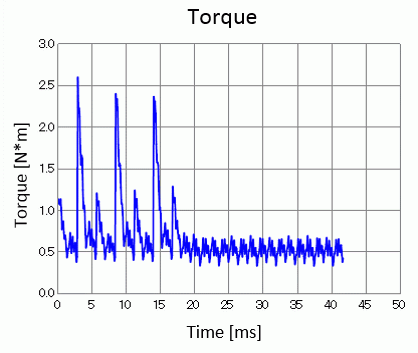
The diagram below shows time-torque characteristics.
Transient state becomes stable at around 20 [ms].
About 0.5[N*m] of torque is obtained.
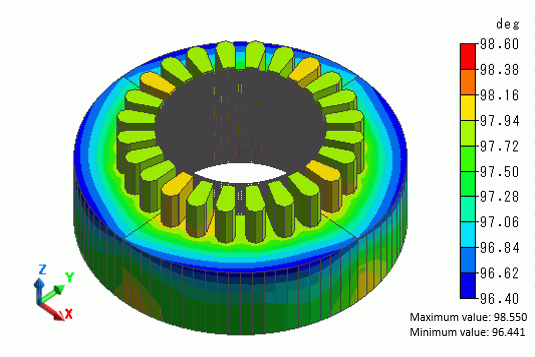
The diagram below shows the temperature distribution of the stator.
In the steady state, it is around 100 [deg].