General
Home / Examples / Acoustic Analysis [Mach] / Example 12: Damping
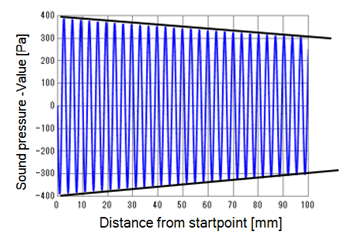
The damping of sound is solved. The imaginary part of sound speed is set to achieve the attenuation rate of 10 [dB/m].
The Harmonic analysis is applied.
Unless specified in the list below, the default conditions are applied.
Item |
Settings |
Solver |
Acoustic Analysis [Mach] |
Analysis Space |
2D |
Analysis Type |
Harmonic Analysis |
Unit |
mm |
Harmonic Analysis tab and Open Boundary tab are set as follows.
Tab |
Setting Item |
Settings |
Harmonic Analysis |
Frequency |
100 [kHz] |
Sweep Setting |
Single Frequency |
|
Mesh |
General Mesh Size |
0.2 |
Element Type |
Rectangle |
Set a speed of 1 [m/s] at the left end and activate the sound wave.
Set the boundary condition of acoustic impedance at the right end to prevent reflection.

Body Number/Type |
Body Attribute Name |
Material Name |
0/Solid |
Attribute_001 |
Damping Material |
Material Name |
Tab |
Setting |
Damping Material |
Sound Speed |
Real Part: 340 [m/s] Imaginary Part: 0.212 [m/s] |
Density |
1.144 [kg/m3] |
Boundary Condition Name/Topology |
Tab |
Boundary Condition Type |
Settings |
v/Edge |
Acoustic |
Speed |
1 [m/s] |
Z/Edge |
Acoustic |
Acoustic Impedance |
Real Part: 388.96 [Pa s/m] Imaginary Part: 0.0242 [Pa s/m] |
The acoustic impedance is set such that the sound wave from the left will pass through without reflection.
Acoustic Impedance =ρc = 1.144x(340+j 0.212)=388.96 + j 0.0242
Based on the target attenuation of 10 [dB/m], the attenuation of 1 [dB] is estimated for the model with a length of 0.1 [m].
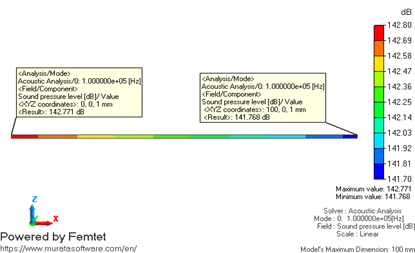
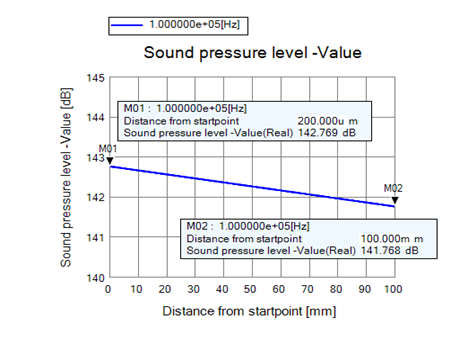
Checking the sound pressure levels.
Left End:142.769 [dB]
Right End:141.768 [dB]
Attenuation Rate1.001 [dB]
The estimated attenuation can be verified.