
Home / Examples / Acoustic Analysis [Mach] / Example 5: Resonance in Cavity
The resonance of sound waves excited in a cavity is analyzed.
The sound waves radiated from the cavity are peaked when the excitation frequency matches the cavity's resonant frequency.
Unless specified in the list below, the default conditions will be applied.
Item |
Settings |
Analysis Space |
Axisymmetric |
Model Unit |
mm |
Item |
Settings |
Solver |
Acoustic Analysis [Mach] |
Analysis Type |
Harmonic Analysis |
Options |
N/A |
The tab setting is listed below.
Tabs |
Setting Item |
Settings |
|
Frequency |
Minimum: 1000 [Hz] Maximum: 10,000 [Hz] |
Harmonic analysis |
Sweep Type |
Division Number: 190 |
|
Sweep Setting |
Select [Fast Sweep]. |
|
|
|
Open Boundary |
Coordinates of Origin |
x = 0 z = 0 |
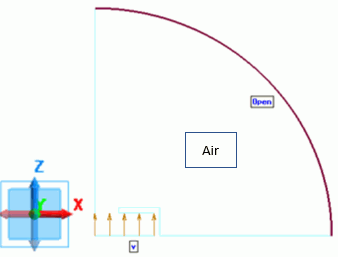
It is axisymmetric, so just right half of the section is created with a sheet body and defined as air. The open boundary is set on the perimeter of the quadrant circle representing the surface of the cavity.
The speed is set as the boundary condition on the bottom of the cavity.
Body Number/Type |
Body Attribute Name |
Material Name |
8/Sheet |
AIR |
000_Air(*) |
* Available from the material DB
The [speed] boundary condition is set on the bottom of the cavity and the [open boundary] condition is set on the perimeter.
Boundary Condition Name/Topology |
Tab |
Boundary Condition Type |
Settings |
v/Edge |
Acoustic |
Speed |
1 [m/s] |
Open/Face |
Acoustic |
Open Boundary |
|
The Figure below is the frequency plot of the sound pressure level [dB] at x=0, z=10.
The peak is at 8.8 [kHz].
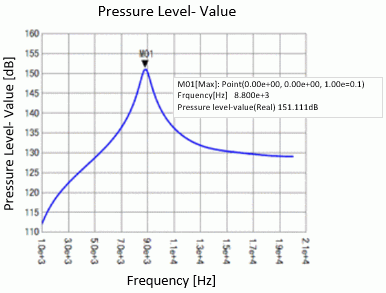
The Helmholtz resonance equation below gives an approximated resonant frequency of 8.69 [kHz].
The value almost coincides with the calculated value.
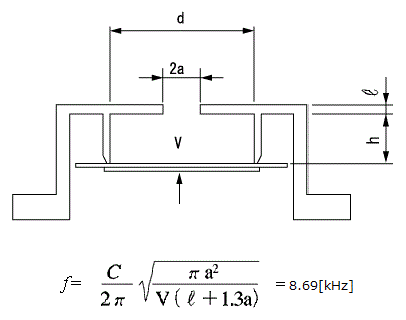 |
| C: Sound speed, V: Volume of cavity |
The gradation contour of the sound pressure level at the driving frequency of 8.8 [kHz] is shown below.
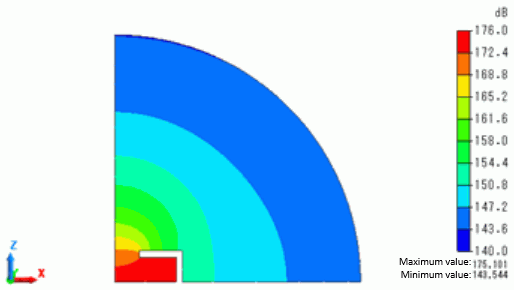
The sound pressure is quite high in the cavity.