General
Home / Examples / Coupled Analysis / Piezoelectric-Acoustic Analysis [Rayleigh/Mach] / Example 3: Fully Coupled Analysis (Sound Wave Drive)
The sound wave is driven in the acoustic domain. The sound pressure is solved as the voltage of the floating electrode on the piezoelectric material.
Item |
Settings |
Analysis Space |
3D |
Model unit |
m |
Item |
Settings |
Solver |
Piezoelectric Analysis [Rayleigh] Acoustic Analysis [Mach] |
Analysis Type |
Harmonic Analysis |
Options |
Select [Fully-coupled Analysis] |
The harmonic analysis tab is set up as follows.
The sound waves propagate outside the analysis domain. Therefore the default open boundary condition below is applied.
Tab |
Setting Item |
Settings |
Harmonic Analysis |
Frequency |
10X103 [Hz] |
Sweep Type |
Single Frequency |
|
Open Boundary Tab |
Type |
Absorbing Boundary |
Order of Absorbing Boundary |
1st-order |
|
Coordinates of Origin |
x = y = z = 0 |
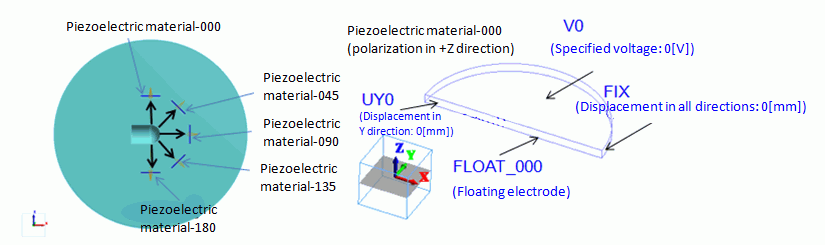
Five semicircle piezoelectric materials are placed around the respiratory sphere used in the example 4. The sound pressure is measured. As shown below, one piezoelectric material has ground and floating electrode. The pressure is detected by the electric potential of the floating electrode.
Body Number/Type |
Body Attribute Name |
Material Name |
4/Solid |
Air |
000_Air(*) |
5/Solid |
Piezoelectric material_000 |
000_P-4 * |
6/Solid |
Piezoelectric material_045 |
000_P-4 * |
7/Solid |
Piezoelectric material_090 |
000_P-4 * |
8/Solid |
Piezoelectric material_135 |
000_P-4 * |
9/Soid |
Piezoelectric material_180 |
000_P-4 * |
* Available from the material DB
Body Attribute Name |
Tab |
Analysis Domain (Solver) |
Piezoelectric material_000 |
Analysis Domain |
Piezoelectric Analysis (Rayleigh) |
Direction |
(x, y, z)=(0, 0, 1) |
|
Piezoelectric material_045 |
Analysis Domain |
Piezoelectric Analysis (Rayleigh) |
Direction |
(x, y, z)=(1, 0, 1) |
|
Piezoelectric material_090 |
Analysis Domain |
Piezoelectric Analysis (Rayleigh) |
Direction |
(x, y, z)=(1, 0, 0) |
|
Piezoelectric material_135 |
Analysis Domain |
Piezoelectric Analysis (Rayleigh) |
Direction |
(x, y, z)=(1, 0, -1) |
|
Piezoelectric material_180 |
Analysis Domain |
Piezoelectric Analysis (Rayleigh) |
Direction |
(x, y, z)=(0, 0, -1) |
|
AIR |
|
Acoustic Analysis (Mach) |
Cautions: In the piezoelectric-acoustic coupled analysis, it is necessary to specify the analysis domain. Specify either piezoelectric analysis or acoustic analysis on the analysis domain tab.
Boundary Condition Name/Topology |
Tab |
Boundary Condition Type |
Settings |
VEL/Face |
Acoustic |
Speed |
1 [m/s] |
Open/Face |
Acoustic |
Open Boundary |
|
FIX |
Mechanical |
Displacement |
UX=0, UY=0, UZ=0 |
UY0 |
Mechanical |
Displacement |
UY=0 |
V0 |
Electric |
Electric Potential |
0 [V] |
FLOAT_000~FLOAT_180 |
Electric |
Floating Electrode |
|
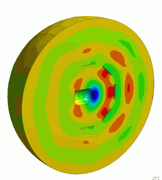
The sound pressure distribution is shown as follows. For comparison purposes, the model with piezoelectric materials removed is shown.
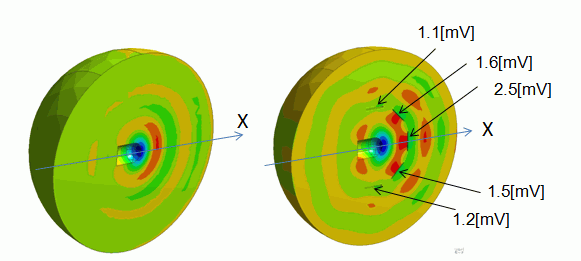
Result 1 (a) The sound pressure distribution of the model with piezoelectric materials removed Result 1 (b) The sound pressure distribution of the model including piezoelectric materials (for reference)
The electric potential of the floating electrodes is shown on the right side of the figure.
We can observe that the sound waves are obstructed by the piezoelectric materials.
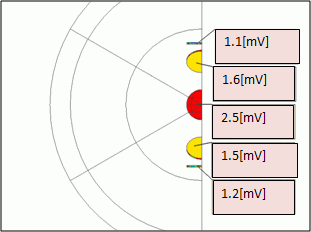
The figure below is the view in the + X direction of the figure above with piezoelectric materials only shown. The colors of the semicircles indicate the electric potential of the floating electrode. The numbers on the right side of the piezoelectric materials are the electric potential of the floating electrode.
The respiratory sphere has a large sound pressure and a large voltage in its front. The voltage corresponding to the sound pressure is obtained.