
General
Home / Examples / Piezoelectric Analysis [Rayleigh] / Example 3: Resonant Analysis
The model is a bar with two reversely polarized piezoelectric plates stuck together. The model is studied in the resonant analysis.
The device's displacement and the resonant frequencies are solved.
Unless specified in the list below, the default conditions will be applied.
Results will vary depending on Femtet version and the PC environment.
Item |
Settings |
Analysis Space |
3D |
Model Unit |
mm |
Item |
Settings |
Solver |
Piezoelectric Analysis [Rayleigh] |
Analysis Type |
Resonant Analysis |
Options |
N/A |
The resonant analysis tab is set up as follows.
Tabs |
Setting Item |
Settings |
Resonant analysis |
Number of Modes |
3 |
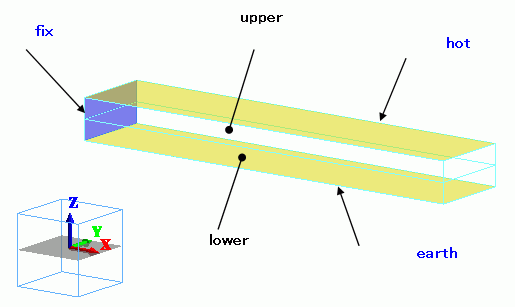
Two solid bodies are created. They are named "upper" and "lower", and reversely polarized.
One end is mechanically fixed. The electric potentials of top and bottom faces are 10 [V] and 0 [V], respectively. The same model as the example 1.
Body Number/Type |
Body Attribute Name |
Material Name |
0/Solid |
upper |
000_P-4 * |
1/Solid |
lower |
000_P-4 * |
* Available from the material DB
The polarizations are set as follows.
Body Attribute Name |
Tab |
Settings |
upper |
Direction |
Vector Specified: Vector: X=Y=0.0, Z=1.0 |
lower |
Direction |
Vector Specified: Vector: X=Y=0.0, Z=-1.0 |
Boundary Condition Name/Topology |
Tab |
Boundary Condition Type |
Settings |
fix/Face |
Mechanical |
Displacement |
Select all UX, UY, and UZ. UX=0, UY=0, UZ=0 |
earth/Face |
Electric |
Electric Wall |
Electric Potential Specified: Electric Potential 0 [V] |
hot/Face |
Electric |
Electric Wall |
Electric Potential Specified: Electric Potential 10 [V] |
To see the calculation results, go to the [Results] tab

and click [Table]  .
.
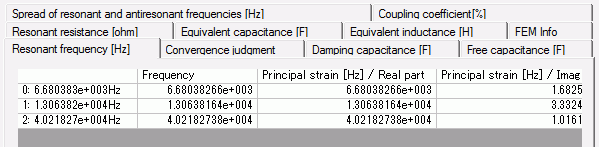
The table below shows the resonant frequencies.
Other characteristics can be seen on other tabs.
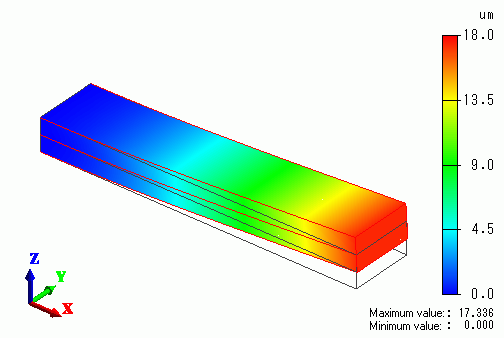
The displacement diagram of Mode[0] is shown below.
The displacement diagram of Mode[1] is shown below.
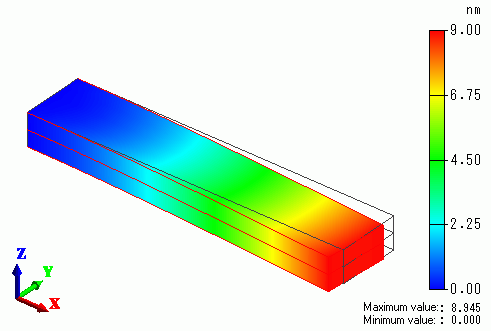
The vibration direction is different from Mode[0]
The displacement diagram of Mode[2] is shown below.
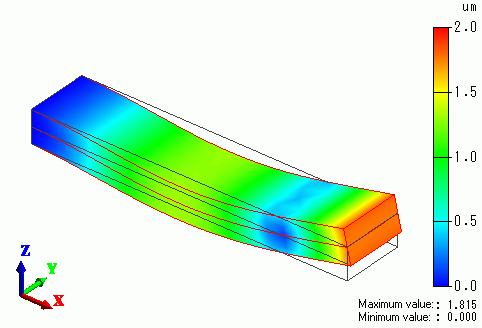
The vibration direction is the same as Mode[0], but the number of nodes are different.