
General
Home / Examples / Piezoelectric Analysis [Rayleigh] / Example 6: Axisymmetric Analysis
An axisymmetric piezoelectric vibrator is analyzed.
Harmonic analysis is performed in the frequency range of 1 to 100 [kHz]. The impedance of the device is solved.
Unless specified in the list below, the default conditions will be applied.
Results will vary depending on Femtet version and the PC environment.
Item |
Settings |
Analysis Space |
Axisymmetric |
Model Unit |
mm |
Use an axisymmetric model for the axisymmetric analysis.
Item |
Settings |
Solver |
Piezoelectric Analysis [Rayleigh] |
Analysis Type |
Harmonic Analysis |
Options |
N/A |
The harmonic analysis tab is set up as follows.
Tab |
Setting Item |
Settings |
Harmonic analysis |
Frequency |
Minimum: 1x10³ [Hz] Maximum: 100x103 [Hz] |
Sweep Type |
Select [Linear Step by Division Number]. Division Number: 200 |
|
Sweep Setting |
Discrete Sweep |
The model is symmetric with reference to x = 0 axis. It consists of sheet bodies.
The "displacement" boundary condition is set on the edge topology.

Body Number/Type |
Body Attribute Name |
Material Name |
0/Sheet |
metal |
104_Stainless_steel * |
1/Sheet |
piezo |
000_P-4 * |
2/Sheet |
metal |
104_Stainless_steel * |
* Available from the material DB
Boundary Condition Name/Topology |
Tab |
Boundary Condition Type |
Settings |
earth/Face |
Electric |
Electric Wall |
Electric Potential Specified: Electric Potential 0 [V] |
hot/Face |
Electric |
Electric Wall |
Electric Potential Specified: Electric Potential 1 [V] |
ux/Edge |
Mechanical |
Displacement |
UX = 0.0[m] |
The calculated impedance characteristics from an S(Y) parameters graph is shown below.
To show dB on the Y axis, select [dB] as the complex number format in the Graph Properties.
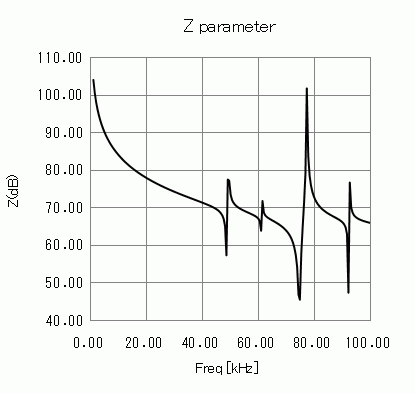
There are four resonances exhibited in the frequency range of 1 [kHz] to 100 [kHz].