Home / Examples / Piezoelectric Analysis [Rayleigh] / Example 26: Floating Electrode
A floating electrode is analyzed.
We will confirm the electric potential of the floating electrode given by the equations of piezoelectricity matches the electric potential obtained by the analysis with Femtet.
The piezoelectric material is deformed by force. The electric potential generated by the deformation is solved.
The electric charge of the floating electrode is 0 [C].
Item |
Settings |
Solver |
Piezoelectric Analysis [Rayleigh] |
Analysis Space |
3D |
Analysis Type |
Static Analysis |
Unit |
mm |
Options |
N/A |
The model is a rectangular solid body. The boundary condition is set on each of the faces.

Body Number/Type |
Body Attribute Name |
Material Name |
0/Solid |
piezo |
000_P-4 * |
* Available from the material DB
Body Attribute Name |
Tab |
Setting |
piezo |
Direction |
Vector Specified Vector: X=Y=0.0, Z=1.0 |
Boundary Condition Name/Topology |
Tab |
Boundary Condition Type |
Setting |
UX0/Face |
Electric |
Magnetic Wall |
|
Mechanical |
Displacement |
Select UX and enter 0.0 |
|
UY0/Face |
Electric |
Magnetic Wall |
|
Mechanical |
Displacement |
Select UY and enter 0.0 |
|
UZ0/Face |
Electric |
Electric Wall |
Electric Potential Specified: Electric Potential 0 [V] |
Mechanical |
Displacement |
Select UZ and enter 0.0 |
|
FLOAT/Face |
Electric |
Electric Wall |
Floating Electrode |
Mechanical |
Free |
|
|
PULL/Face |
Electric |
Magnetic Wall |
|
Mechanical |
Distributed Face Load |
1 [Pa] |
Fig. (a) below shows the distribution of the stress. The stress of 1[Pa] in the X direction is observed. It is generated by applying the face load of 1 [Pa].
We will examine the electric field generated by the mechanical stress using the d-type piezoelectric equation.
D = dT+εE (1)
The stress has only Tx of the X component. Of the d-constants related to the X component of the stress, only d31 has non-zero value. It means there may be a DZ component. But there is a floating electrode and its charge is 0, so DZ is 0.
From equation (1), 0=d31*Tx+εz*Ez is true. The electric field Ez is given by applying the stress (Tx) to the equation. For the material 000P-4 used for this analysis, d31=-0.7e-11[ C/N] and εz=200*ε0.
Ez = -d31*Tx/εz = -(-0.7e-11)*1.0/(200*8.854e-12) = 3.953e-3 [V/m] (2)
Fig (b) shows the calculation result of electric field. It matches the result obtained by the equation (2). Since the electric field in the piezoelectric body is constant, the electric potential difference is obtained by multiplying Ez by the thickness (t = 1 mm).
The electric potential of the floating electrode is given as φ = Ezxt = 3.953e-3 x 1.0e-3 = 3.953e-6 [V].
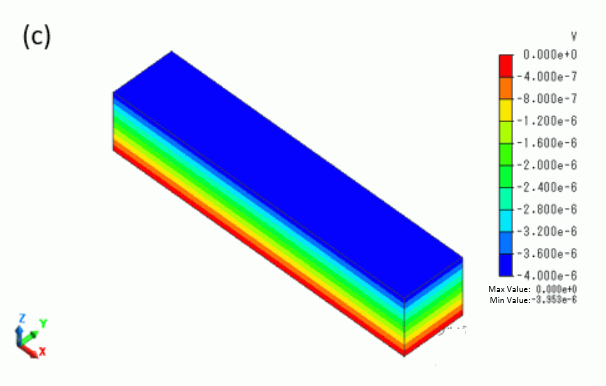
Fig (c) below shows the distribution of electric potential. The minimum value is -3.953e-6. It matches the electric potential obtained in the calculation above.
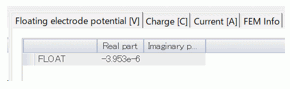
The electric potential of the floating electrode can be confirmed in the result table as well.

Result Table