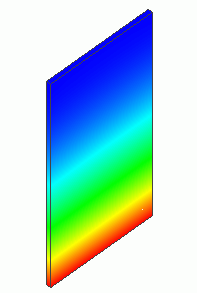
General
Home / Examples / Thermal Analysis [Watt] / Example 5: Heat Radiation by Natural Convection (Steady-State Analysis)
The aluminum plate has its bottom face maintained at a constant temperature. Heat dissipation from the plate by natural convection is analyzed.
The heat transfer coefficient is acquired manually.
To acquire it automatically, see [Example 14: Natural Convection with Correction Coefficient Automatically Calculated].
The temperature distribution and the heat flux vectors are solved.
Unless specified in the list below, the default conditions will be applied.
Results will vary depending on Femtet version and the PC environment.
Item |
Settings |
Analysis Space |
3D |
Model Unit |
mm |
Item |
Settings |
Solver |
Thermal Analysis [Watt] |
Analysis Type |
Steady-state Analysis |
Options |
N/A |
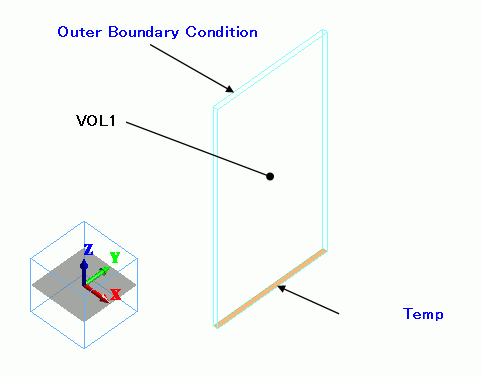
Aluminum plate, defined by a rectangular solid body, is placed vertically. The bottom face is set with the Temperature boundary condition.
The other faces are set with the Heat transfer/Ambient radiation boundary condition.
Body Number/Type |
Body Attribute Name |
Material Name |
0/Solid |
VOL1 |
404 Pure-Al1100 * |
* Available from the material DB
The coefficient for the natural convection is given by the formula below. For the details, please refer to the Thermal tab.
The coefficient can be calculated automatically by selecting [Heat Transfer] > [Natural Convection (Automatic Coefficient Calculation)] for the boundary condition.
2.51×C×(1/L)^(1/4) = 2.50 [W/m2/deg5/4]
where
C = 0.56
L = 0.1
Boundary Condition Name/Topology |
Tab |
Boundary Condition Type |
Settings |
Temp/Face |
Thermal |
Temperature |
80 [deg] |
Outer Boundary Condition |
Thermal |
Heat Transfer: Convection |
Natural convection: 2.50 [W/m2/deg5/4] Ambient Temperature: 25 [deg] |
The temperature distribution is shown below.
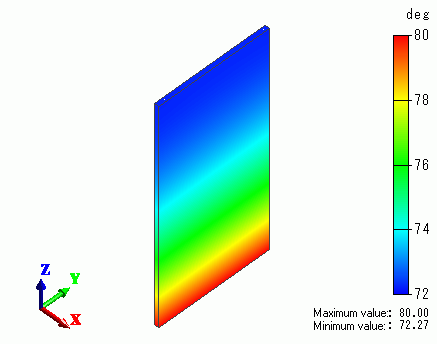
The temperature is 80 [deg] at the bottom face and it decreases gradually to 72 [deg] toward higher places.
The vectors of the heat flux are shown below.
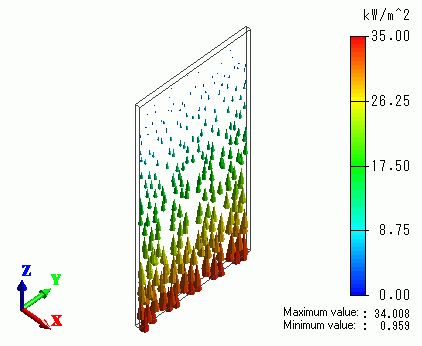
Heat flux vectors point from higher temperature towards lower temperature. Their magnitude indicates the temperature gradient.