
General
Home / Examples / Thermal Analysis [Watt] / Example 11: Blocks Set with Discontinuous Boundary
The [Discontinuous] boundary condition is studied in this example. The model consists of two blocks in contact with each other.
The boundary between the contacting bodies is typically a continuous boundary. Thermal conduction will make a continuous temperature distribution.
When applying the discontinuous boundary condition, thermal conduction is not taken into account, leading to discontinuous temperature distribution.
The temperature distribution and the heat flux vectors are solved.
Unless specified in the list below, the default conditions will be applied.
Results will vary depending on Femtet version and the PC environment.
Item |
Settings |
Analysis Space |
3D |
Model Unit |
mm |
Item |
Settings |
Solver |
Thermal Analysis [Watt] |
Analysis Type |
Steady-state Analysis |
Options |
N/A |
Two rectangular solid bodies are in contact with each other. The [Discontinuous] boundary condition is set at the contact face.
The material is polyethylene. The top and bottom faces are set with the "temperature" boundary condition.
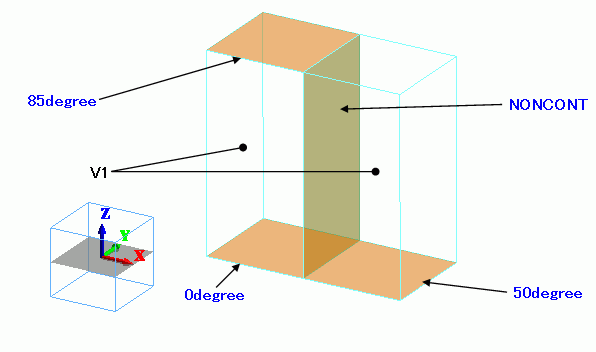
Body Number/Type |
Body Attribute Name |
Material Name |
0/Solid |
V1 |
000_Polyethylene(PE) * |
1/Solid |
V1 |
000_Polyethylene(PE) * |
* Available from the material DB
Boundary Condition Name/Topology |
Tab |
Boundary Condition Type |
Settings |
0degree/Face |
Thermal |
Temperature |
0 [deg] |
50degree/Face |
Thermal |
Temperature |
50 [deg] |
85degree/Face |
Thermal |
Temperature |
85 [deg] |
NONCONT |
Symmetry/Continuity |
Discontinuous |
Discontinuous |
The temperature distribution is shown below.
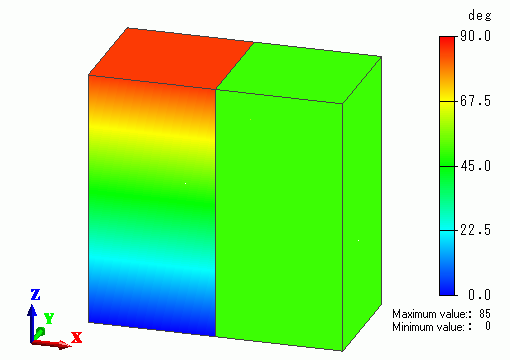
The right body has a uniform temperature of 50 [deg] throughout its entire body, while the left body exhibits a temperature distribution.
There is no heat transfer between the bodies.
For comparison, the [Continuous] boundary condition is set at the contact face. The result is shown below.
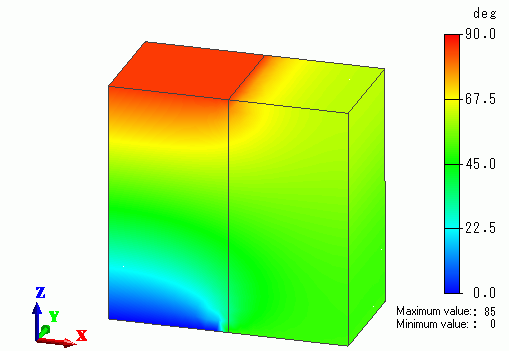
The condition allows heat transfer between the two bodies, resulting in continuous temperature distributions.