General
Home / Examples / Thermal Analysis [Watt] / Example 13: Heat Flux
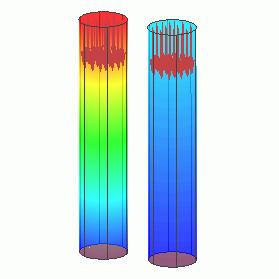
Two rods with different thermal conductivities are placed closely and subjected to the common [Heat Flux] boundary condition.
The temperature distribution and the heat flux vectors are solved.
Unless specified in the list below, the default conditions will be applied.
Results will vary depending on Femtet version and the PC environment.
Item |
Settings |
Analysis Space |
3D |
Model Unit |
mm |
Item |
Settings |
Solver |
Thermal Analysis [Watt] |
Analysis Type |
Steady-state Analysis |
Options |
N/A |
Tab |
Setting Item |
Settings |
Mesh Tab |
Meshing Control |
Select Place middle nodes on the curve to make smooth cylinders. |
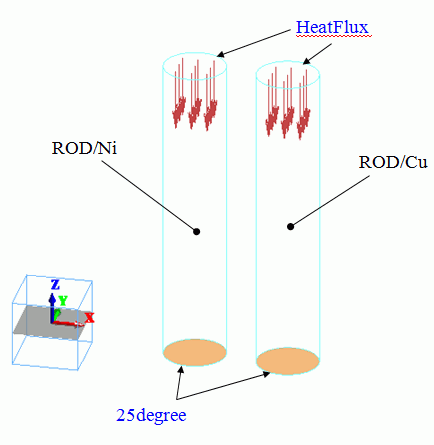
Two cylindrical solid bodies are created. One is of copper and the other is of nickel. Their thermal conductivities are different.
The [Heat Flux] and [Temperature] boundary conditions are set on the top and bottom faces, respectively.
Body Number/Type |
Body Attribute Name |
Material Name |
0/Solid |
ROD |
008_Cu * |
1/Solid |
ROD |
010_Ni * |
* Available from the material DB
Boundary Condition Name/Topology |
Tab |
Boundary Condition Type |
Settings |
25degree/Face |
Thermal |
Temperature |
25 [deg] |
HeatFlux/Face |
Thermal |
Heat Flux |
100000 [W/m2] |
* The positive value means the heat flux directs inward.
The temperature distribution is shown below.
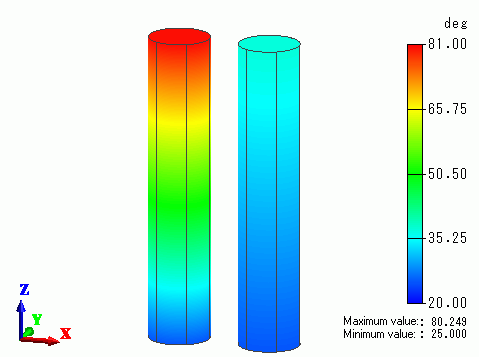
The temperature difference between the top and bottom faces is higher with Ni than Cu.
The vectors of the heat flux are shown below.
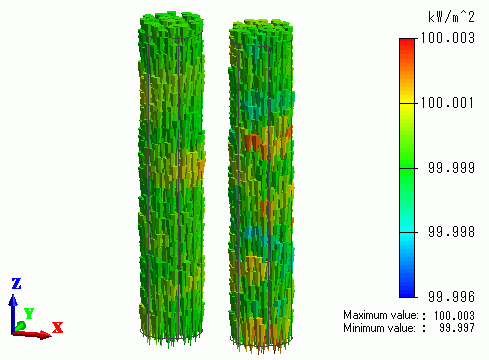
When the heat flux is the same, the temperature gradient is steeper with lower conductive material.