Home / Examples / Thermal Analysis [Watt] / Example 15: Thermal Resistance Set on Boundary Face
This model consists of two bodies. Their interface has thermal resistivity.
The temperature distribution and the heat flux vectors are solved.
Unless specified in the list below, the default conditions will be applied.
Results will vary depending on Femtet version and the PC environment.
Item |
Settings |
Analysis Space |
3D |
Model Unit |
mm |
Item |
Settings |
Solver |
Thermal Analysis [Watt] |
Analysis Type |
Steady-state Analysis |
Options |
N/A |
This model consists two bodies made of aluminum. They share a boundary face.
The thermal resistance is set as a boundary condition on the boundary face. A high temperature is set on the top face of the upper body and a low temperature is set on the bottom face of the other.

Body Number/Type |
Body Attribute Name |
Material Name |
0/Solid |
conductor |
001_Al * |
* Available from the material DB
Boundary Condition Name/Topology |
Tab |
Boundary Condition Type |
Settings |
100degree/Face |
Thermal |
Temperature |
100 [deg] |
0degree/Face |
Thermal |
Temperature |
0 [deg] |
TR/Face |
Thermal |
Thermal Resistance |
0.1 [deg/W] |
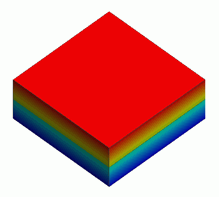
The temperature distribution is shown below.
The temperature changes discontinuously on paths through the boundary face, on which thermal resistance is set.

The vectors of the heat flux are shown below.
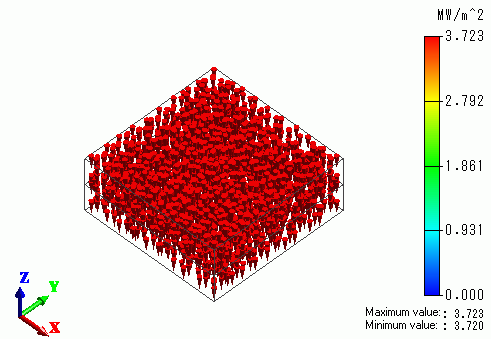
The integral of the heat flux is calculated with Integration on Results Window. Calculation result of the heat transfer on the top face of the body is shown below.
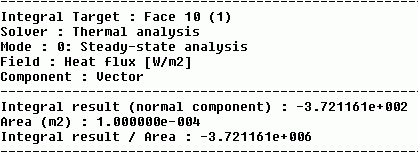
Theoretical value is calculated as shown below. Analysis results almost match with the theoretical value.
Thermal resistance of body [deg/W] = Thickness in the heat flux direction [m] / (cross sectional area [mm^2] x Thermal conductivity [W/m/deg]),
Body dimensions: 10 [mm] x 10 [mm] x 2 [mm], and Thermal conductivity of aluminum: 237 [W/m/deg]
With these, calculation is done as below.
Total thermal resistance = thermal resistance of upper body + thermal resistance at boundary + thermal resistance of lower body
= 2 x 10^-3 / (237 x 100 x 10^-6) + 0.1 + 2 x 10^-3 / (237 x 100 x 10^-6)
= 0.2688 [deg/W]
Overall Heat Transfer [W] = Temperature Difference [deg] / Total Thermal Resistance [deg/W]
= (100 - 0 ) / 0.2688
= 372.02 [W]