General
Home / Examples / Thermal Analysis [Watt] / Example 21: Measurement of Thermal Resistance and Heat Flow Rate with Measuring Terminal Boundary
The model includes a heat body and provide heat radiation from the boundary. The heat flow rate and thermal resistance are solved.
For the second model, the heat flow rate and thermal resistance are solved in a domain using the [Measuring Terminal] boundary condition.
Item |
Settings |
Solver |
Thermal Analysis [Watt] |
Analysis Space |
3D |
Analysis Type |
Steady-state Analysis |
Model Unit |
mm |
Options |
N/A |
Two solid box bodies are defined. One of them is given the body attribute of[heat source], and the other one is given the boundary condition of [heat transfer: convection/ambient radiation].
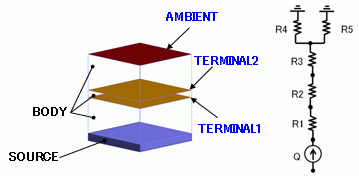
For the second model, the solid body is cut in the middle and [measuring terminal] boundary condition is applied to the sections.
General mesh size is 1.0
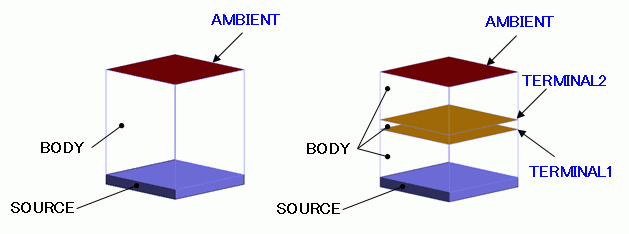
Body Number/Type |
Body Attribute Name |
Material Name |
0/Solid |
BODY |
MAT |
1/Solid |
SOURCE |
MAT_SOURCE |
The heat source of the body attribute [SOURCE] is set as follows.
Body Attribute Name |
Tab |
Settings |
SOURCE |
Heat Source |
0.0011 [W] |
The thermal conductivity of the material properties [MAT], [MAT_SOURCE] are set as follows.
Material Name |
Tab |
Settings |
MAT |
Thermal Conductivity |
0.01 [W] |
MAT_SOURCE |
Thermal Conductivity |
100 [W] |
Boundary Condition Name/Topology |
Tab |
Boundary Condition Type |
Settings |
AMBIENT/Face |
Heat |
Heat Transfer/Convection |
Select Natural Convection (Automatic Coefficient Calculation) |
| Radiation Type: Ambient (Speed Prioritized) | Select Individual Setting Ambient Temperature: 25 [deg] |
||
TERMINAL1/Face (for Model 2 only) |
Heat |
Measuring Terminal |
N/A |
TERMINAL2/Face (for Model 2 only) |
Heat |
Measuring Terminal |
N/A |
The vector diagrams of the heat flux of the Models 1 and 2 are shown below. The unit of the color scale is [W/m2].
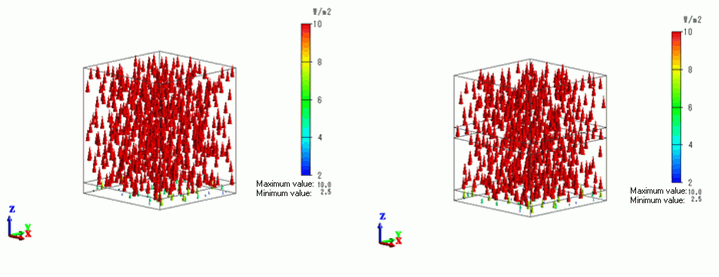
Compared with the Model 1, the Model 2 has [Measuring terminal] added as the boundary condition. The result is not different from the Model 1.
The heat flux of 10 [W/m2] is exhibited in the BODY.
The heat flow rate in the BODY is 0.001 [W] based on the cross sectional area of 100 [mm].
All heat of the heat source of 0.001 [W] is flowing upward.
The heat flow rate of the Model 1 is shown in the table below.
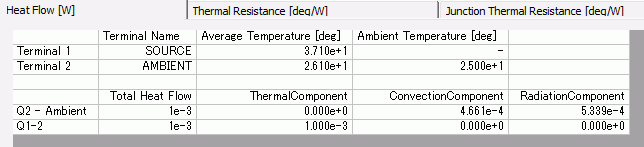
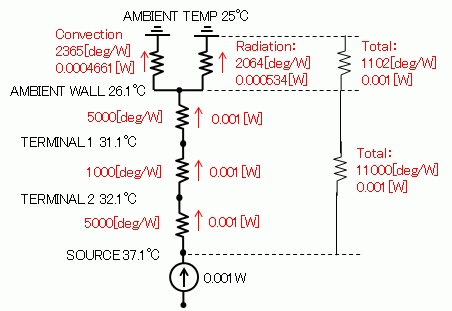
At Q1-2, the heat flow rate from the heat source body SOURCE (Terminal 1) to the boundary AMBIENT (Terminal 2) is 0.001 [W].
At Q1-Ambient, the heat flow rate from the boundary AMBIENT (Terminal 2) to the ambient is 0.001 [W].
As natural convection and ambient radiation are set concurrently as boundary conditions, their details are also shown.
The heat flow rate of the Model 2 is shown in the table below.
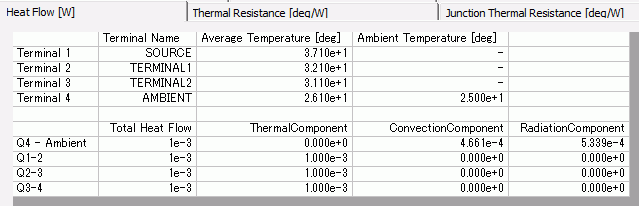
At Q1-2, the heat flow rate from the heat source body SOURCE (Terminal 1) to the measuring terminal TERMINAL1 (Terminal 2) is 0.001 [W].
At Q2-3, the heat flow rate from the measuring terminal TERMINA1 (Terminal 2) to the measuring terminal TERMINAL2 (Terminal 3) is 0.001 [W].
At Q3-4, the heat flow rate from the measuring terminal TERMINAL2 (Terminal 3) to the boundary AMBIENT (Terminal 4) is 0.001 [W].
The thermal resistance of the Model 1 is shown in the table below.
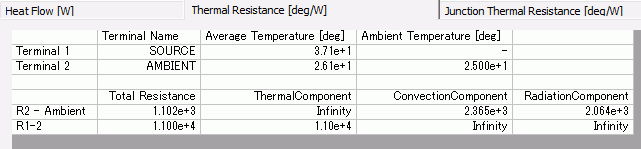
At R1-2, the thermal resistance is 11000 [deg/W] between the heat source body SOURCE (Terminal 1) and the boundary AMBIENT (Terminal 2).
With thermal conductivity: 0.01 [W/m/deg], thickness: 11 [mm], and cross section: 100 [mm],
the theoretical value is 11 x 1e-3 / ( 0.01 * 100 x 1e-6 ) = 11000 [deg/W].
The results and the theoretical value match.
At R2-Ambient, the thermal resistance is 1102[deg/W] across the boundary AMBIENT (Terminal 2) and the ambient.
As natural convection and ambient radiation are set concurrently as boundary conditions, their details are also shown.
The thermal resistance of the Model 2 is shown in the table below.
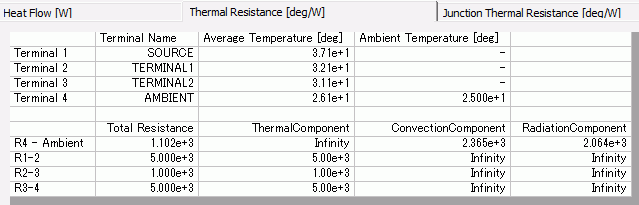
The thermal resistance between the heat source body SOURCE (Terminal 1) and the boundary AMBIENT (Terminal 2) of the Model 1
is divided at the measuring terminals and each detail of the thermal resistance is shown.
At R1-2, the thermal resistance is 5000[deg/W] between the heat source body SOURCE (Terminal 1) and the measuring terminal TERMINAL1 (Terminal 2).
At R2-3, the thermal resistance is 1000[deg/W] between the measuring terminal TERMINAL1 (Terminal 2) and the measuring terminal TERMINAL2 (Terminal 3).
At R3-4, the thermal resistance is 5000[deg/W] between the measuring terminal TERMINAL2 (Terminal 3) and the boundary AMBIENT (Terminal 4).
The results are reasonable considering each thickness is 5 [mm], 1 [mm], and 5 [mm].
The equivalent circuit of the results is shown as follows.