General
Home / Examples / Thermal Analysis [Watt] / Example 23: Multilayer Thermal Conductive Sheets
An analysis model is an alumina substrate, on which copper, nickel, and gold are plated. A thermal analysis is performed.
The temperature distribution, the thermal resistance between the temperature boundaries, and the heat flux distribution are solved.
Unless specified in the list below, the default conditions will be applied.
Results will vary depending on Femtet version and the PC environment.
Item |
Settings |
Solver |
Thermal Analysis [Watt] |
Analysis Space |
3D |
Analysis Type |
Steady-State Analysis |
Unit |
mm |
Options |
None |
An alumina substrate is created by a box. A sheet body is created on the upper face of the box. Copy the sheet body twice making it three.
Each sheet body is given copper, nickel, and gold as material property. They are also given thickness as a body attribute.
The sample project contains, in addition to the one with electrodes of sheet bodies, a model whose electrodes are made of solid bodies and a model without electrodes, for comparison purposes.
The temperature boundary condition for the two models is 0 deg and 100 deg at the ends of the substrate.

Multilayer Sheet Model
Body Number/Type |
Body Attribute Name |
Thickness of Sheet Body |
Material Name |
0/Solid |
Substrate |
|
001_Alumina * |
4/Sheet |
Electrode1 |
20×10-3 [mm] |
008_Cu (*) |
5/Sheet |
Electrode2 |
5×10⁻³[mm] |
010_Ni * |
6/Sheet |
Electrode2 |
5×10⁻³ [mm] |
002_Au * |
* Available from the material DB
Multilayer Solid Model (Thickness is same as that of sheet body)
Body Number/Type |
Body Attribute Name |
Material Name |
0/Solid |
Substrate |
001_Alumina * |
4/Solid |
Electrode1 |
008_Cu (*) |
5/Solid |
Electrode2 |
010_Ni * |
6/Solid |
Electrode2 |
002_Au * |
* Available from the material DB
Boundary Condition Name/Topology |
Tab |
Boundary Condition Type |
Settings |
100degree/Face |
Thermal |
Temperature |
100 [deg] |
0degree/Face |
Thermal |
Temperature |
0 [deg] |
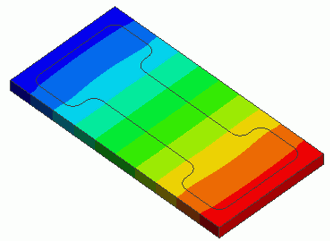
The temperature distribution and the thermal resistance across the two temperature boundaries are shown below. The unit of the color scale is [deg].


For both multilayer sheet model and multilayer solid model, the thermal conductivity of the electrodes is higher than the substrate. Their thermal resistance is lower than that of the substrate-only model.
Since the thermal conductivity is especially high on the wider areas at the ends of the electrode, the temperature gradient is low.
The number of element divisions is 24640 for the sheet body, and 54576 for the solid body.
The sheet model gives the results comparable to that of the solid model at the smaller calculation load.
The contour diagram of the heat flux is shown below. The unit of the color scale is [MW/m2].
The results of the multilayer sheet model is as follows.
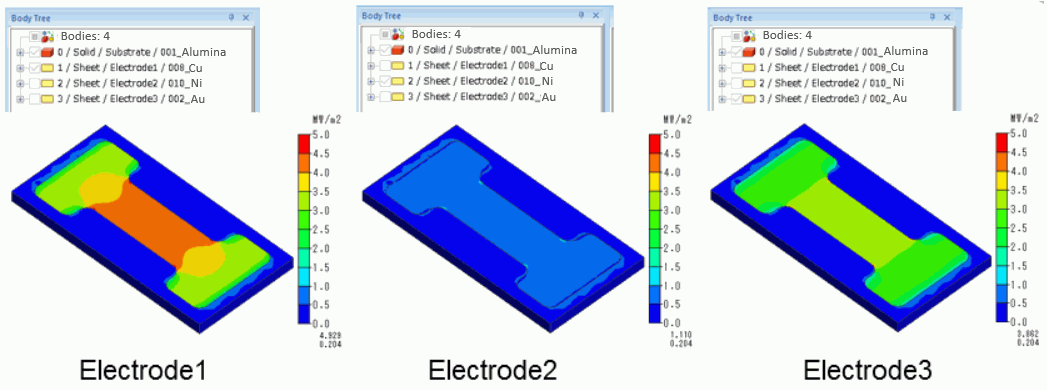
The results of the multilayer solid model is as follows.

The multilayer sheet model and the multilayer solid model show almost the same heat flux density.
The thermal conductivity of Cu (Electrode1) and Au (Electrode3) is high and their heat flux is higher than Ni (Electrode2). Their heat flow density is higher as well.
As the sheet bodies of the model are overlapping, the contour display of each sheet will overlap if they are output at the same time.
Select the body only of your interest on the body tree to see the results.
(Note)
If multiple sheet bodies are created on the surface of a solid body, they will work as multilayer thermal conductive sheets.
The thermal conduction in the face direction can be analyzed with the multilayer sheet model the same way as the multilayer solid model.
The layer structure is not taken into account in the thermal conduction in the thickness direction. The thermal resistance is considered to be zero. The sheet body, therefore, is not suitable if prominent temperature gradient occurs due to the thermal conduction in the thickness direction.
To take into account the temperature gradient of the heat conductivity in the multilayer direction, use the solid body.
To use Mesher G1, the multilayer sheet body must be the same form. (The body form is irrelevant in the case of Mesher G2.)