General
Home / Examples / Thermal Analysis [Watt] / Example 25: Periodic Boundary
Home/Examples/Thermal Analysis [Watt]/Example 25: Periodic Boundary
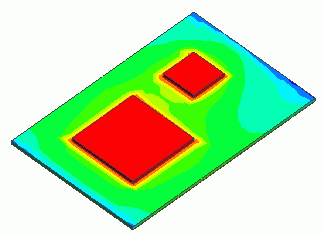
The thermal analysis using the periodic boundaries is explained here.
The temperature distribution and the heat flux vectors are solved.
Unless specified in the list below, the default conditions will be applied.
Results will vary depending on Femtet version and the PC environment.
Item |
Settings |
Solver |
Thermal Analysis [Watt] |
Analysis Space |
3D |
Analysis Type |
Steady-state Analysis |
Unit |
mm |
Analysis Options |
None |
Body Number/Type |
Body Attribute Name |
Material Name |
Mesh Size |
0/Solid |
SUB |
006_Glass_epoxy *1 |
|
1/Solid |
GND |
008_Cu *1 |
|
2/Solid |
MAINCHIP |
001_Alumina *2 |
|
3/Solid |
SUBCHIP |
001_Alumina *2 |
|
4/Solid |
HOLE |
008_Cu *1 |
0.5 |
5/Solid |
HOLE |
008_Cu *1 |
0.5 |
6/Solid |
HOLE |
008_Cu *1 |
0.5 |
7/Solid |
HOLE |
008_Cu *1 |
0.5 |
8/Solid |
HOLE |
008_Cu *1 |
0.5 |
9/Solid |
HOLE |
008_Cu *1 |
0.5 |
10/Solid |
HOLE |
008_Cu *1 |
0.5 |
11/Solid |
HOLE |
008_Cu *1 |
0.5 |
*1 Available from the material DB.
Boundary Condition Name/Topology |
Tab |
Boundary Condition Type |
Setting |
Outer Boundary Condition |
Thermal |
Heat Transfer: Convection |
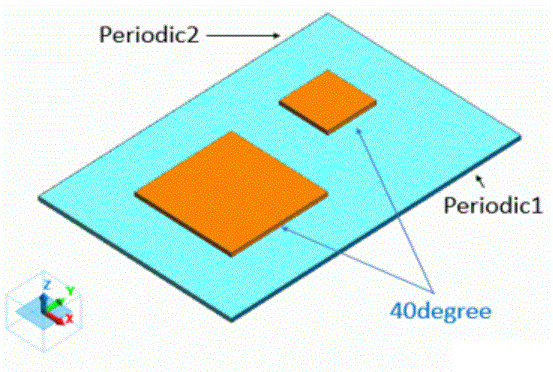
Natural Convection (Automatic Coefficient Calculation) Room Temperature: 25 [deg] |
t40 |
Thermal |
Temperature |
40 [deg] |
Periodic1 |
Symmetry/Continuity |
Periodic |
|
Periodic2 |
Symmetry/Continuity |
Periodic |
|
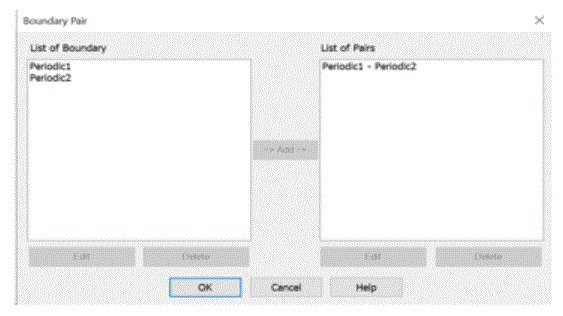
“Periodic1” and “Periodic2” are set to be a periodic boundary pair.
Select [Natural Convection (Automatic Coefficient Calculation)] on the outer boundary condition.
* The correction coefficient for the natural convection is calculated automatically. See [Heat Transfer: Ambient Radiation] for more information.
The temperature diagram is shown as below.
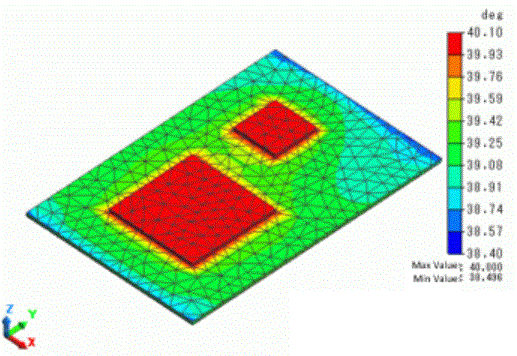
You can see the temperature is the same on the faces with periodic boundaries.