Home / Examples / Thermal Analysis [Watt] / Example 28: Thermal Resistance with Heat Sink (Steady-state Analysis)
The IC that generates constant heat is cooled with the heat sink having a known thermal resistance. The heat dissipation by natural convection is solved in the steady-state analysis.
The temperature distribution and the heat flux vectors are solved.
Unless specified in the list below, the default conditions are applied.
Results will vary depending on Femtet version and the PC environment.
Item |
Setting |
Analysis Space |
3D |
Model Unit |
mm |
Item |
Setting |
Solver |
Thermal Analysis [Watt] |
Analysis Type |
Steady-state Analysis |
Analysis Options |
None |
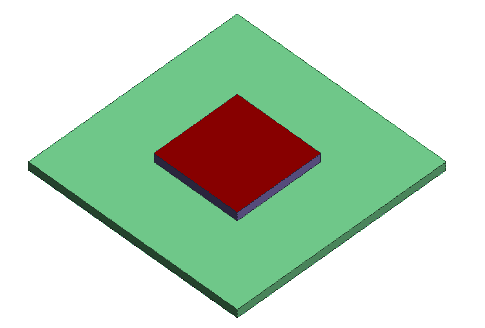
A substrate (VOL1) and an IC (VOL2) are solid bodies.
Natural convection is set for the outer boundary condition.
The boundary condition [Heatsink] is set to the top of the VOL2 to analyze the heat transfer of the heat sink.
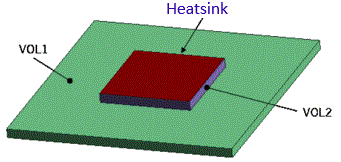
Body Number/Type |
Body Attribute Name |
Material Name |
Mesh Size |
0/Solid |
VOL1 |
006_Glass_epoxy * |
2.0 |
1/Solid |
VOL2 |
001_Alumina * |
2.0 |
* Available from the material DB
IC (VOL2) is set as follows on the Heat Source tab.
Body Attribute Name |
Tab |
Setting |
VOL2 |
Heat Source |
1 W |
The boundary conditions are set as follows:
Boundary Condition Name/Topology |
Tab |
Boundary Condition Type |
Setting |
Outer Boundary Condition |
Thermal |
Heat Transfer: Convection |
Natural Convection (Automatic Coefficient Calculation) Room Temperature (Ambient Temperature): 25 [deg] |
BC_Heatsink/Face |
Thermal |
Heat Transfer: Convection |
Heat Sink Thermal Resistance: 17 [deg/W] Room Temperature (Ambient Temperature): 25 [deg] |
The temperature distributions of the substrate and IC are shown below.
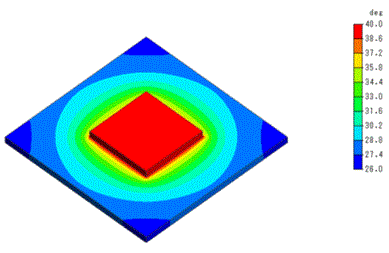
The surface temperature of the IC is 40 deg. Removing the boundary condition [Heat Sink] and setting the outer boundary condition to natural convection (automatic coefficient calculation), the surface temperature of the IC rises to 93 deg.
This shows that the heat sink is dissipating heat.