|
Home / Examples / Coupled Analysis / Fluid-Thermal Analysis [Bernoulli/Watt] / Example 17: Static Mixer
Example 17: Static Mixer
General
-
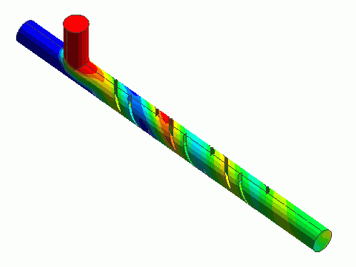
The mixing process, with a static mixer, of waters having different temperatures is analyzed.
-
The fluid flows in with a mole fraction of 0% from the first inlet and a mole fraction of 100% from the second inlet.
-
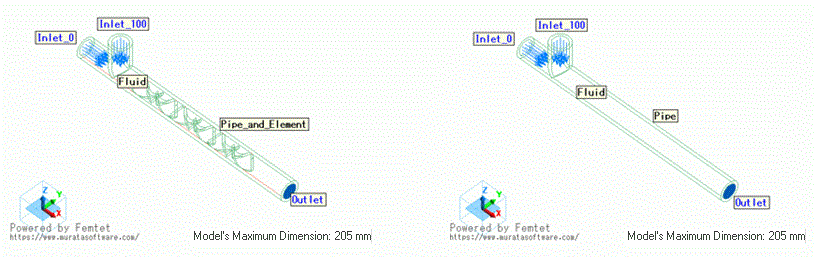
The static mixer has a portion, referred to as "Element", inside its pipe. The Element promotes the mixing.
-
The degree of mixing is compared between with and without the Element.
-
Unless specified in the list below, the default conditions will be applied.
-
Obtain this session's project file. (Right-click and choose 'Save link as')
-
Results will vary depending on Femtet version and the PC environment.
Analysis Space
|
Item |
Settings |
|
Analysis Space |
3D |
|
Model Unit |
mm |
Analysis Conditions
|
Item |
Tab |
Settings |
|
Solver |
Solver Selection |
Fluid Analysis [Bernoulli] Thermal Analysis [Watt] |
|
Analysis Type |
Fluid-Thermal Analysis |
Steady-state Analysis |
|
Ambient Temperature |
Fluid-Thermal Analysis |
Ambient Temperature: 0 [deg] |
|
Meshing Setup |
Mesh |
General Mesh Size: 2.0 [mm] |
Model
Compare the model that has a portion, referred to as "Element", along the flow path in the pipe and the model that does not.
Body Attributes and Materials Setting
|
Body Number/Type |
Body Attribute Name |
Material Name |
|
19/Solid |
Fluid |
100_Water * |
|
23/Solid(with the Element) |
Pipe_and_Element |
001_Al * |
|
22/Solid(without the Element) |
Pipe |
001_Al * |
* Available from the material DB
Boundary Condition
|
Boundary Condition Name/Topology |
Tab |
Boundary Condition Type |
Settings |
|
Inlet_0/Face |
Fluid |
Inlet |
Forced Inflow Flow Velocity: 1 [m/s] Fluid Temperature Select Use Ambient Temperature. |
|
Inlet_0/Face |
Fluid |
Inlet |
Forced Inflow Flow Velocity: 1 [m/s] Fluid Temperature Select [Direct Entry]. 100 [deg] |
|
Outlet/Face |
Fluid |
Outlet/Outlet |
Natural Inflow/ Natural Outflow |
Results
The temperature of diffusing materials and the streamlines are displayed below.
For the model with the Element, the fluids having lower and higher temperatures, respectively, swirl along the Element.
|
With the Element |
Without the Element |
|
|
|
|
|
|
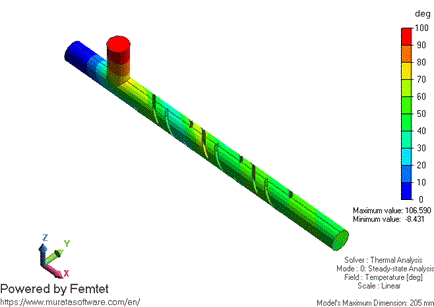
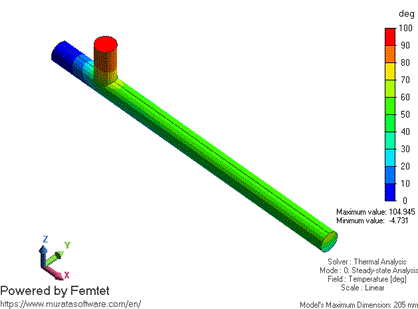
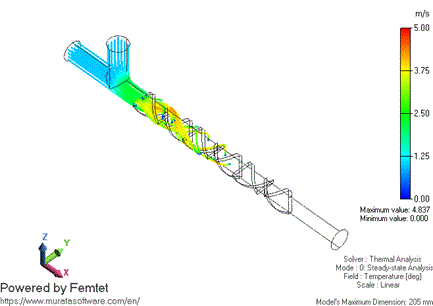
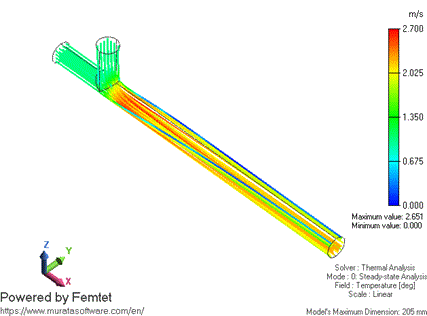
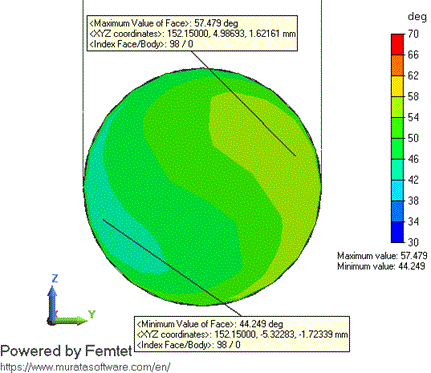
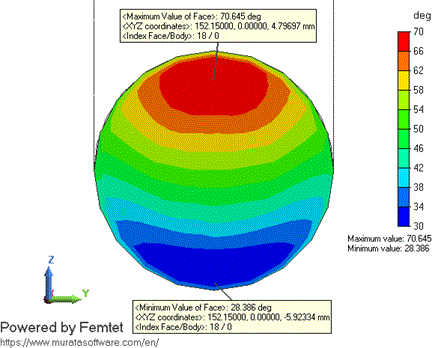
The distribution of temperature at the outlet is displayed.
The temperatures are in the range of 29 to 70 degrees without the Element and 43 to 59 degrees with the Element. This indicates the Element enhances the mixing.
|
With the Element |
Without the Element |
|
|
|