


|
Home / Examples / Electric Analysis [Coulomb] / Example 11: Conductor's Resistance
Example 11: Conductor's Resistance
General
-
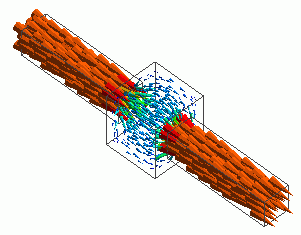
A conductor bar that has a swelling in the middle compared to both ends is analyzed.
-
The resistance and the current density are solved.
-
Unless specified in the list below, the default conditions will be applied.
-
Obtain this session's project file. (Right-click and choose 'Save link as')
-
Results will vary depending on Femtet version and the PC environment.
Analysis Space
|
Item |
Settings |
|
Analysis Space |
3D |
|
Model Unit |
mm |
Analysis Conditions
To calculate the resistance, select Conductor at Material Type.
|
Item |
Settings |
|
Solver |
Electric Analysis [Coulomb] |
|
Analysis Type |
Static Analysis (Resistance) |
|
Options |
N/A |
Model
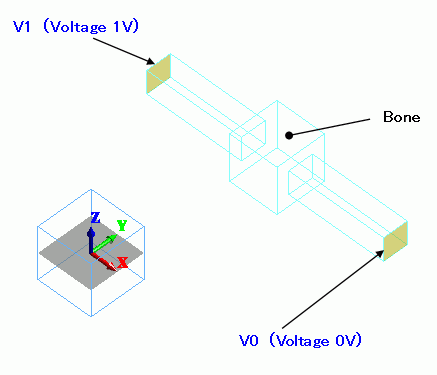
Create the bar by performing the boolean operations on the box-shaped solid bodies.
Electrodes are set on the I/O faces of the current with the electric wall boundary condition.
The electric potential is applied to the electrodes.
Body Attributes and Materials
Select the aluminum for the material.
|
Body Number/Type |
Body Attribute Name |
Material Name |
|
3/Solid |
Bone |
001_Al * |
* Available from the material DB
Boundary Conditions
|
Boundary Condition Name/Topology |
Tab |
Boundary Condition Type |
Settings |
|
V0/Face |
Electric |
Electric Wall |
Electric Potential Specified 0 [V] |
|
V1/Face |
Electric |
Electric Wall |
Electric Potential Specified 1 [V] |
Results
By clicking the [Resistance] tab on the table, the resistance R1-2 between the face of electrode 1 (with boundary condition V0) and
the face of electrode 2 (with boundary condition V1) is confirmed to be 2.33×10⁻⁴ [Ω].
The vectors of the current density are shown below.
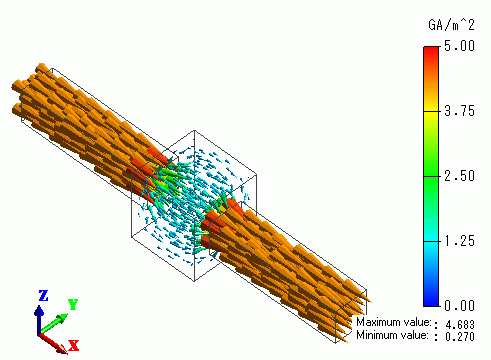
The current density is low at the thick portion.