


|
Home / Examples / Stress Analysis [Galileo] / Example 13: Resonance of Tuning Fork
Example 13: Resonance of Tuning Fork
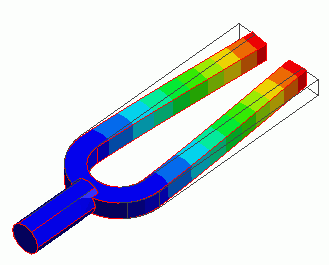
General
-
The resonance of a tuning fork is analyzed.
-
The state of deformation and the distributions of the displacement and stress are solved.
-
Unless specified in the list below, the default conditions will be applied.
-
Obtain this session's project file. (Right-click and choose 'Save link as')
-
Results will vary depending on Femtet version and the PC environment.
Analysis Space
|
Item |
Settings |
|
Analysis Space |
3D |
|
Model Unit |
m |
Analysis Conditions
The analysis type is the harmonic analysis.
|
Item |
Settings |
|
Solver |
Stress Analysis [Galileo] |
|
Analysis Type |
Resonant Analysis |
|
Options |
N/A |
The resonant analysis tab is set up as follows.
|
Tab |
Setting Item |
Settings |
|
Resonant analysis |
Number of Modes |
6 |
|
Approximated Frequency |
0 [Hz] |
Model
A tuning fork is created by combining cylindrical and rectangular solid bodies with boolean.
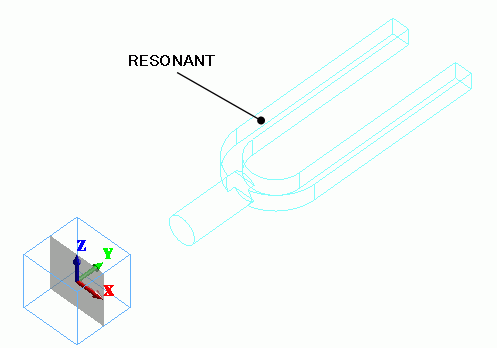
Body Attributes and Materials
|
Body Number/Type |
Body Attribute Name |
Material Name |
|
8/Solid |
RESONANT |
001_Al * |
* Available from the material DB
Boundary Conditions
N/A
Results
The following will be output on the output window or the log file.
|
<<Eigenvalue analysis>> Eigenvalue (resonant frequency):[Hz] Mode[ 0] = 5.06139730e+002 Mode[ 1] = 7.76589632e+002 Mode[ 2] = 1.58726071e+003 Mode[ 3] = 1.92468740e+003 Mode[ 4] = 3.15995476e+003 Mode[ 5] = 4.14822255e+003 |
The resonant frequencies can be checked on Table.
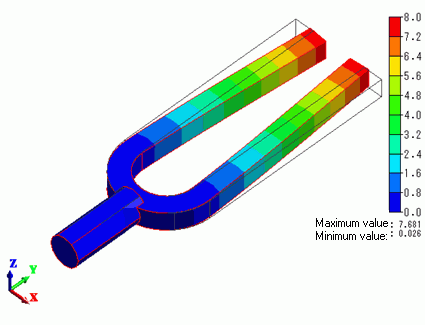
The displacement of the basic resonant mode, Mode[0], is shown below. The contour indicates the magnitude of the displacement.
The displacement of the high-order mode, Mode[1], is shown below. The contour indicates the magnitude of the displacement.
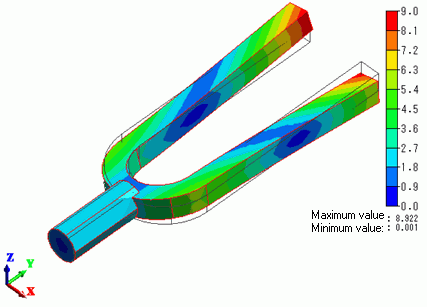
Mode[0] and Mode[1] exhibit completely different resonance.