|
Home / Examples / Coupled Analysis / Magnetic-Thermal-Fluid Analysis [Gauss/ Bernoulli/Watt] / Example 2: Heating due to the Iron Loss (Magnetic-Thermal-Fluid Analysis)
Example 2: Heating due to the Iron Loss (Magnetic-Thermal-Fluid Analysis)
General
-
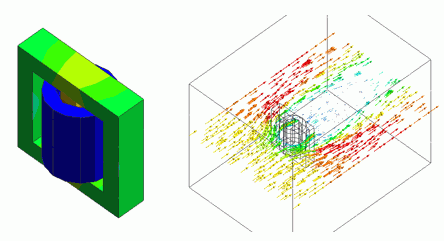
A coil is wound on a core. The heating due to the iron loss is analyzed with Magnetic field-Thermal-Fluid Coupled Analysis.
-
Computes flow and temperature under a constant flow velocity.
-
The vectors of the magnetic field, the loss in the core, and the temperature/flow velocity distribution by the heating are solved.
-
Unless specified in the list below, the default conditions are applied.
-
Results will vary depending on Femtet version and the PC environment.
Analysis Model Download
-
Project file Download (Save the project file before open. Femtet 2026 or later is required.)
Analysis Space
|
Item |
Subject |
|
Analysis Space |
3D |
|
Model Unit |
mm |
Analysis Condition
|
Item |
Tab |
Settings |
|
Solver |
Solver Selection |
Magnetic Analysis [Gauss] Fluid Analysis [Bernoulli] Thermal Analysis [Watt]
Select [Buoyancy] and [Temperature] |
|
Magnetic-Analysis Type |
Magnetic/Thermal Analysis |
Harmonic analysis |
|
Fluid-Thermal Analysis Tab/Analysis Type |
Thermal-Fluid Analysis |
Steady-state analysis |
|
Options |
Thermal-Fluid Analysis |
Flow Type External Flow Velocity: 1 m/s |
The frequency of the current is set to 50 [kHz].
|
Tab |
Item |
Subject |
|
Mesh |
Frequency-Dependent Meshing |
Reference Frequency: 50x103 [Hz] Surface Treatment for Conductors: Generate skin meshes |
|
Harmonic analysis |
Frequency |
Sweep Type: Single Frequency Frequency: 50 x 103[Hz] |
Model
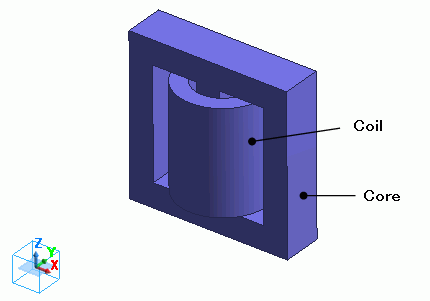
A coil is wound on a core.
The bodies of a core (Core) and a loop coil (Coil) are defined.
Body Attribute and Material Setting
|
Body Number/Type |
Body Attribute Name |
Material Name |
|
5/Solid |
Coil2 |
008_Cu * |
|
7/Solid |
Coil1 |
008_Cu * |
|
6/Solid |
Core |
Core |
(*) Available from the material DB
Body attribute is set up as follows to apply current to the loop coil.
|
Body Attribute Name |
Tab |
Setting |
|
Coil |
Current |
Waveform: AC Current: 0.1 [A] Turns: 100 [Turns] Induced Current: None Direction: Loop Coil/Magnetic Field Direction: Direction Vector of Magnetic Field: X=0, Y=0, Z=1 |
The material properties of the core are set up as follows. The loss is defined in the iron loss table.
|
Material Name |
Tab |
Settings |
|||||
|
Core |
Permeability |
Relative Permeability: 3000 |
|||||
|
Electric Conductivity |
Conductivity Type: Conductor Conductivity: 0.1 [S/m] |
||||||
|
Thermal Conductivity |
Thermal Conductivity: 10 [W/m/deg] |
||||||
|
Iron loss |
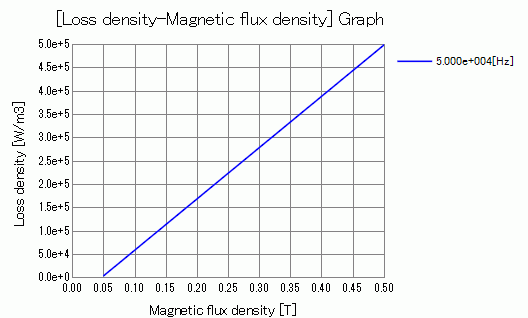
Iron Loss Calculation Type: Iron loss table Frequency: 5 x 10⁴[Hz] [Magnetic Flux Density-Loss Density] Table *
* This is not the actual material's property. |
Press the Graph button. The following graph will show up.
Results
To see the iron loss, go to the [Results] tab

and click [Show Numerical Summary Table]  .
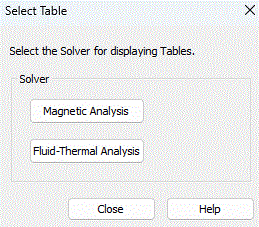
Select Magnetic Analysis.
The joule loss is shown below.
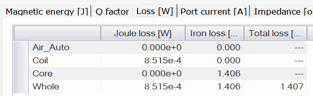
The iron loss is shown below.
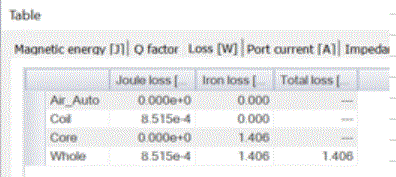
The core's iron loss is approximately 0.9 [W].
The joule loss and the hysteresis loss of the core are not given because the the material property is defined on the iron loss table.
The loss characteristics are defined in the iron loss table. Only iron loss is obtained.
If it is defined by the iron loss experimental formula, the joule loss and the hysteresis loss will be output as well.
See [Loss Calculation in the Magnetic Analysis] for details of the loss.
The vectors of the magnetic flux density are shown below.
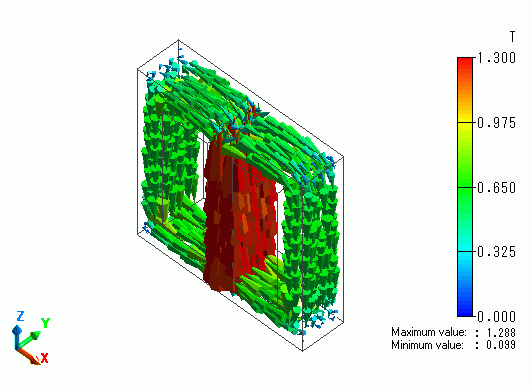
The flux density is looping through the core.
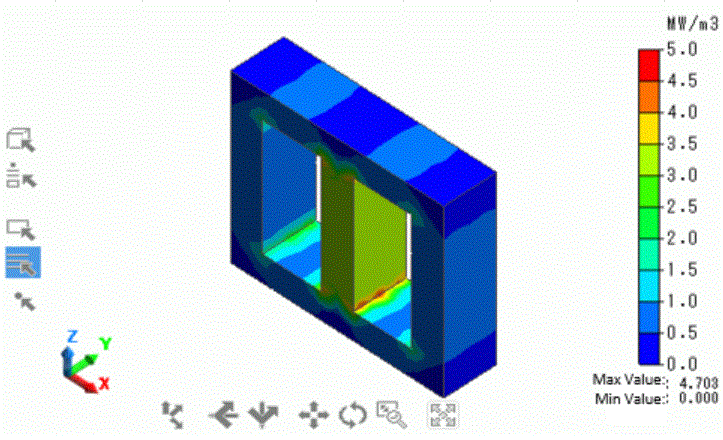
The iron loss density is shown below.
Show the results of the Thermal-Fluid analysis.
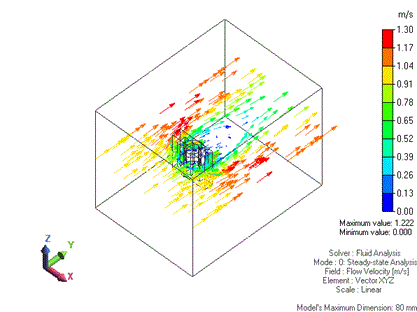
The result of the flow velocities is shown below. The cross section at Z=0 is displayed.
Air flowing from the -Y direction is obstructed by the coil and core and is diverted around them.
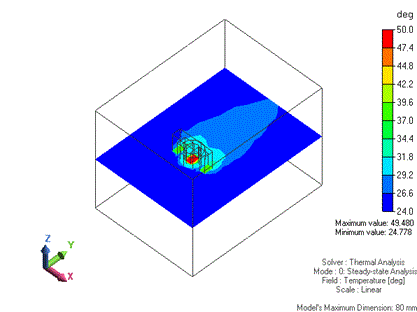
The temperature result is shown below.