|
Home / Examples / Magnetic Analysis (Gauss, Static Analysis/Harmonic analysis) / Example 13: Inductance of Two Parallel-Plate Electrodes
Example 13: Inductance of Two Parallel-Plate Electrodes
General
-
Inductance of the two parallel-plate electrodes is solved.
-
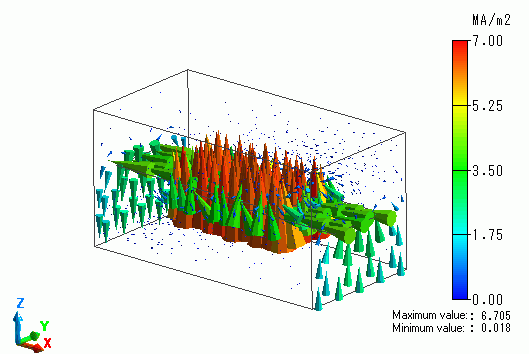
The inductance, the vectors of the magnetic field and the magnetic flux density are solved.
-
Unless specified in the list below, the default conditions will be applied.
-
Obtain this session's project file. (Right-click and choose 'Save link as')
-
Results will vary depending on Femtet version and the PC environment.
Analysis Space
|
Item |
Settings |
|
Analysis Space |
3D |
|
Model Unit |
mm |
Analysis Conditions
|
Item |
Settings |
|
Solver |
Magnetic Analysis [Gauss] |
|
Analysis Type |
Static Analysis |
|
Options |
N/A |
Model
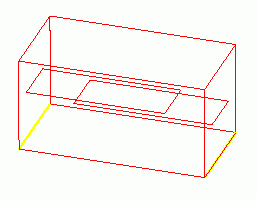
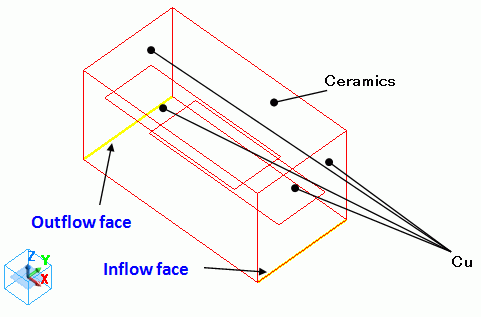
A ceramic cuboid is created and parallel plate electrodes are defined on the surface and inside of the cuboid.
Body Attributes and Materials
|
Body Number/Type |
Body Attribute Name |
Material Name |
|
3/Sheet |
Coil |
008_Cu * |
|
4/Sheet |
Coil |
008_Cu * |
|
5/Sheet |
Coil |
008_Cu * |
|
6/Sheet |
Coil |
008_Cu * |
|
10/Solid |
Coil |
Ceramics |
* Available from the material DB
The body attribute is set as follows to apply the current to the electrodes and ceramic body.
|
Body Attribute Name |
Tab |
Settings |
|
Coil |
Current |
Waveform: Constant Current: 1 [A] Turns: 1 [Turns] Direction: Specify Inflow/Outflow faces (In the Air Box): Select Inflow Face and Outflow Face. |
Define Ceramics as a conductor of very low conductivity as follows.
|
Material Name |
Tab |
Settings |
|
Ceramics |
Conductivity |
Conductivity Type: Conductor |
Boundary Conditions
No setting.
Results
To see the results of inductance calculation, go to the [Results] tab
and click [Show Numerical Summary Table]  .
.
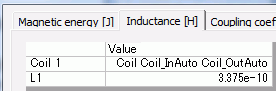
The vectors of the magnetic field are shown below.
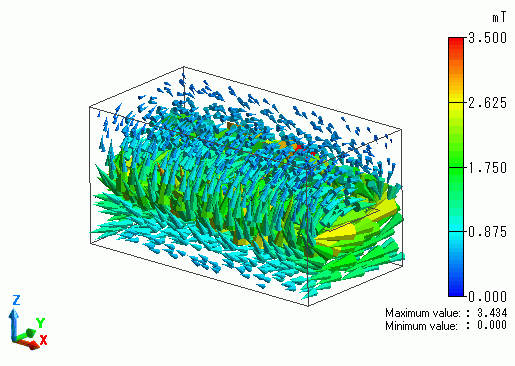
The vectors of the current density are shown below.