|
Home / Examples / Acoustic Analysis [Mach] / Example 12: Damping
Example 12: Damping
General
-
The damping of sound is solved. The imaginary part of sound speed is set to achieve the attenuation rate of 10 [dB/m].
The approach explained below assumes the attenuation rate is not so large.
-
The Harmonic analysis is applied.
-
Unless specified in the list below, the default conditions are applied.
-
Obtain this session's project file. (Right-click and choose 'Save link as')
-
Results will vary depending on Femtet version and the PC environment.
The project file contains three projects for the harmonic analysis, the transient analysis, and TopImage.
The project for the harmonic analysis is explained.
Analysis Conditions
|
Item |
Settings |
|
Solver |
Acoustic Analysis [Mach] |
|
Analysis Space |
2D |
|
Analysis Type |
Harmonic Analysis |
|
Unit |
mm |
Harmonic Analysis tab and Open Boundary tab are set as follows.
|
Tab |
Setting Item |
Settings |
|
Harmonic Analysis |
Frequency |
100 [kHz] |
|
Sweep Type |
Single Frequency |
|
|
Mesh |
General Mesh Size |
0.2 |
|
Element Type |
Rectangle |
Model
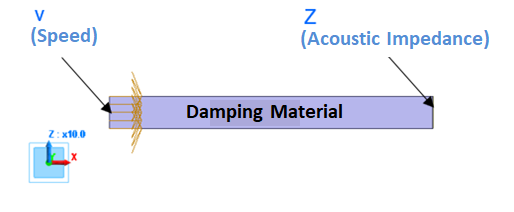
Set a speed of 1 [m/s] at the left end and activate the sound wave.
Set the boundary condition of acoustic impedance at the right end to prevent reflection.
Body Attributes and Materials
|
Body Number/Type |
Body Attribute Name |
Material Name |
|
0/Solid |
Attribute_001 |
Damping Material |
|
Material Name |
Tab |
Setting |
|
Damping Material |
Sound Speed |
Real Part: 340 [m/s] Imaginary Part: 0.212 [m/s] |
|
Density |
1.144 [kg/m3] |
The density and sound speed (real part) are obtained from air’s properties.
The imaginary part of sound speed is set to achieve the attenuation rate, α = 10 [dB/m].
Imaginary part of sound speed = (α/8.68) x (c2/ω) = 0.212
- The value of 8.68 in the equation above corresponds to 20 log(e). Note that "log" is the common logarithm and "e" is the base of natural logarithm, Napierian number.
- This equation is derived using the assumption that the imaginary part of sound speed is significantly smaller than the real part.
Boundary Conditions
|
Boundary Condition Name/Topology |
Tab |
Boundary Condition Type |
Settings |
|
v/Edge |
Acoustic |
Speed |
1 [m/s] |
|
Z/Edge |
Acoustic |
Acoustic Impedance |
Real Part: 388.96 [Pa s/m] Imaginary Part: 0.0242 [Pa・s/m] |
The acoustic impedance is set such that the sound wave from the left will pass through without reflection.
Acoustic Impedance = ρc = 1.144 x (340+j 0.212) = 388.96 + j 0.242
Results
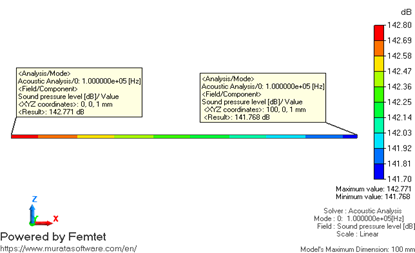
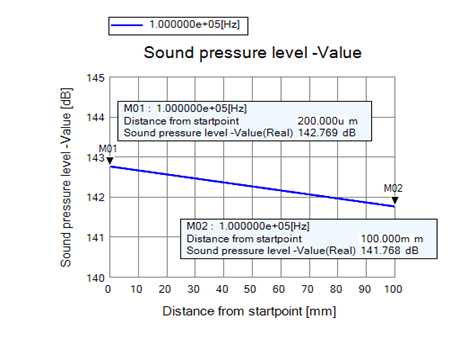
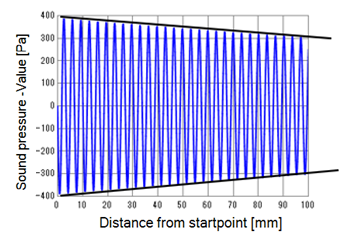
Based on the target attenuation of 10 [dB/m], the attenuation of 1 [dB] is estimated for the model with a length of 0.1 [m].
Checking the sound pressure levels.
Left End:142.769 [dB]
Right End:141.768 [dB]
Attenuation Rate1.001 [dB]
The estimated attenuation can be verified.