


|
Home / Examples / Acoustic Analysis [Mach] / Example 13: Sound-absorbing Material (Table Input)
Example 13: Sound-absorbing Material (Table Input)
General
-
The model of this example is created referring to the website of Architectural Institute of Japan (AIJ).
-
The characteristics of a sound-absorbing material is analyzed with the Miki model *1,*2.
-
The material properties of the sound-absorbing material are input by the frequency response table of complex sound velocity and complex density.
-
The resultant material properties of the sound-absorbing material are compared with measurements obtained from AIJ.
-
Obtain this session's project file. (Right-click and choose 'Save link as')
-
Results will vary depending on Femtet version and the PC environment.
Analysis Space
|
Item |
Settings |
|
Analysis Space |
2D Thickness in Depth Direction: 1 [mm] |
|
Model Unit |
mm |
Analysis Conditions
|
Item |
Settings |
|
Solver |
Acoustic Analysis [Mach] |
|
Analysis Type |
Harmonic Analysis |
|
Options |
Select [Calculate loss]. |
The harmonic analysis tab and Mesh tab are set as follows.
|
Tab |
Setting Item |
Settings |
|
Mesh |
General Mesh Size: |
1 |
|
Harmonic Analysis |
Frequency: Sweep Values |
Minimum: 100 [Hz] Maximum: 10000 [Hz] Number of Divisions 100 |
|
Frequency: Sweep Type |
Log Step |
|
|
Frequency Sweep |
Discrete Sweep |
Model
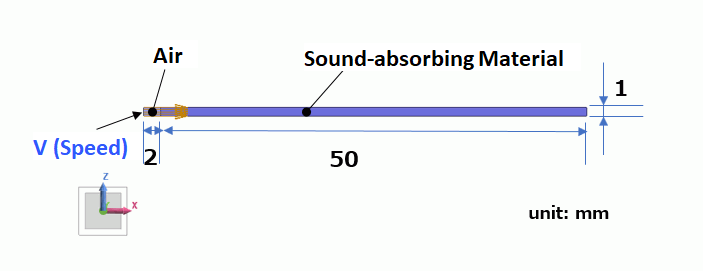
Create a rectangular sheet body, 50 x 1 [mm], and assign sound-absorbing material to the body. To its left, create a sheet body of air, 2 x 1 [mm].
Set the speed boundary condition, v, to the edge at the left end of the air domain. The other edges have no boundary conditions, resulting in outer boundary conditions of the rigid wall.
Body Attributes and Materials
|
Body Number/Type |
Body Attribute Name |
Material Name |
|
0/Solid |
Sound-absorbing Material |
Sound-absorbing Material |
|
1/Solid |
AIR |
000_Air |
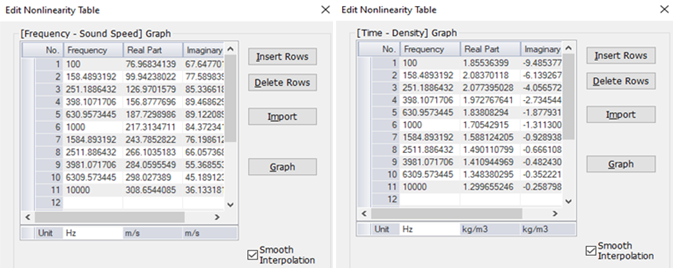
How to determine the material properties is crucial in this example. Calculate the complex sound speed and complex density of the material in Excel and enter them in the table below. The calculation procedures are shown below.
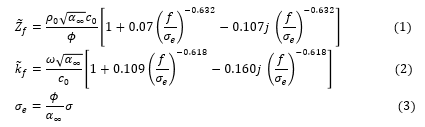
Using the Miki model, which is popular for the internal fluid model of porous material, the frequency responses of the characteristic acoustic impedance, Zf, and complex wavenumber, kf, are given by equations (1) to (3).
Material properties below are used.
Airflow Resistivity (σ): 6900 [N/m4]
Tortuosity (α∞): 1.0 [ ]
Porosity(φ): 1.0 [ ]
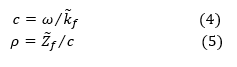
Complex sound speed, c, and complex density, ρ, are required for the acoustic analysis in Femtet. They are obtained from equations (4) and (5) using complex wavenumber and characteristic acoustic impedance resulted from the Miki model.
- Excel file for material calculation (model13_material_miki_model.xlsx). Click here to download the file.
- The method of entering the frequency response of complex sound speed and complex density in the table is applicable for other models other than the Miki model.
Boundary Conditions
|
Boundary Condition Name/Topology |
Tab |
Boundary Condition Type |
Settings |
|
v/Edge |
Sound Wave |
Speed |
1.0 [m/s] Select [Specify the incident wave] |
|
Outer Boundary Condition |
Acoustic |
Rigid Wall |
|
Results
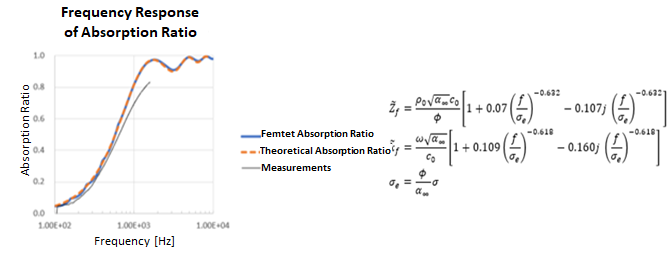
The frequency response of the absorption ratio of the sound-absorbing material is compared with theoretical values and measurements. At first, the radiation impedance in the result table in Femtet is shown, and then how to calculate the absorption ratio in Excel, and the calculation results are shown.
1. Frequency Response of Radiation Impedance
In the result table, go to the [Detailed Radiation Impedance] tab, select [Show all results summary], and click the [Graph] button. The frequency response graph will appear.
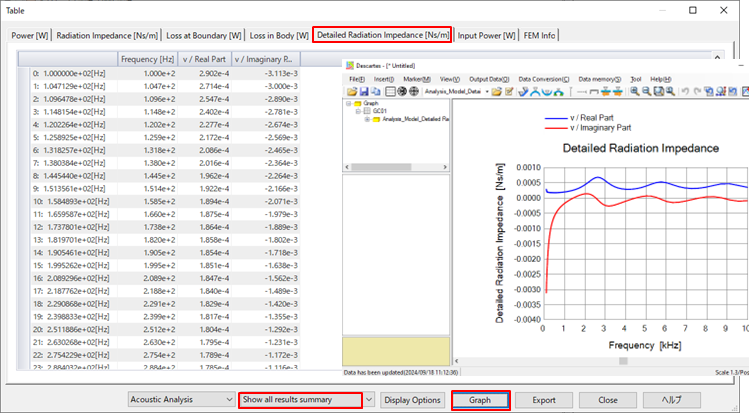
Fig. 1 Frequency Response of Radiation Impedance (Table and Graph)
2. Frequency Response of Absorption Ratio
The absorption ratio is given by the equation below.
Absorption ratio = Loss in body / Input power (6)
The terms on the right side of the equation (6) are given from the result table. The absorption ratio is obtained by calculating the equation (6).
As the frequency response of the absorption ratio cannot be provided from Femtet, it is graphed using Excel.
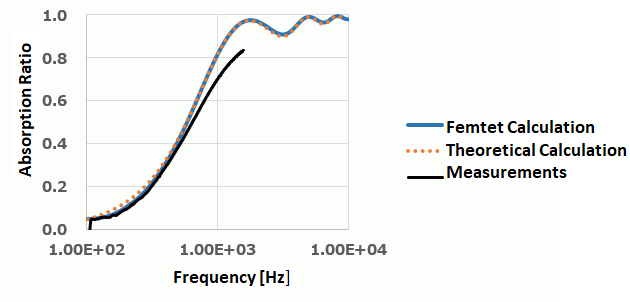
Fig.2 Frequency Response of Absorption Ratio
Reference:
*1 Miki Y., Acoustical properties of porous materials - Modifications of Delany-Bazley models, J. Acoust. Soc. Jpn (E). 11(1), 1990, pp. 19-24
*2 Miki Y., Acoustical properties of porous materials - Generalization of empirical models, J. Acoust. Soc. Jpn (E). 11(1), 1990, pp. 25-28