


|
Home / Examples / Piezoelectric Analysis [Rayleigh] / Example 2: Harmonic Analysis
Example 2: Harmonic Analysis
General
-
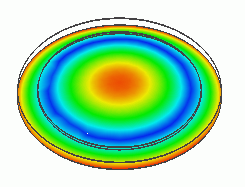
The model is a piezoelectric disc.
The AC voltage applied across the top and bottom faces generates the spreading vibration.
-
The device's displacement is solved.
-
Unless specified in the list below, the default conditions will be applied.
-
Obtain this session's project file. (Right-click and choose 'Save link as')
-
Results will vary depending on Femtet version and the PC environment.
Analysis Space
|
Item |
Settings |
|
Analysis Space |
3D |
|
Model Unit |
mm |
Analysis Conditions
|
Item |
Settings |
|
Solver |
Piezoelectric Analysis [Rayleigh] |
|
Analysis Type |
Harmonic Analysis |
|
Options |
N/A |
The harmonic analysis tab is set up as follows.
|
Tab |
Setting Item |
Settings |
|
Harmonic Analysis |
Frequency |
Minimum: 1000 [Hz] Maximum: 1000 [Hz] |
|
Sweep Type |
Select [Linear Step by Division Number] Division: 0 |
Model
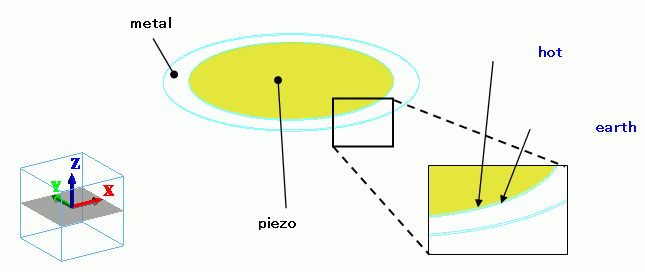
The piezoelectric disc (piezo) is placed on top of the aluminum disc (metal).
The electric potential is specified on the top and bottom faces.
Body Attributes and Materials
|
Body Number/Type |
Body Attribute Name |
Material Name |
|
0/Solid |
metal |
001_Al * |
|
1/Solid |
piezo |
000_P-4 * |
* Available from the material DB
Boundary Conditions
|
Boundary Condition Name/Topology |
Tab |
Boundary Condition Type |
Settings |
|
earth/Face |
Electric |
Electric Wall |
Electric Potential Specified: Electric Potential 0 [V] |
|
hot/Face |
Electric |
Electric Wall |
Electric Potential Specified: Electric Potential 1 [V] |
Results
The gradation contour of the displacement is shown below.
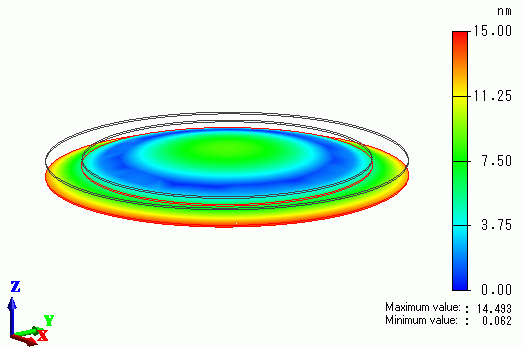
The piezoelectric disc's vibration causes the distortion on the aluminum disc.