


|
Home / Examples / Thermal Analysis [Watt] / Example 11: Blocks Set with Discontinuous Boundary
Example 11: Blocks Set with Discontinuous Boundary
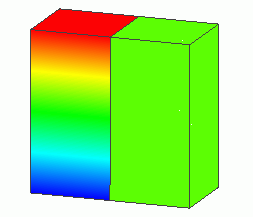
General
-
The [Discontinuous] boundary condition is studied in this example. The model consists of two blocks in contact with each other.
-
The boundary between the contacting bodies is typically a continuous boundary. Thermal conduction will make a continuous temperature distribution.
When applying the discontinuous boundary condition, thermal conduction is not taken into account, leading to discontinuous temperature distribution.
-
The temperature distribution and the heat flux vectors are solved.
-
Unless specified in the list below, the default conditions will be applied.
-
Obtain this session's project file. (Right-click and choose 'Save link as')
-
Results will vary depending on Femtet version and the PC environment.
Analysis Space
|
Item |
Settings |
|
Analysis Space |
3D |
|
Model Unit |
mm |
Analysis Conditions
|
Item |
Settings |
|
Solver |
Thermal Analysis [Watt] |
|
Analysis Type |
Steady-state Analysis |
|
Options |
N/A |
Model
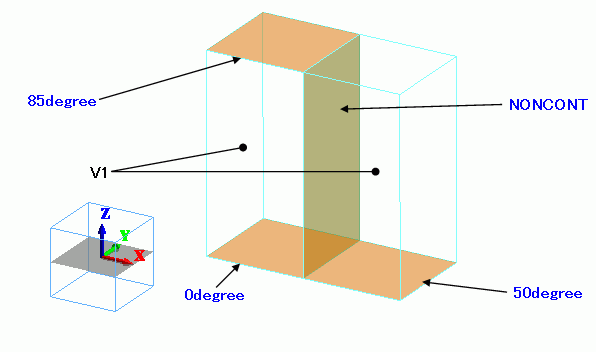
Two rectangular solid bodies are in contact with each other. The [Discontinuous] boundary condition is set at the contact face.
The material is polyethylene. The top and bottom faces are set with the "temperature" boundary condition.
Body Attributes and Materials
|
Body Number/Type |
Body Attribute Name |
Material Name |
|
0/Solid |
V1 |
000_Polyethylene(PE) * |
|
1/Solid |
V1 |
000_Polyethylene(PE) * |
* Available from the material DB
Boundary Conditions
|
Boundary Condition Name/Topology |
Tab |
Boundary Condition Type |
Settings |
|
0degree/Face |
Thermal |
Temperature |
0 [deg] |
|
50degree/Face |
Thermal |
Temperature |
50 [deg] |
|
85degree/Face |
Thermal |
Temperature |
85 [deg] |
|
NONCONT |
Symmetry/Continuity |
Discontinuous |
Discontinuous |
Results
The temperature distribution is shown below.
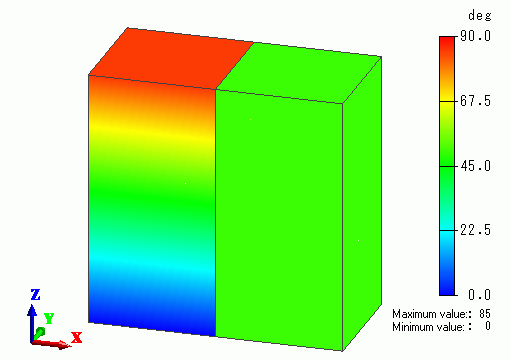
The right body has a uniform temperature of 50 [deg] throughout its entire body, while the left body exhibits a temperature distribution.
There is no heat transfer between the bodies.
For comparison, the [Continuous] boundary condition is set at the contact face. The result is shown below.
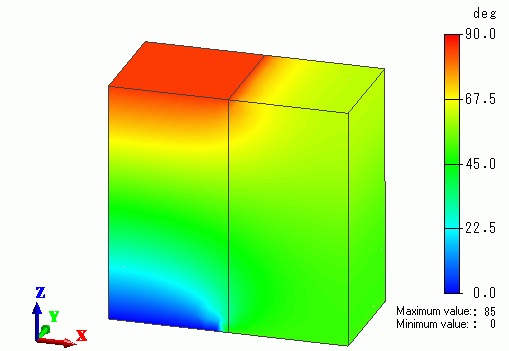
The condition allows heat transfer between the two bodies, resulting in continuous temperature distributions.