|
Home / Technical Notes / Fluid Analysis/Fluid-Thermal Analysis / Loss Coefficient at Inlet and Outlet for Natural Flow
Loss Coefficient at Inlet and Outlet for Natural Flow
If a loss coefficient is set to the inlet of the natural flow in the inlet boundary condition, calculation is executed assuming that the total pressure was lost by ΔP at the inlet.
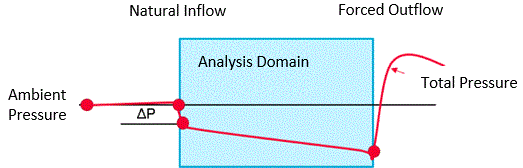
If a loss coefficient is set to the outlet of the natural flow in the outlet boundary condition, calculation is executed assuming that the static pressure was lost by ΔP at the outlet.
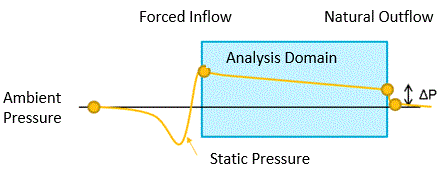
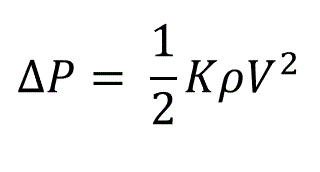
The pressure loss (ΔP) at the inlet/outlet is expressed in the following equation where ρ is fluid density, V is flow velocity, and K is loss coefficient.
The loss coefficient K (resistance coefficient) depends on the shape of the opening and the opening ratio.
Typical equations are as follows.
Porous Plate
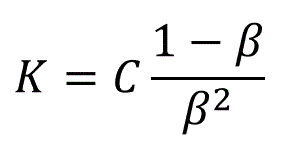
In the equation below, β is opening ratio and C is coefficient (1.4 - 2.0). Strictly speaking, the calculation depends on the diameter of the opening and the thickness of the plate.
Wire Net
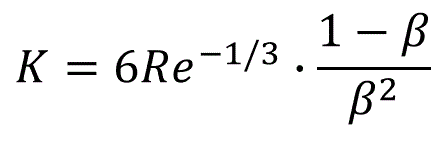
In the equation below, β is opening ratio and Re is Reynolds number.