|
Home / Technical Notes / Stress Analysis / Participation Factor and Effective Mass in Resonant Analysis
Participation Factor and Effective Mass Calculated in the Resonant Analysis
Matrix Equation for Resonant Analysis
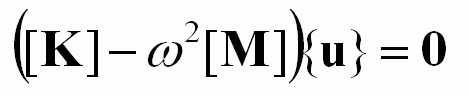
[K] is the stiffness matrix, which is related to the material's elasticity.
[M] is the mass matrix, which is related to the material's density.
{u} is the displacement vector, which is the unknown.
ω is the angular frequency, which is another unknown.
The eigenvalues and eigenvectors of this equation are the resonant angular frequencies and displacement vectors.
The number of modes can be specified on Resonant Analysis tab.
Eigenvalues and eigenvectors are obtained for each mode.
Normalizing Eigenvectors
Eigenvectors of the equation above are not unique.
Their multiples satisfy the equation, too.
Femtet obtains normalized eigenvectors for each mode as follows.
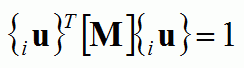
where i is the mode number and T indicates the transpose of a matrix/vector.
Participation Factor
Participation factor is used to evaluate the responsiveness against the acceleration.
For a normalized eigenvector, the participation factor is given by:
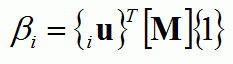
where {1} is the unit vector ( All its components are 1).
Eigenvectors have components in X, Y and Z directions.
So does the unit vector.
The unit vector can be separated into the ones of each direction.
For example, the responsive in X direction is obtained
by using the X-direction unit vector: X component = 1 and Y/Z components = 0
Femtet calculates participation factors for Ux, Uy and Uz directions.
U indicates the translational freedom, whereas R indicates the rotational freedom which is mostly used for shell elements.
It is theoretically possible to obtain rotational responses around X, Y and Z axis for shell elements,
but they cannot obtained with Femtet currently.
If the participation factor is positive, the response is in the same direction as the acceleration.
If negative, the response is in the opposite direction.
With the larger value, the system is more responsive to the acceleration.
Effective Mass and Effective Mass Ratio
Effective mass is another parameter to evaluate the responsiveness against the acceleration.
It is calculated from the participation factor.
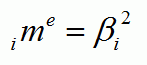
The sum of effective masses of all the possible modes
is the model's mass.
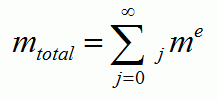
The modes with larger effective mass are more dominant.
The effective mass ratio is the ratio of the effective mass with reference to the model's mass. It is an indicator of the mode's dominance.
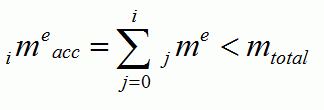
The accumulated effective mass is defined by the equation below.
It is the sum of effective masses up to mode i.
If it is large or closer toe the model's mass, it would be containing dominant modes.
The accumulated effective mass ratio is the ratio of the accumulated effective mass with reference to the model's mass. It is an indicator of the dominance up to mode i..