


|
Home / Technical Notes / Magnetic analysis / Fast Stabilizer
Fast Stabilizer
To perform steady-state transient analysis with taking into account the nonlinearity of the magnetic material, it will require many number of timesteps before reaching the steady state.
There are two correction methods effective to reduce the number of timesteps in great degree. One is the simplified TP-EEC method and the other is the simplified 3-phase AC TP-EEC method which can be used for the 3-phase AC system.
Solver Luvens (transient magnetic analysis) can perform the simplified TP-EEC method only if the subsystem of the analysis object having time derivative item is half periodic (antiperiodic).
That is, in the subsystem of the object, there must be solution to the following equations.
coil current: I (t+T/2) = - I (t), magnetic field B(t+T/2) = -B (t), eddy current J(t+T/2) - -J (t)
where t is time and T is period.
Typically, the simplified TP-EEC method is applicable to the case where stator of motor is connected with external circuit because stator is half periodic in most cases.
For 3-phase AC system, the simplified 3-phase AC TP-EEC method will be effective which utilizes the equality of each phase in the system and corrects three times faster than the simplified TP-EEC method.
Two methods, however, are not effective for the induction motor having little slip (less than 2%).
The unknown variables for the correction have time derivative items in the differential equations which describe the analysis object.
In the magnetic field analysis equations, magnetic vector potential in the eddy current may be corrected, and in the circuit coupled analysis, current of coil and magnetic vector potential of coil may be corrected.
It is not required to correct all of these variables.
In the circuit coupled analysis, correction of current of coil only will give sufficient correction effect in many cases.
As the naming indicates, these two methods are "simplified". Correction methods which are not "simplified" exist too.
To explain such methods, EEC (Explicit Error Correction) method must be explained in the first place. However, the "simplified" methods can be explained without employing a concept of EEC method.
It can be simply said that relational equations solved in the steady state are directly used as correction equations.
Detail explanations are as follows.
Simplified TP-EEC Method
Half periodic field f(t) is calculated.
If f(t) reaches the steady state, the relationship between f(t) and f(t+T/2) is represented by the following equation where f(t + T/2) is half period after f(t).
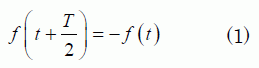
This equation is transformed to the following.

This gives the correction equation by the simplified TP-EEC method as follows.

As shown here, correction is applied at every half period in the simplified TP-EEC method.
Simplified 3-Phase AC TP-EEC Method
3-phase AC system (U, V, W) is calculated.
Assumption is that the three variables (U, V, W) are electrically equal.
And (U, V, W) is interchangeable with (V, W, U) or (W, U, V) in the analysis system.
If this system reaches the steady state, the relationships between U, V, W, and dU, dV, dW are represented by the following equations where dU, dV, and dW are 1/6 period after U, V, and W respectively based on the Figure 1.

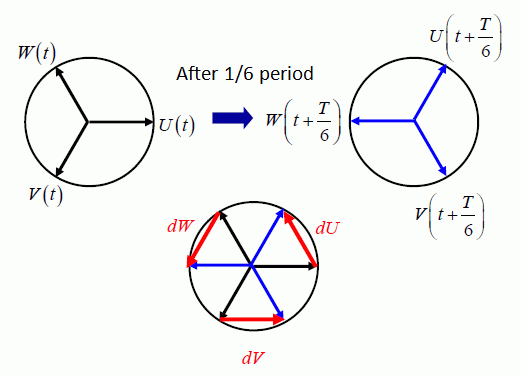
Figure 1. Change after 1/6 period in the steady state
As dU + dV + dW = 0, the relationship is expressed more generally as follows.

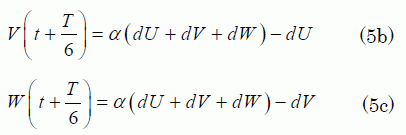
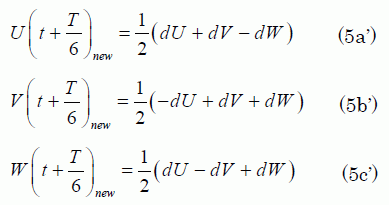
Use α=1/2 as correction expression which is generally effective for all odd number-order harmonics. Correction equations by the simplified 3-phase AC TP-EEC method are given as follows.
dU, dV, dW are expressed as follows.

Correction at every 1/6 period is possible in the simplified 3-phase AC TP-EEC method.
In the transient analysis, steady state can be reached very fast by correcting 3-phase AC system (U, V, W) at every 1/6 period with equations (5a'), (5b'), (5c'), and (6).
Current of coil or magnetic vector potential of coil in the circuit coupled analysis are the candidates for correction in the 3-phase AC system (U, V, W). But as mentioned earlier, correction of current of coil only will be effective
As mentioned in the beginning, three variables (U, V, W) are assumed to be electrically equal as a condition. It might seem to require meshes to be congruent after 120-degree rotation of electrical angle for the rotating machinery. It is, however, not required. As far as the equality of the three variables is generally satisfied, this method is effective in a wide range of analyses.
For the inverter-driven electric equipments with 3-phase AC system, it takes time before current of coil reaches the steady state in the analysis. So the correction by the simplified 3-phase AC TP-EEC method is very effective.