


|
Home / Technical Notes / Magnetic analysis / Homogenizing Method
Homogenizing Method
To analyze layered magnetic steel plate, it is required to take the layer structure into account.
If meshing is applied to the layered structure as it is, the number of meshes of the analysis space would become enormous as the thickness of electromagnetic plate is about 0.2 to 0.5mm. Immense amount of time would be needed for calculation.
Therefore, the homogenizing method is employed for the analysis with small number of elements.
This method uses macromodel of homogenized minute structure by utilizing the periodicity of layered structure. Permeability and permittivity of the magnetic material will be represented by macromodel which takes layered structure into account.
In the equations below, N// is magnetic resistivity in layer plane direction (direction normal to the layer direction), N⊥ is magnetic resistivity in layer direction, and α (0<α<1) is space factor of magnetic plates.
Magnetic resistivity is a reciprocal number of permeability. Generally, value of α is a bit smaller than 1.
Magnetic circuit in layer plane direction can be regarded as parallel circuit of electromagnetic plates and insulating layers. Magnetic circuit in layer direction can be regarded as series cuircuit of electromagnetic plates and insulating layers.
Therefore, magnetic resistivities N// and N⊥ are represented as follows respectively.
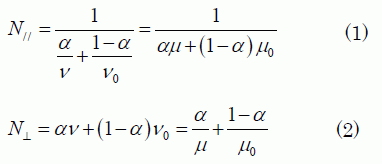
N// : magnetic resistivity of homogenized macromodel in layer plane direction
N⊥: magnetic resistivity of the homogenized macromodel in layer direction
v: magnetic resistivity of electromagnetic plates 
ν0: magnetic resistivity of insulating layers (magnetic resistivity in the free space) 
α: space factor of electromagnetic plates
If the value of space factor α is close to 1, the relationship of N// , N⊥, and v can be written as follows.

For example, with typical values of α=0.97 and μr=1000,  will be given.
Electric conductivities in layer plane direction Σ// and in layer direction Σ⊥ are expressed as follows.
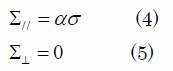
This model is based on the assumption that eddy current does not flow in layer direction, and insulating layers exist on the surface of electromagnetic plates in layer plane direction which reduce the cross sectional area of the plates. The electric conductivity is decreased equivalently by α times the reduced cross sectional area.
Tangent line component of the magnetic field and normal component of the magnetic flux density are expressed as below.

The equations below are the relationships of the magnetic field H and the magnetic flux density B.

From equations (6) and (7), the equations below are given.
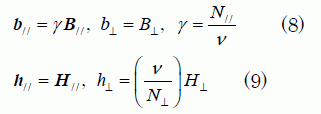
b//: magnetic flux density of electromagnetic plates in layer plane direction
b⊥: magnetic flux density component of electromagnetic plates in layer direction
h//: magnetic field of electromagnetic plates in layer plane layer
h⊥: magnetic field component of electromagnetic plates in layer direction
B//: magnetic flux density of macromodel in layer plane direction
B⊥: magnetic flux density component of macromodel in layer direction
H//: magnetic field of macromodel in layer plane direction
H⊥: magnetic field component of macromodel in layer direction
The magnetic field of the electromagnetic plates b is obtained as follows with equations (1), (2), (7), (8), and the magnetic field B of the macromodel.
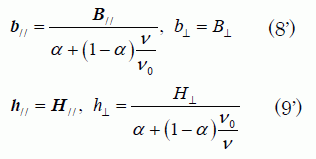
In the magnetic analysis, if homogenizing method is applied to the layered structure, magnetic flux density B and magnetic field H of the macromodel are solved and with equations (8’) and (9’), b =(b//, b⊥ ) and h =(h//, h⊥ ) are obtained.
In the nonlinear analysis, differential magnetic resistivity tensor  is needed to apply the Newton-Raphson method which is widely used to achieve convergence fast.
Usually, the equation is expressed as follows for the magnetic analysis.
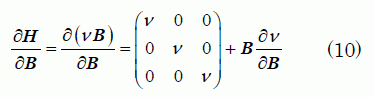
where
On the other hand, for the macromodel in the homogenizing method which is anisotropic, the relationship of each parameter is expressed in the following equation having the 3rd item as the layer direction component.
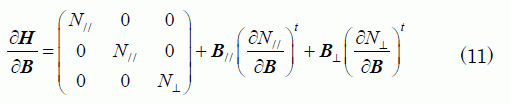
where
N// : magnetic resistivity of homogenized macromodel in layer plane direction
N⊥: magnetic resistivity of the homogenized macromodel in layer direction
B//: magnetic flux density of macromodel in layer plane direction
B⊥: magnetic flux density of the macromodel in layer direction
In equation (11), superscript "t" on the 2nd and 3rd items of the right side indicates inversed vectors.
The vectors here are considered to be the 3x1 matrices in the 3D space. The inversed vectors indicate 1x3 matrices.
From equations (12) and (13),
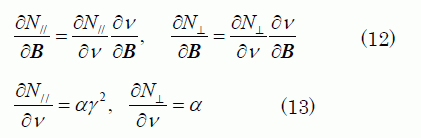
Equation (11) can be rewritten as follows.
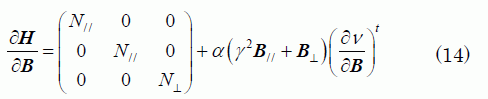
It is not relevant to the permeability of the electromagnetic plates if the mark of value of the magnetic flux densityb is + or -.
Furthermore, it can be said that the permeability of the electromagnetic plates is a function of b2 as well as b.
Therefore, it can be also said that the magnetic resistivity ν of the electromagnetic plates which is a reciprocal of the permeability is a function of b2.
In the 2nd item  of the right side of the equation (14), ν is a function of b2, and the equations below are given.

The equation (16) is given from the equation (8).

It can be written as follows.

 of the right side can be written as below.

Based on the third expression for γ in (8), equation (19) is given.

From the equations (17), (18), and (19), equations below are given.

where
 of the both sides will give the following equations.

From the equations (14), (15), and (21), equations below are given.
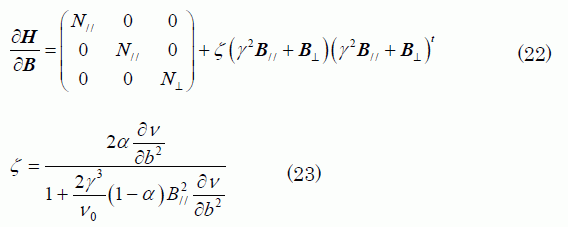
where
Please note the homogenizing method explained here uses equations (4) and (5). It can solve eddy current generated at plane normal to the layer direction ( or generated at magnetic flux in layer direction) whereas it cannot solve minute eddy current generated at the plane thickness of around 0.2mm to 0.5mm in layer direction (or generated at magnetic flux normal to the layer direction).