


|
Home / Technical Notes / Electromagnetic analysis / Analysis Condition / Q Factor in the Resonant Analysis
Q Factor in the Resonant Analysis
In the electromagnetic-resonant analysis, the resonant mode and its resonant frequency are solved based on the Maxwell’s equation.
From the field distribution of resonant modes, the energy stored in the resonator and the power consumption are obtained. Based on them, total Q factor of the resonator, Q factors of dielectric and electrode are calculated.
Total Q factor of the resonator is calculated as below.
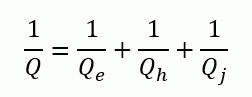
Fig 1: Calculation of Q factor
where Qe is given by the power consumption due to the electric energy loss, Qh is given by the power consumption due to the magnetic energy loss,
and Qj is given by Joule loss by the current flowing in the conductor such as electrode.
- Joule loss [W] is obtained as energy loss per unit time.
When calculating Q factor, Joule loss is divided by resonant frequency.
As shown in Fig 2, the result table of the electromagnetic-resonant analysis displays Q factor of dielectric material, Q factor of electrode, and total Q factor.

Fig 2: Result table of electromagnetic-resonant analysis
Q factor of dielectric material takes Qe and Qh into account for each body. Q factor of electrode is Qj.
Total Q factor takes Qe, Qh, and Qj of all bodies of the resonator into account.
Calculation method of the power consumption (electric energy loss, magnetic energy loss, and Joule loss) and the field values depends on
whether [Calculate the Q factor with high accuracy] is selected for the resonant analysis. (Fig. 3)
Calculation methods are as below.
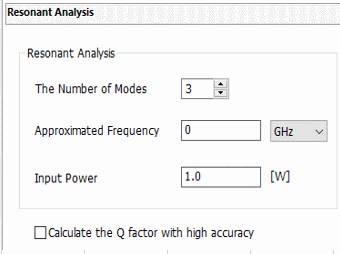
Fig. 3: Setting on the Resonant Analysis Tab
If [Calculate the Q factor with high accuracy] is not selected (default setting)
In the analysis to obtain a field of resonant mode, the losses of all materials are ignored. Then dielectric tangent and magnetic loss tangent are ignored,
and all conductors are treated as perfect conductors. The inside of the conductor such as electrode is not analyzed.
The resonant frequency of the resonant mode is given as a real number.
In this case, the electric energy loss is estimated by multiplying the electric energy by dielectric tangent (tanδ).
Likewise, the magnetic energy loss is estimated by magnetic loss tangent (tanδ).
Since the obtained electric field is an analysis result ignoring dielectric tangent, calculation of the electric energy loss is not necessarily accurate.
Joule loss is roughly calculated based on the impedance of the conductor using the magnetic field on the conductor obtained by the analysis.
Also, the calculation is not necessarily accurate because the conductor is treated as a perfect conductor (electric field = 0) in the analysis.
However, the loss is relatively small in most cases. In such a case, the result of analysis ignoring the loss is
not so much different from the analysis that calculates Q factor with high accuracy. Compared with the analysis with high accuracy, the analysis that ignores the loss can reduce the analysis time and memory consumption.
Therefore, if the loss is relatively small, the analysis without selecting [Calculate the Q factor with high accuracy] is effective.
Unlike the analysis with high accuracy, precalculation of resonant frequency described below is not required.
If [Calculate the Q factor with high accuracy] is selected
In the analysis to obtain a field of resonant modes, dielectric tangent, magnetic loss tangent, and impedance of the conductor are taken into account. The inside of the conductor such as electrode is analyzed as well.
Therefore, the resonant mode and the resonant frequency are complex numbers. The electric energy calculated from the electric field is also a complex number.
In this case, the constant electric energy stored in the resonator is given as a real part of
the electric energy calculated from the field, and the electric energy loss is given as its imaginary part. This is applicable for the magnetic energy as well.
Joule loss is obtained by the electric field in the conductor and the impedance of the conductor.
-
-
See Complex Resonant Frequency for the resonant frequency having an imaginary part.
-
Reference frequency is used to calculate the impedance of conductor. Therefore, resonant frequency is precalculated by executing a resonant analysis without selecting [Calculate the Q factor with high accuracy]. The obtained frequency is an approximate value of the resonant frequency that is to be used for the analysis.
After the precalculation, select [Calculate the Q factor with high accuracy] and enter the precalculated value as a reference frequency.
-
In this case, all of the electric energy loss, the magnetic energy loss, and Joule loss are taken into account to calculate Q factor.
The calculation is accurate even if the loss is not small. In this method however, since all fields are complex numbers and the inside of the conductor is calculated,
longer calculation time and more memory will be required in comparison with the analysis where [Calculate the Q factor with high accuracy] is deselected.