


|
Home / Technical Notes / Fluid Analysis/Thermal-Fluid Analysis / Simple Fluid analysis/Simple Thermal-Fluid Analysis / Simple Thermal-Fluid Coupled Analysis
Simple Thermal-Fluid Analysis
The simple Thermal-Fluid analysis can be performed by running the solvers Pascal and Watt.
Compared with normal Thermal-Fluid analysis, the calculation is simplified and faster.
This is because the simulation is simplified.
Details of how performs calculation is explained below.
Analysis of Fluid
The flow velocities are calculated first.
Air is the only fluid Femtet can simulate.
The distribution of flow velocities depends on the body type (solid or fluid), and the boundary condition (Inflow or Outflow).
The assumptions are as follows:
-
Laminar flow (Turbulent flow cannot be analyzed)
-
Non-viscous fluid
-
Incompressible fluid
-
The fluid is air.
-
The openings (the entrance and the exit of the fluid) are perpendicular to the flow vector.
Analysis of Heat
The heat transfer by fluids are solved not by applying the formulas of energy conservation but by applying the boundary conditions.
The boundary conditions of heat transfer are automatically applied on the boundaries between solid (heat source) and fluid,
and the thermal analysis [Watt] is performed for the solids and the boundary conditions.
Therefore, the temperature distribution of the fluid cannot be viewed.
Femtet sets parameters of the heat transfer boundary condition automatically for each element as follows.
-
Room temperature: Same as Inflow Fluid Temperature of the Boundary Condition.
-
Coefficient of Heat Transfer: Calculated by the formula below.
The local coefficient of heat transfer
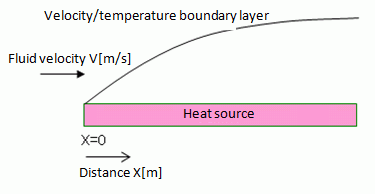
| hx is the coefficient of heat transfer against X. |
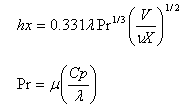 |
| Fluid's material property |
| λ: Thermal conductivity [w/m/K] ν: Kinematic viscosity [㎡/s]=μ/ρ μ: Viscosity [Pas] Cp: Specific heat at constant pressure [J/k g/K] ρ: Density[kg/m³] |