


|
ホーム / テクニカルノート / 音波解析 / 多孔質吸音材モデル
多孔質吸音材モデル
1.miki model
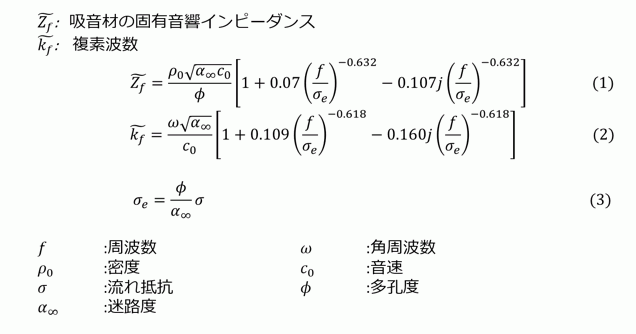
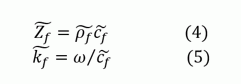
Femtetで使うには、密度、音速に変換する必要がある。 得られた固有音響インピーダンスと、複素波数から、 実効密度、複素音速 へは、以下の(4),(5) の関係を使って、変換する。
2. JCA (Johnson-Champoux-Allard) model
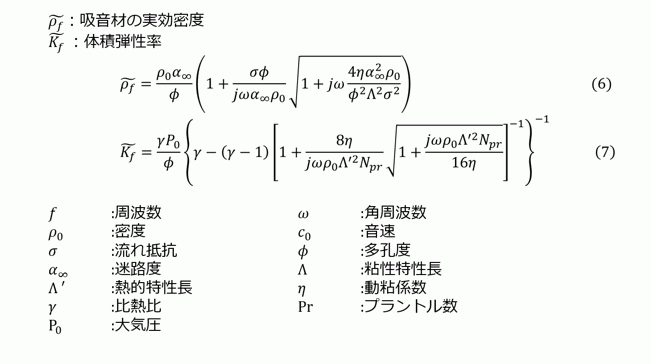
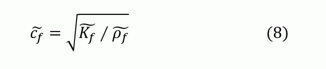
Femtetで使うには、密度、音速に変換する必要がある。 得られた実効密度と、体積弾性率から、複素音速 へは、以下の(8)式 の関係を使って、変換する。
ただし、 大気圧は 101.3e3[KPa] 、比熱比は 1.4 で変更できないことになっていて、動粘係数、プラントル数を直接入力することはできない。
動粘係数は(粘度/密度)から、 プラントル数は、(粘度x比熱/熱伝導率)、で求めている。
「参考資料」
[1] 日本建築学会 音響数値解析小委員会ウエブサイト news-sv.aij.or.jp/kankyo/s26/AIJ-Benchmark/index_j.html
[2]
Miki Y., Acoustical properties of porous materials - Modifications
of Delany-Bazley models, J. Acoust. Soc. Jpn (E). 11(1), 1990, pp. 19-24
[3] Miki Y., Acoustical properties of porous
materials - Generalization of empirical models, J. Acoust. Soc. Jpn (E).
11(1), 1990, pp. 25-28
[4] Johnson D. L., Koplik
J. and Dashen R., Theory of dynamic permeability and tortuosity in fluid-saturated
porous media, J. Fluid Mech. 176, 1987, pp. 379-402
[5] Champoux Y. and Allard J.-F., Dynamic tortuosity
and bulk modulus in air-saturated porous media, J. Appl. Phys. 70, 1991,
pp. 1975-1979
以上