

Technical FAQs
Technical FAQs on Femtet operations and other topics are provided here.
For FAQs on purchasing and other topics, please see FAQs.
-
 Electromagnetic Analysis
-
 Magnetic Field Analysis
-
 Electric Field Analysis
-
 Stress Analysis
-
 Thermal Analysis
-
 Fluid Analysis
-
 Piezoelectric Analysis
-
 Acoustic Analysis
-
 Installation
-
 Modeling
-
 Mesh Generation
-
 Analysis Results
-
 Macro
Macro
-
 Others
Electromagnetic Analysis
What kind of analysis can the electromagnetic solver “Hertz” of Femtet perform?
Please refer to the PDF document for details.
What material properties are required for the electromagnetic analysis?
Please refer to the PDF document for details.
Are there any comparisons between calculations by Femtet and actual measurements?
Please refer to the PDF document for details.
Can Femtet analyze an antenna array?
Please refer to the PDF document for details.
Can Femtet perform the analysis with surface roughness taken into account in the electromagnetic analysis?
Please refer to the PDF document for details.
Can Femtet perform the analysis with surface impedance taken into account?
Please refer to the PDF document for details.
Can Femtet perform the analysis with the shielding effect taken into account?
Please refer to the PDF document for details.
Can Femtet display a directivity graph?
Please refer to the PDF document for details.
How to display horizontal and vertical polarizations from the analysis result?
Please refer to the PDF document for details.
How to solve current and voltage?
Please refer to the PDF document for details.
Can Femtet display VSWR or group delay?
Please refer to the PDF document for details.
Does Femtet implement the renormalize and deembedded functions?
Please refer to the PDF document for details.
How much size of air domain is required to analyze an antenna?
Please refer to the PDF document for details.
How does the reference frequency work? What value is usually used?
Please refer to the PDF document for details.
What structures are required for ports in the electromagnetic analysis of Femtet?
Please refer to the PDF document for details.
How much size is optimal for meshes?
Please refer to the PDF document for details.
Why does the Lanczos calculation not converge?
Please refer to the PDF document for details.
Why does the error ‘E3113 Non-propagating mode is selected’ appear?
Please refer to the PDF document for details.
When the lumped-constant boundary condition is set, errors can occur. How to solve the problem?
Please refer to the PDF document for details.
How to increase the accuracy and speed of calculation in Electromagnetic Analysis?
Please refer to the PDF document for details.
How to avoid the parallel plate mode in the 3D electromagnetic harmonic analysis?
Please refer to the PDF document for details.
How to cope with unexpected results in the electromagnetic analysis?
Please refer to the PDF document for details.
How to cope with errors in electromagnetic analysis?
Please refer to the PDF document for details.
Magnetic Field Analysis
What material properties does Femtet require in the magnetic analysis?
Please refer to the PDF document for details.
What kind of analysis can Femtet perform in the magnetic analysis?
Please refer to the PDF document for details.
Can Femtet perform the analysis with the proximity effect taken into account?
Please refer to the PDF document for details.
How is the magnetic analysis performed when the required data is out of the domain of the B-H curve table?
Please refer to the PDF document for details.
In the harmonic analysis of magnetic fields, does the specified current value represent a peak value?
Please refer to the PDF document for details.
How to calculate the inductor’s floating capacitance?
Please refer to the PDF document for details.
How to set a multi-turn coil in the magnetic analysis?
Please refer to the PDF document for details.
How to set inflow and outflow portions of a coil in the magnetic analysis?
Please refer to the PDF document for details.
What settings are required to analyze a resonant coil in the magnetic analysis?
Please refer to the PDF document for details.
How does Femtet calculate inductance?
Please refer to the PDF document for details.
Why does the calculated inductance of an air-core coil not coincide with the actual measurements?
Please refer to the PDF document for details.
What kind of loss can Femtet calculate?
Please refer to the PDF document for details.
Can Femtet calculate electromagnetic force?
Please refer to the PDF document for details.
Can Femtet perform the analysis with magnetic saturation taken into account?
Please refer to the PDF document for details.
Can Femtet perform the analysis with the skin effect taken into account?
Please refer to the PDF document for details.
Can Femtet perform induction heating analysis?
Please refer to the PDF document for details.
Can Femtet analyze a coil with DC superimposed?
Please refer to the PDF document for details.
How does Femtet represent the current loss of a conductor?
Please refer to the PDF document for details.
Can Femtet calculate the electromotive force that is generated by electromagnetic induction?
Please refer to the PDF document for details.
How to calculate leakage inductance in the magnetic analysis?
Please refer to the PDF document for details.
How to calculate permeance coefficient?
Please refer to the PDF document for details.
Why does calculation in the magnetic analysis not converge?
Please refer to the PDF document for details.
Electric Field Analysis
How to set up anisotropic materials?
Please refer to the PDF document for details.
How to calculate capacitance between a finger and an electrode?
Please refer to the PDF document for details.
How to calculate resistance?
Please refer to the PDF document for details.
How to perform the analysis with an electric load of X [Ω] connected?
Please refer to the PDF document for details.
What boundary condition can be set at the cutting plane of a symmetric model?
Please refer to the PDF document for details.
How to analyze nonlinear electric conductivity having electric field dependence?
Please refer to the PDF document for details.
How to analyze the model including both dielectric and conductive materials?
Please refer to the PDF document for details.
Can Femtet calculate the stray capacitance of a coil?
Please refer to the PDF document for details.
An input value for electric potential in the harmonic analysis corresponds to which range: peak-to-peak or peak-to-zero?
Please refer to the PDF document for details.
Does the capacitance calculated by Femtet for a parallel plate capacitor coincide with the theoretical value?
Please refer to the PDF document for details.
How to calculate the charge accumulating on the electrodes?
Please refer to the PDF document for details.
How to solve the value of a current through a conductor?
Please refer to the PDF document for details.
How much air domain is required for the electric analysis?
Please refer to the PDF document for details.
How does the floating electrode boundary condition work?
Please refer to the PDF document for details.
What is analyzed for the model having multiple electrodes?
Please refer to the PDF document for details.
How to display electric force lines?
Please refer to the PDF document for details.
How to obtain a difference in electric potential between two specified points?
Please refer to the PDF document for details.
When viewing the result of a thin model for better visibility, how to adjust to enlarge the result display in a specified direction?
Please refer to the PDF document for details.
How to calculate the average of the magnitude of the electric field in a body?
Please refer to the PDF document for details.
How to calculate the shape that has been deformed by static force?
Please refer to the PDF document for details.
What are the governing equations in the electric analysis of Femtet?
Please refer to the PDF document for details.
Stress Analysis
What is normal stress, shear stress, and principal stress?
Please refer to the PDF document for details.
What do the positive and negative components of normal stress or strain represent?
Please refer to the PDF document for details.
Why is maximum principal stress represented by contours, while principal stress is represented by vectors?
Please refer to the PDF document for details.
What is the relationship between the maximum value of principal stress and the maximum value of maximum principal stress and between the minimum value of principal stress and the minimum value of the minimum principal stress? How about strain?
Please refer to the PDF document for details.
Why do the maximum value of principal stress in vectors and the maximum value of maximum principal stress in contours not match?
The same question for strain as well.
Please refer to the PDF document for details.
Why does stress become highly concentrated or localized at a certain portion of a model?
Please refer to the PDF document for details.
How to calculate the stress that affects peeling on the bonding face between bodies?
Please refer to the PDF document for details.
How to calculate the average stress on a face or an edge?
Please refer to the PDF document for details.
How to analyze a warp deformation with thermal expansion and contraction taken into account due to temperature variation?
Please refer to the PDF document for details.
In Femtet, which is the temperature-dependent coefficient of linear thermal expansion, an instantaneous one or a secant coefficient one?
Please refer to the PDF document for details.
Can Femtet set an anisotropic coefficient of linear thermal expansion?
Please refer to the PDF document for details.
How to create a model including parts adhering to each other?
Please refer to the PDF document for details.
In Femtet, can bodies be connected with a spring?
How to create a model including a spring?
Please refer to the PDF document for details.
Can Femtet perform an analysis with centrifugal force taken into account?
Please refer to the PDF document for details.
How to eliminate the self weight that is generated by optionally setting acceleration or the centrifugal force that is generated by optionally setting angular velocity, for specified parts?
Please refer to the PDF document for details.
How to use the acceleration that is set optionally in the analysis condition and the acceleration of a boundary condition for different purposes?
Please refer to the PDF document for details.
In 2D stress analysis, what result is affected by [Thickness in Depth Direction]?
Please refer to the PDF document for details.
What is the difference between plane strain approximation and plane stress approximation in 2D analysis?
Please refer to the PDF document for details.
What is the difference between resonant analysis and harmonic analysis?
Please refer to the PDF document for details.
Can Femtet analyze the vibration test?
Please refer to the PDF document for details.
Can Femtet analyze the impact test?
Please refer to the PDF document for details.
Can Femtet analyze the drop test?
Please refer to the PDF document for details.
What is the multilayer plane stress sheet model?
Please refer to the PDF document for details.
How to use analysis results to calculate the volume, area or length of the deformed model?
Please refer to the PDF document for details.
What is the symmetric model? What are its advantages and its application range?
Please refer to the PDF document for details.
Can an asymmetric deformation be analyzed using the symmetric model?
Please refer to the PDF document for details.
How to set the resultant deformations of an analysis to forced displacement boundary conditions?
Please refer to the PDF document for details.
What analysis does the results import function allow for?
Please refer to the PDF document for details.
How to calculate the torque generated at the fixed portion?
Please refer to the PDF document for details.
When the damping ratio between two resonant frequencies is given, how to transfer it into the Rayleigh damping coefficients?
Please refer to the PDF document for details.
What type of nonlinear analyses does Femtet support?
Please refer to the PDF document for details.
How to obtain the contact force generated at the contact face?
Please refer to the PDF document for details.
How to cope with the non-convergence of calculation in the contact analysis?
Please refer to the PDF document for details.
How to take into account the thermal and electric conductivities for the face that has been in contact during the stress analysis?
Please refer to the PDF document for details.
When two bodies having the same material name are in simple contact, the cross section contour values on the simple contact face are averaged and displayed to be continuous.
Please refer to the PDF document for details.
Can Femtet perform the analysis associated with nonlinear geometry?
Please refer to the PDF document for details.
Calculation does not converge due to mesh collapsing in the large strain analysis.
Please refer to the PDF document for details.
Does Femtet support nonlinear materials in the analysis?
Please refer to the PDF document for details.
How does Femtet deal material properties in the range where the input data does not cover?
Please refer to the PDF document for details.
How to determine the material parameters of a hyperelastic material from material test data?
Please refer to the PDF document for details.
Can Femtet analyze the material like a sponge?
Please refer to the PDF document for details.
Thermal Analysis
What is the difference between steady state analysis and transient analysis?
Please refer to the PDF document for details.
Can Femtet perform the analysis with heat sources changing over time?
Please refer to the PDF document for details.
If a heat source switches frequently or varies rapidly, how to analyze the model including that heat source?
Please refer to the PDF document for details.
If multiple solid bodies are set to one body attribute, how much the heat source for each body is?
Please refer to the PDF document for details.
How much heat source needs to be specified for an axisymmetric or 2D model?
Please refer to the PDF document for details.
What is the simple method to set heat dissipation boundary conditions, such as natural convection and ambient radiation, to surfaces of a model?
Please refer to the PDF document for details.
What material properties are required for the thermal analysis?
Please refer to the PDF document for details.
How to set the temperature dependency for anisotropic thermal conductivity?
Please refer to the PDF document for details.
Can Femtet perform the analysis with surface-to-surface radiation taken into account?
Please refer to the PDF document for details.
How to obtain heat balance or heat transfer balance from the analysis result?
Please refer to the PDF document for details.
How to represent the maximum and minimum temperatures on the specified face graphically in the thermal-transient analysis?
Please refer to the PDF document for details.
What assumptions are applied to a 2D analysis of the thermal solver?
Please refer to the PDF document for details.
Why do the results differ when analyzing the same model in the 2D and 3D analyses?
Please refer to the PDF document for details.
How is thermal conduction modeled for sheet bodies, or multilayer thermal conductive sheets, in the thermal analysis?
Please refer to the PDF document for details.
Can Femtet analyze substrate warping caused by heat?
Please refer to the PDF document for details.
Can Femtet perform the analysis with heat generated by joule loss taken into account?
Please refer to the PDF document for details.
Can Femtet perform the transient analysis using the results of the steady-state analysis as initial temperatures?
Please refer to the PDF document for details.
Can Femtet perform the thermal analysis with forced convection taken into account to simulate a thermostatic chamber or reflow furnace?
Please refer to the PDF document for details.
Can the heat transfer coefficient of convection that is automatically or directly calculated for each case below be checked, and what is the calculation method?
・ For natural convection, determining automatically
・ For natural convection, determining by using a directly entered value
・ For forced convection, determining by using specified air flow speed and typical length
Please refer to the PDF document for details.
Can Femtet perform an analysis by coupling the contact analysis with the thermal analysis?
Please refer to the PDF document for details.
How to cope with errors below?
E3058 The calculation did not converge with the iterative method. Try the direct method.
E3041 No convergence in the iterative calculation.
Please refer to the PDF document for details.
Fluid Analysis
What to do if the fluid analysis does not converge ?
Refer to the following technical notes in Femtet Help.
Home/Thechnical Notes/Fluid Analysis/Fluid-Thermal Analysis/If Fluid Anlysis/Fluid-Thermal Analysis Does Not Converge
If the problem persists, contact technical support through Inquiries on the Murata Software Website.
Piezoelectric Analysis
Why does the result of the harmonic analysis in a piezoelectric analysis indicate that the peak of a resultant displacement is divided around the resonant frequency?
Please refer to the PDF document for details.
How to calculate the volume, area, or length of a deformed model in an analysis result?
Please refer to the PDF document for details.
How to calculate the amount of electric charge that has been
stored on an electrode?
Please refer to the PDF document for details.
How does Femtet specify the direction of materials?
Please refer to the PDF document for details.
What is the relationship between the compliance matrix and the stiffness matrix?
Please refer to the PDF document for details.
What are the four piezoelectricity forms, such as e-form and d-form?
Please refer to the PDF document for details.
How to input the parameters of anisotropic materials?
Please refer to the PDF document for details.
How to set temperature coefficients for temperature-dependent materials?
Please refer to the PDF document for details.
Can the piezoelectric solver of Femtet analyze a model where electric conductivity is set?
Please refer to the PDF document for details.
Can Femtet perform the analysis with mechanical damping taken into account?
Please refer to the PDF document for details.
How to perform the piezoelectric-harmonic analysis with viscoelasticity taken into account?
Please refer to the PDF document for details.
What is the representation of the electric potential boundary condition in harmonic and resonant analyses: peak-to-peak (P-P) or Root Mean Square (RMS)?
Can the phase be set to the electric potential boundary condition?
Please refer to the PDF document for details.
What is the difference between harmonic analysis and resonant analysis?
Please refer to the PDF document for details.
How to obtain the displacement in the resonant analysis?
Please refer to the PDF document for details.
When resonant frequencies are displayed in the mode on the results tab, why is ‘no convergence’ displayed there?
Please refer to the PDF document for details.
How to set a symmetric model?
Please refer to the PDF document for details.
What is the 2D approximation in 2D analysis?
Please refer to the PDF document for details.
How to perform the analysis with resistance of air or water taken into account?
Please refer to the PDF document for details.
How to perform the analysis with initial stress taken into account?
Please refer to the PDF document for details.
How to switch the S-parameter graph to the Smith chart?
Please refer to the PDF document for details.
How to display the real and imaginary data using two axes?
Please refer to the PDF document for details.
A piezoelectric speaker and a piezoelectric microphone are placed apart. Sound waves generated by the speaker are received by the microphone. How to analyze the model including both the speaker and microphone?
Please refer to the PDF document for details.
Acoustic Analysis
Can Femtet set phase differences to multiple sound sources?
Please refer to the PDF document for details.
After the acoustic analysis, how to change the phase parameter?
Please refer to the PDF document for details.
What type of boundary conditions can be set to a vibration source?
Please refer to the PDF document for details.
How to calculate the sound pressure level?
Please refer to the PDF document for details.
How does the open boundary condition work in the analysis?
Please refer to the PDF document for details.
What is acoustic impedance? How does the acoustic impedance boundary condition work in analysis?
Please refer to the PDF document for details.
What are the suitable applications for acoustic impedance boundaries and open boundaries, respectively?
Please refer to the PDF document for details.
Can Femtet analyze phenomena related to sound reflection, absorption or damping, or transmission?
Please refer to the PDF document for details.
Can Femtet perform the analysis with absorption or damping taken into account?
Please refer to the PDF document for details.
Can Femtet analyze tubes resonating with each other in the acoustic analysis?
Please refer to the PDF document for details.
How to use Huygens’ principle to calculate waves in the outer space of a boundary?
Please refer to the PDF document for details.
How to display a directivity graph?
Please refer to the PDF document for details.
How to calculate the sound pressure distribution at a point away from a sound source?
Please refer to the PDF document for details.
What is the characteristic of analyzing ultrasonic waves?
Please refer to the PDF document for details.
How does Femtet represent radiation energy?
Please refer to the PDF document for details.
What are the advantages of using a symmetric model?
Please refer to the PDF document for details.
What is the optimal mesh size for the acoustic analysis?
Please refer to the PDF document for details.
Can Femtet analyze the vibration caused by piezoelectricity and the generated sound waves in a coupled analysis?
Please refer to the PDF document for details.
What is the difference between longitudinal and transverse waves?
Please refer to the PDF document for details.
What analysis can be performed by the acoustic-transient analysis?
Please refer to the PDF document for details.
Installation
An error occurs when I try to install Femtet.
The administrator rights are required for installation. See Installation Manual for details.
An error occurs when I try to install Rastool.
Please ensure that you have the latest driver (Sentinel HASP/LDK – Command Line Run –time Installer) before the install.
1. Decompress the file.
2. [hadpdinst.exe] is created.
3. Open DOS window from the Windows start menu.
4. Drag and drop the [haspdinst.exe] on the DOS window.
5. Type argument -i (see the figure below).
6. Press enter and wait for a while.
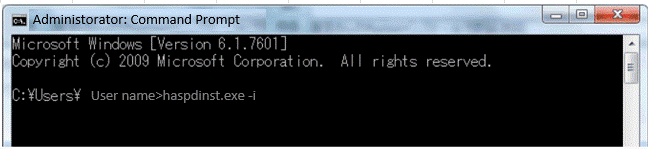
If a message like [Operation successfully completed.] appears, proceed to installing Rustool.
Modeling
How to capture a model diagram?
Please refer to the PDF document for details.
How to share the body form of a model between different projects?
How to copy the body to another project?
Please refer to the PDF document for details.
How to set a boundary condition to a part of a body?
How to designate a mesh size discretely on a part of a body?
Please refer to the PDF document for details.
How much drawable range and resolution of a model does Femtet have?
Please refer to the PDF document for details.
How to create a coil model having a structure other than a spiral?
Please refer to the PDF document for details.
How to create 2D models from 3D models?
Please refer to the PDF document for details.
What is the outer boundary condition?
Please refer to the PDF document for details.
How to smoothly connect two apart faces having different shapes?
Please refer to the PDF document for details.
Can I import CAD data to Femtet?
X_T file and DXF file are supported. If the CAD has Parsolid as a kernel, the data can be handled by Femtet. The typical CAD are, Unigraphics®, IronCAD®, SolidEdge, and SolidWorks®. If you use CAD translator (optional), other formats of data can be imported as well.
Can Femtet edit the imported CAD data?
Please refer to the PDF document for details.
Why could a mesh error occur when meshing the model of imported CAD data?
Please refer to the PDF document for details.
How to convert 2D DXF data to 3D data?
Please refer to the PDF document for details.
When graphical objects, such as faces, in DXF data are imported to Femtet, why are they not imported as a sheet body?
Please refer to the PDF document for details.
Why can the wire bodies of imported DXF data not be converted to a sheet body?
Please refer to the PDF document for details.
Mesh Generation
What kind of mesh is available?
Mesh is triangle for 2D analysis, and tetrahedron for 3D analysis. Nastran mesh data can be imported.
Can I export the mesh form to other software after analysis?
Go to Tool tab > Service > Save Nastran Data. You can save the deformed shape as well.
How do I determine the proper mesh size?
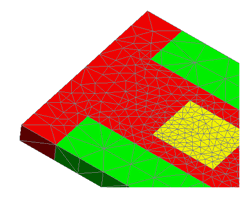
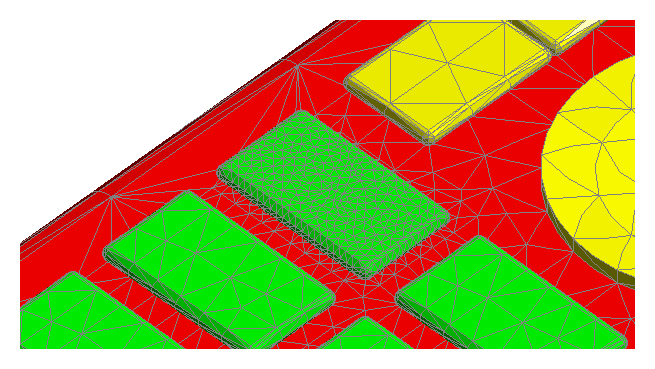
In the finite element method, fine meshes are required for the place where the physical changes are drastic. You can use adaptive meshing function, which will automatically give a fine mesh size to the place where calculation error is large. You can also set a fine mesh size manually.
[Adaptive meshing function]
[Mesh size manually]
How to optimize the mesh size?
Please refer to the PDF document for details.
What is the difference in analysis accuracy between triangular elements and rectangular elements?
Please refer to the PDF document for details.
What is the difference in analysis accuracy between tetrahedral elements and hexahedral elements?
Please refer to the PDF document for details.
How can we reduce meshing errors?
Please refer to the PDF document for details.
What should be done if you fail to create meshes?
Please refer to the PDF document for details.
How to set a specific mesh size to a model partially?
Please refer to the PDF document for details.
Can Femtet save mesh data into a file or read from a file?
Please refer to the PDF document for details.
Can Femtet only create meshes or perform an analysis?
Please refer to the PDF document for details.
After the Femtet has been updated to a newer version, the results differ from those obtained previously.
Please refer to the PDF document for details.
What should be done if Femtet fails to create meshes for a model having many curved faces?
Please refer to the PDF document for details.
What should be done if you fail to create skin meshes?
Please refer to the PDF document for details.
How to divide a thin body, which has a large aspect ratio, in the thickness direction into meshes?
Please refer to the PDF document for details.
What should be done if an error occurs related to a self contact?
Please refer to the PDF document for details.
How to output the resultant deformed shapes into a CAD format file?
Please refer to the PDF document for details.
How much memory is required for an analysis?
Please refer to the PDF document for details.
What is the difference between 1st-order elements and 2nd-order elements?
Please refer to the PDF document for details.
What is the mesh quality?
Please refer to the PDF document for details.
Analysis Results
How to capture the result display screen?
Please refer to the PDF document for details.
How to check the analysis results at the specified point?
Please refer to the PDF document for details.
How to save the analysis results on a specified edge, face, or body in csv format?
Please refer to the PDF document for details.
How to check the integral and average values on the specified edge, face, or body?
Please refer to the PDF document for details.
How to calculate the scalar dispersion of results on a face?
Please refer to the PDF document for details.
How to adjust the ranges of multiple contour displays for comparison?
Please refer to the PDF document for details.
How to change the range of analysis results?
Please refer to the PDF document for details.
How to adjust vector diagrams for easy viewing?
Please refer to the PDF document for details.
Why do the maximum values not coincide between in the output window and the results window?
Please refer to the PDF document for details.
How to check the results of the parametric analysis?
Please refer to the PDF document for details.
Why is the displacement diagram in an unnatural and distorted shape?
Please refer to the PDF document for details.
Why is the contour display terminated abnormally or does the results display not look proper?
Please refer to the PDF document for details.
A contour diagram may show some field values changing discontinuously at the boundary of bodies. If coordinates on the boundary are specified in the [Results as Specified Coordinates] dialog box, to which body do the acquired field values belong?
Please refer to the PDF document for details.
How to represent Y-parameter and Z-parameter graphically?
Please refer to the PDF document for details.
How to represent VSWR and the real and imaginary parts of S-parameters graphically?
Please refer to the PDF document for details.
How to change the view of a graph?
Please refer to the PDF document for details.
How to save the data of a graph into a CSV file?
Please refer to the PDF document for details.
How to compare several data curves on the same plot window?
Please refer to the PDF document for details.
How to represent XYGraph, SmithChart, or PolarGraph graphically?
Please refer to the PDF document for details.
If multiple edges are selected to represent the data on them graphically, how to determine its start point?
Please refer to the PDF document for details.
Macro
What should be done if Femtet macros do not work properly?
Please refer to the PDF document for details.
What should be done if Excel can terminate abnormally on reading a mesh or result file for a large-scale model using a macro?
Please refer to the PDF document for details.
Mises’s equivalent stress can be acquired by two methods using macros as shown below.
-Converting from tensor by the TransEquivalentValue method
-Directly acquiring from the potential of GALILEO_VON_MISES_C
Should they be used differently?
Please refer to the PDF document for details.
How to edit a macro file? Are there any tips?
Please refer to the PDF document for details.
Are there any samples using macros?
Please refer to the PDF document for details.
Others
What analysis can Femtet perform?
Femtet has eight solvers.
| Electric Field Analysis | Solves the electric field distribution when the voltage is applied to dielectric and conductive materials. |
| Magnetic Field Analysis | Solves the magnetic field distribution when the current runs in coil or magnet. |
| Electromagnetic Analysis | Solves the propagation constant, S-parameters, resonance of waveguide, and other various electromagnetic waves problems. |
| Acoustic Analysis | Solves the sound propagation driven by sound pressure or velocity. |
| Piezoelectric Analysis | Solves the behavior of piezoelectric materials such as quartz and piezoelectric ceramics. |
| Thermal Analysis | Solves solid model which has temperature boundary condition or heat transfer boundary. |
| Mechanical Stress Analysis | Solves the deformation and stress distribution of elastic material generated by such factors as pressure, load, acceleration, and thermal load. |
| Fluid Analysis | Solves turbulent flows such as air cooling and water cooling can be taken into account. |
Is multiphysics possible?
Yes. Various kinds of coupled analyses are available.
The possible solver combinations and the physical properties passed on are shown below. There are two types of multiphysics analyses. In the weak-coupling analysis, results of solver 1 is passed on to solver 2. In the strong-coupling analysis, solvers 1 and 2 interact with each other.
| Multiphysics Type (Solver 1 to Solver 2) | Physical Properties Passed On | To Solve |
| Electric Field-Thermal Analysis (Strong Coupling) | Current density Temperature distribution | Heat generated by Joule loss. |
| Magnetic Field-Thermal Analysis (Strong Coupling) | Current density Temperature distribution | Heat generated by Joule loss. |
| Piezoelectric-Acoustic Analysis (Strong Coupling) | Displacement Sound pressure | Velocity converted from displacement. |
| Electromagnetic-Thermal Analysis (Weak Coupling) | Current density | Heat generated by Joule loss. |
| Thermal-Mechanical Stress Analysis (Weak Coupling) | Temperature distribution | Mechanical stress with temperature distribution taken into account. |
| Electric field-Mechanical Stress Analysis (Weak Coupling) | Electrostatic force Electrostriction | Mechanical stress with electrostatic force taken into account. Mechanical stress with rlectrostriction taken into account. |
| Magnetic field-Mechanical Stress Analysis (Weak Coupling) | Electromagnetic force | Mechanical stress with electromagnetic force taken into account. |
Can I automate the analysis process?
Femtet has a parametric analysis function. The dimensions and materials of the model and boundary conditions can be changed parametrically. Furthermore, the process from model creation to post-processing can be automated with the macro functions. Macros are written in VBA and work on Excel (see examples). For the details of Macro operations, go to [Macro Help] after activating Femtet.
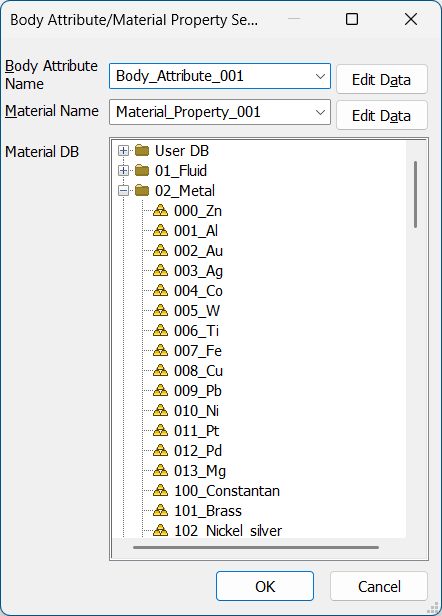
Is material database available?
Femtet has an extensive database covering various materials. You can register your won data too.
What options do you offer?
For information on the pricing and features of each additional option, please see this page.
I want to control the number of cores to use.
Go to Femtet button on the upper left on Femtet window > General Settings > Setting for Parallel Computing.
What type of analysis can Femtet perform?
Please refer to the PDF document for details.
What type of differential equations does Femtet solve?
Please refer to the PDF document for details.
How many elements of a model can be solved by Femtet?
Please refer to the PDF document for details.
What should be done if the computer is out of memory?
Please refer to the PDF document for details.
How much is the efficiency of parallel computing?
How to set the number of cores used for various parallel computing?
Please refer to the PDF document for details.
What should be done if nonlinear calculation does not converge?
Please refer to the PDF document for details.
What should be done if the calculation does not converge with the iterative method selected as the matrix solver?
Please refer to the PDF document for details.
What analysis does the results import function of Femtet allow?
Please refer to the PDF document for details.
What should be done if an error occurs in the batch simulation?
Please refer to the PDF document for details.
What should be done if the message, “Failed to allocate the memory area”, appears during the analysis?
Please refer to the PDF document for details.
What are the benchmark results of analysis time, memory consumption, and efficiency of parallel computing?
Please refer to the PDF document for details.
How can the Femtet operations be automated?
Please refer to the PDF document for details.
How to register frequently used conditions including body attributes, material properties, and boundary conditions, and use the conditions in another project?
Please refer to the PDF document for details.
How to copy the analysis model in a project?
Please refer to the PDF document for details.
How to group bodies?
Please refer to the PDF document for details.